Class 1B NI and PAYE Settlement Agreements (2026/27)
Class 1B National Insurance is a yearly employer charge on items in a PAYE Settlement Agreement (PSA). The rate for 2026/27 is 15%. A PSA lets you pay the tax and NI on certain minor or irregular benefits in one go, instead of putting each item on employees’ tax records. This page explains what a PSA covers, how the bill is built and when it is worth having.
In this guide17 sections
What a PSA is
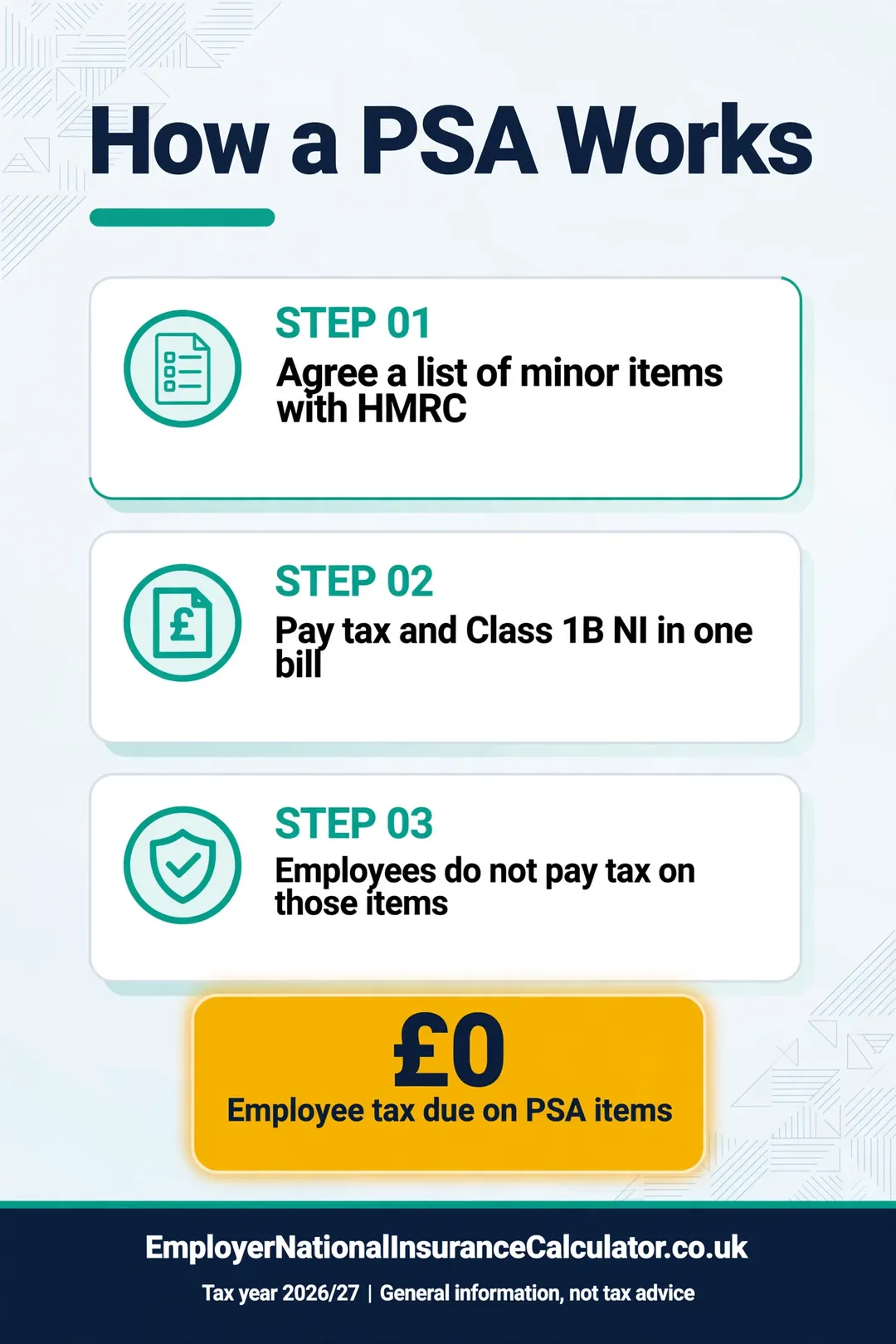
A PSA is an agreement with HMRC. You list the benefits and expenses it covers. You pay the income tax and NI on those items for all employees in one annual bill. Employees do not pay tax on the items, and they do not appear on P11D forms.
A PSA can cover items that are minor, irregular, or hard to share between staff. Examples include:
- Small gifts that are not trivial benefits
- Staff entertainment that falls outside the annual party exemption
- Taxable travel and subsistence costs
- Items paid for out of the company’s budget, such as meals when working late
What you pay
A PSA bill has three parts.
| Part | Rate |
|---|---|
| Income tax on the items, grossed up | Employees’ tax rates, usually estimated at 40% on grossed-up amounts |
| Class 1B NI on the items | 15% |
| Class 1B NI on the tax itself | 15% |
Because the employer pays the tax for staff, HMRC treats the tax paid as extra pay. It is grossed up, and NI is charged on it as well. This is why a PSA can cost more than it first looks.
Example
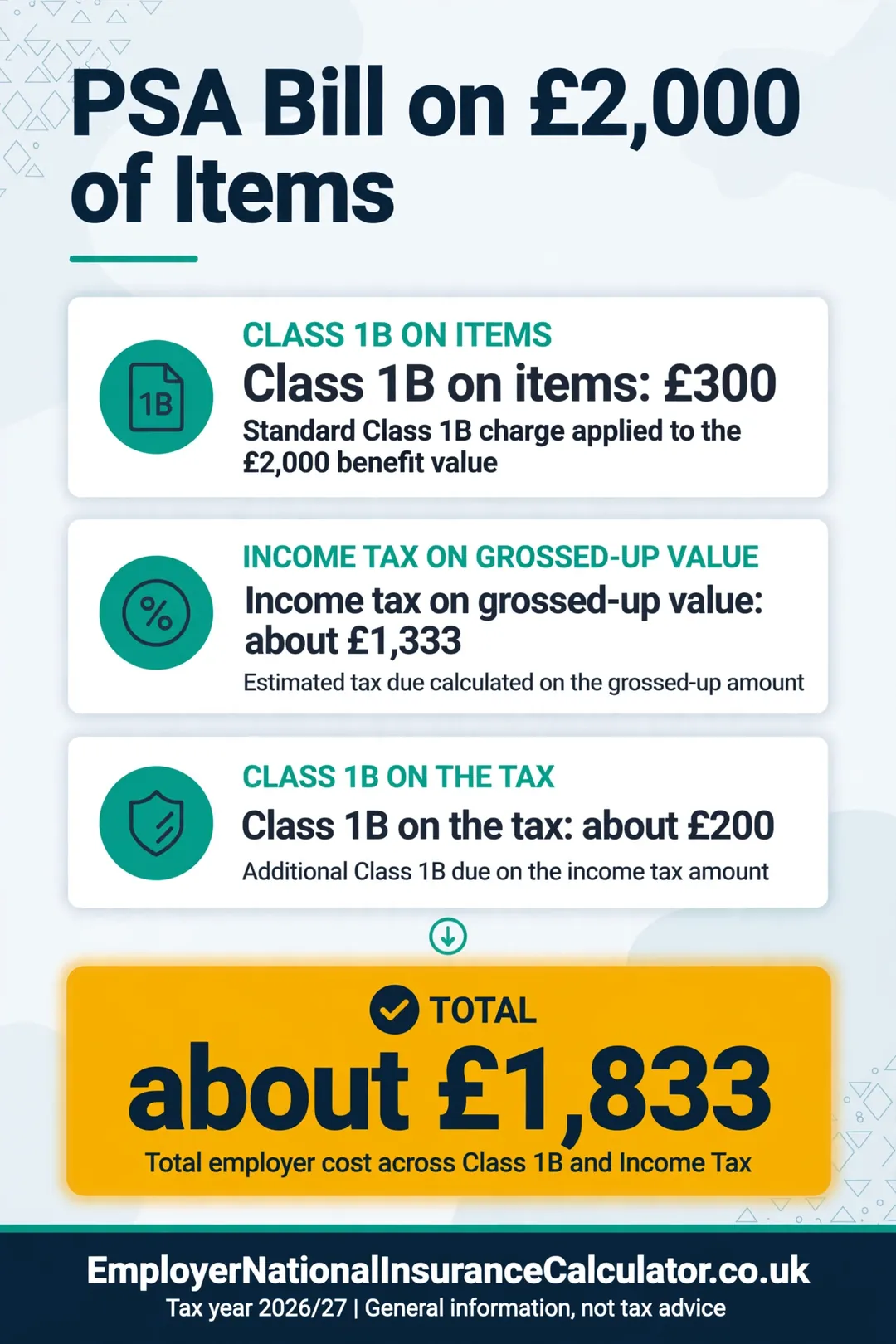
An employer agrees a PSA for £2,000 of minor benefits.
| Step | Amount |
|---|---|
| Value of items | £2,000 |
| Income tax on grossed-up value at 40% | £1,333.33 |
| Value plus tax | £3,333.33 |
| Class 1B on value plus tax at 15% | £500 |
| Total PSA bill (tax plus Class 1B) | £1,833.33 |
Your accountant will work out the exact figure, using each employee’s actual rate where it is known. The lesson is that a PSA costs real money, but saves the paperwork of reporting each item to each employee.
Key dates
| Date | What |
|---|---|
| Before 6 July | Ask HMRC for a PSA before this date after the tax year ends |
| 19 October | Pay by cheque |
| 22 October | Pay Class 1B and PSA tax, if paying electronically |
Is a PSA worth it?
A PSA suits you if many staff receive minor items and tracking each one would be a burden. It is less useful when only a few staff receive large benefits. In that case, reporting on a P11D may be cleaner. Compare the costs before you apply.
When a PSA makes sense
| Situation | Good fit for a PSA? |
|---|---|
| Many small gifts at Christmas | Yes |
| One large taxable benefit for a director | Usually not |
| Irregular expenses that are hard to split | Yes |
| Staff entertainment that goes over the annual limit | Yes |
How to set one up
- List the items you want in the agreement.
- Contact HMRC and ask for a PSA. They will confirm the terms in writing.
- Keep records of the items and their values through the year.
- Work out the bill after the tax year ends.
- Pay by 22 October.
Case study: a £60 Christmas gift
A firm gives 40 staff a £60 gift, which is over the £50 trivial benefit limit. The total is £2,400.
| Route | What happens |
|---|---|
| Without a PSA | Report 40 benefits on P11D forms, pay Class 1A of £360, and staff pay tax through their codes |
| With a PSA | Pay one bill of about £2,200 covering tax and NI, and staff pay nothing |
The PSA costs more cash, because the employer carries the tax. It saves the forms and staff tax adjustments, and many employers feel that is worth it for a goodwill gift. See Class 1A for the other route.
Mistakes to avoid
- Applying after the deadline of 5 July.
- Including items that are not allowed in a PSA.
- Forgetting to pay by 22 October.
- Not keeping a list of the items.
- Assuming a PSA is cheaper. It often costs more because the employer pays the tax.
Related reading
Class 1B sits alongside other employer NI charges. For the yearly benefits charge, see Class 1A. For the payment dates in one place, see how to pay employer NI. For the main rates, see the rates page.
PSA or P11D: which to choose
| Question | Lean towards a PSA | Lean towards a P11D |
|---|---|---|
| How many people receive the item? | Many | One or two |
| How big is each item? | Small | Large |
| Is the value hard to split? | Yes | No |
| Do you want staff to pay no tax? | Yes | No |
| Cash available for a bigger bill? | Yes | Limited |
A timetable for a PSA
| When | What to do |
|---|---|
| During the year | Keep a log of PSA items, who got them and their value |
| Before 6 July after the year end | Ask HMRC to agree the PSA |
| By 22 October | Pay the PSA bill electronically |
What is not allowed in a PSA
PSAs are for minor, irregular or impracticable items. They are not for regular pay, cash bonuses or major benefits such as company cars in most cases. HMRC publishes lists of what qualifies. If you are unsure, ask before you rely on a PSA.
How a PSA bill compares with Class 1A
For £5,000 of items spread over many staff:
| PSA | Class 1A route | |
|---|---|---|
| NI paid | £1,250 (Class 1B) | £750 (Class 1A) |
| Income tax paid by employer | £3,333.33 | £0, staff pay their own |
| Total paid by employer | £4,583.33 | £750 |
The PSA costs more in cash because the employer pays the staff tax. The benefit is that staff pay nothing and no individual P11D entries are needed.
Frequently asked questions
What is Class 1B National Insurance?
An employer-only charge, at 15%, on items covered by a PAYE Settlement Agreement.
What is a PAYE Settlement Agreement?
An agreement with HMRC that lets you pay the tax and NI on certain minor benefits in one bill.
When is Class 1B due?
By 22 October after the tax year ends, if you pay electronically. By 19 October if you pay by cheque.
Do employees pay tax on PSA items?
No. The employer pays the tax and NI on their behalf.
Is a PSA the same as Class 1A?
No. Class 1A is charged on reported benefits. Class 1B is charged on items in a PSA.
Is the PSA bill deductible for corporation tax?
Usually yes, in the same way as the cost of the items. Ask your accountant.
Can I change a PSA each year?
Yes. You can add or remove items by agreeing it with HMRC.
Does a PSA cover director benefits?
It can, if the items qualify, but large benefits are usually dealt with on a P11D.
Is Class 1B the same rate as Class 1A?
Yes. Both are 15% in 2026/27.
When must I ask for a PSA?
Before 6 July after the end of the tax year to which it applies.
Related guides
- Class 1A National Insurance 2026/27: Rate and Deadlines
- Employer NI Exemptions and Reliefs 2026/27
- How and When to Pay Employer NI to HMRC
- Employer NI Rates 2026/27: All Rates and Thresholds
- Employer NI on Bonuses (2026/27)
Official sources
- National Insurance rates and categories
- HMRC guidance on PAYE Settlement Agreements
This page is independent information, not tax advice, and has no link with HMRC. Figures were checked on 20 October 2026 for the 2026/27 tax year. Always confirm the final figures with HMRC or your payroll provider.