National Insurance Changes for 2026/27
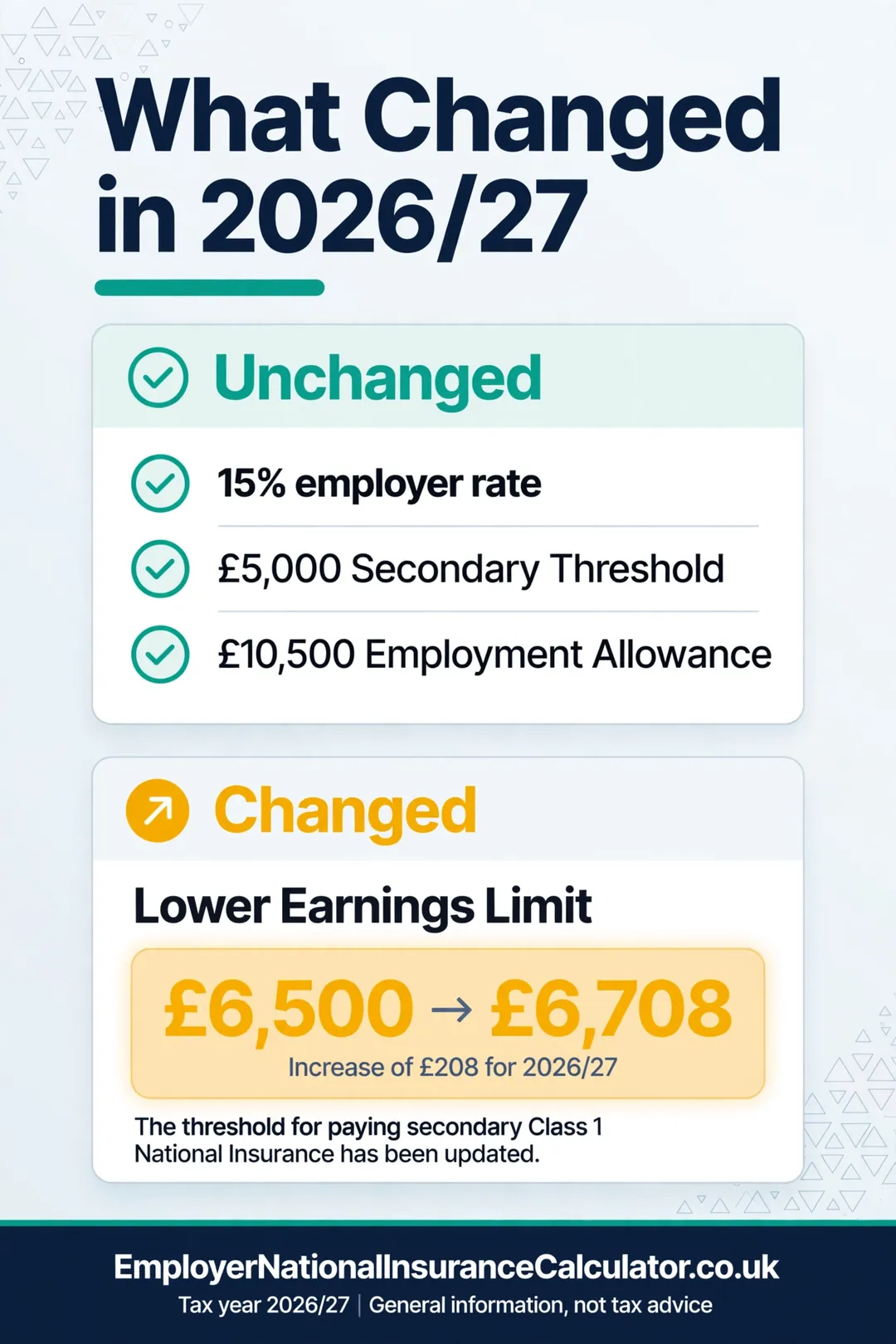
Very little changed for employers on 6 April 2026. The 15% rate, the £5,000 Secondary Threshold and the £10,500 Employment Allowance all stayed the same. The Lower Earnings Limit rose to £6,708, and a cap on NI-free pension salary sacrifice is due to start in April 2029. This page shows what moved, what did not, and what to do about it.
In this guide16 sections
What changed and what did not
| Item | 2025/26 | 2026/27 | Changed? |
|---|---|---|---|
| Employer Class 1 rate | 15% | 15% | No |
| Class 1A and 1B rate | 15% | 15% | No |
| Secondary Threshold | £5,000 | £5,000 | No (frozen to April 2031) |
| Upper Secondary Threshold | £50,270 | £50,270 | No |
| Freeport and Investment Zone limit | £25,000 | £25,000 | No |
| Primary Threshold | £12,570 | £12,570 | No |
| Employment Allowance | £10,500 | £10,500 | No |
| Lower Earnings Limit | £6,500 | £6,708 | Yes, up £208 |
| Employee main rate | 8% | 8% | No |
What it means for your bill
The 2025/26 figures are in the 2025/26 rates guide.
Nothing in this table moves an employer’s NI cost on its own. The bill for a £30,000 employee is £3,750 in both years. Your cost only changes if pay changes, if staff join or leave, or if their category letter changes.
| Salary | Employer NI 2025/26 | Employer NI 2026/27 | Change |
|---|---|---|---|
| £20,000 | £2,250 | £2,250 | £0 |
| £30,000 | £3,750 | £3,750 | £0 |
| £45,000 | £6,000 | £6,000 | £0 |
| £70,000 | £9,750 | £9,750 | £0 |
So if your payroll budget for 2025/26 was right, the NI part of the 2026/27 budget is the same plus the effect of any pay rises. Each £1,000 of extra pay adds £150.
The Lower Earnings Limit
The Lower Earnings Limit (LEL) rose from £6,500 to £6,708. It is the pay level at which an employee earns a qualifying year for the State Pension without paying any NI themselves. In pay-period terms it is £129 a week or £559 a month.
For most employers the change is invisible, because staff earn well above it. It matters in two places:
- Directors who take a small salary. A salary at the LEL keeps the State Pension year but triggers employer NI of £256.20, less than before the Secondary Threshold fell but not nothing. See director salary for 2026/27.
- Part-time staff near the limit. An employee on £6,600 does not earn a qualifying year but you still pay £240 in employer NI.
The 2029 salary sacrifice cap
From 6 April 2029, only the first £2,000 a year of pension contributions made through salary sacrifice will be free of NI. Anything above £2,000 will be treated as pay for NI, for both employer and employee. Until then, all pension salary sacrifice stays free of NI.
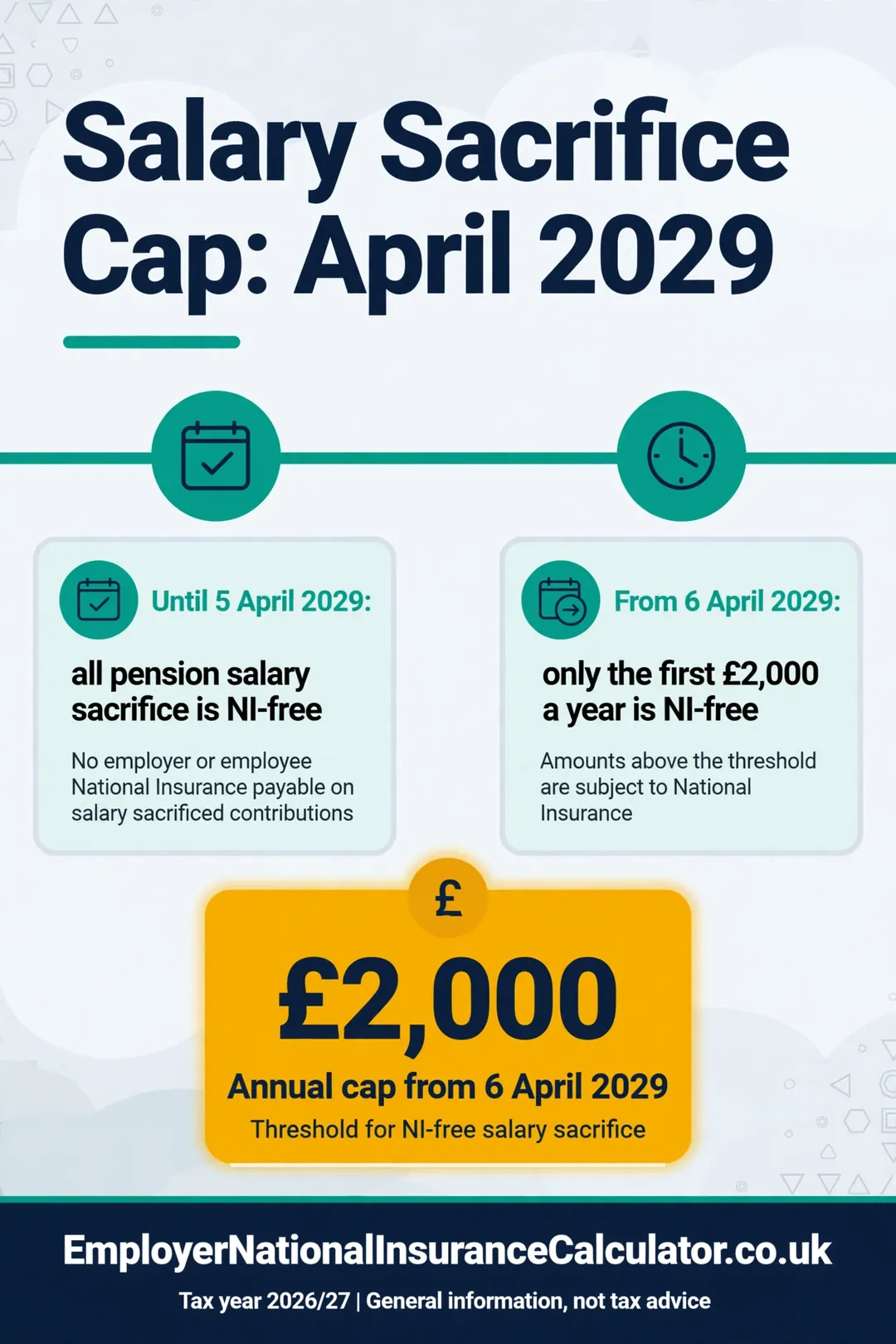
The cap does not change anything in 2026/27. It matters now because contracts you set up this year will still be running in 2029. Read the full guide at salary sacrifice pension cap 2029.
What the cap costs an employer
Take an employee on £60,000 who sacrifices £6,000 a year into a pension.
| Before April 2029 | From April 2029 | |
|---|---|---|
| NI-free sacrifice | £6,000 | £2,000 |
| Sacrifice charged to NI | £0 | £4,000 |
| Extra employer NI | £0 | £600 |
For ten employees doing the same, the extra employer cost is £6,000 a year. Employees would also lose 2% on the same £4,000 (£80 each), as they pay 2% above £50,270 on this salary.
What did not change
- Employee NI stays at 8% on earnings between £12,570 and £50,270, and 2% above that.
- Class 1A on benefits stays at 15%.
- The 0% employer rate for under-21s, apprentices under 25 and veterans stays in place up to £50,270.
- The Freeport and Investment Zone limit stays at £25,000.
- The date limits for P11D (6 July) and Class 1A (22 July) are the same.
Effect on different businesses
A micro business with one or two staff. Employment Allowance still covers the bill. Two employees on £25,000 cost £6,000 in employer NI, which the £10,500 allowance covers in full. See employer NI for small businesses.
A mid-sized firm. With 25 staff on £32,000, employer NI is £101,250 before the allowance and £90,750 after it. The bill rises only if payroll grows.
A firm with many higher earners. Salary sacrifice matters most here. The cap from April 2029 costs more the more people sacrifice above £2,000.
A director-owned company. The higher LEL means a salary at the limit costs £256.20 in employer NI. With Employment Allowance unavailable to a sole-director company, that cost is real. See the director calculator.
Statutory pay for 2026/27
The standard weekly rate for Statutory Maternity Pay is £194.32 from April 2026. Statutory payments are pay, so employer NI applies above the threshold. Most employers can recover 92% of statutory payments. Qualifying small employers can recover 108.5%. Check your own position on GOV.UK before you rely on either figure. See employer NI on statutory pay.
Key dates for 2026/27 and beyond
| Date | What happens |
|---|---|
| 6 April 2026 | 2026/27 tax year starts |
| 22nd of each month | Electronic PAYE payment due |
| 5 April 2027 | 2026/27 tax year ends |
| 6 July 2027 | P11D and P11D(b) due for 2026/27 |
| 22 July 2027 | Class 1A due, electronic payment (19 July by cheque) |
| 6 April 2029 | £2,000 salary sacrifice cap starts |
| April 2031 | Secondary Threshold freeze ends |
Why so little changed
The big changes came in April 2025. Since then, the government has frozen the Secondary Threshold instead of raising it each year. Employer NI therefore rises automatically as pay rises, without any new announcement. For payroll teams, 2026/27 is about checking, not re-learning. See the full rates history.
Why the 2029 cap exists
The cap limits the NI-free saving on salary sacrifice. The government said the old rules cost the Exchequer billions each year, with most of the benefit going to higher earners. The cap protects the first £2,000 for everyone and raises money from larger sacrifices.
What staff will notice
Employees who sacrifice more than £2,000 will see a smaller NI saving from April 2029. Staff who sacrifice less will see no change. If you pass on your employer NI saving by adding it to their pension, the amount you add will also fall.
A checklist for your payroll team
- Confirm that your software holds the 2026/27 thresholds, including the new Lower Earnings Limit of £6,708.
- Check that Employment Allowance is switched on. See how to claim.
- Review category letters for anyone who has turned 21 or 25 since last April. See the letters guide.
- Look at any salary sacrifice schemes and plan for 2029.
- Update your budget with the figures on the rates page.
- Diarise 6 July (P11D) and 22 July (Class 1A) for next summer.
What to do in the next two years
- Count how many staff sacrifice more than £2,000 a year.
- Use the salary sacrifice savings guide to model the extra cost.
- Read NI on pension contributions to see your other options.
- Check your own bill with the calculator.
Frequently asked questions
Did employer NI go up in April 2026?
No. The rate stayed at 15% and the Secondary Threshold at £5,000.
What is the new Lower Earnings Limit?
£6,708 a year, £559 a month or £129 a week. It was £6,500 in 2025/26.
Is the Employment Allowance still £10,500?
Yes. It is unchanged for 2026/27.
When does the salary sacrifice cap start?
6 April 2029. It limits NI-free pension salary sacrifice to £2,000 a year per employee.
Does the cap apply this year?
No. Until 5 April 2029, all pension salary sacrifice stays free of NI.
Did the Primary Threshold change?
No. It stays at £12,570.
What happens to the threshold after 2031?
The freeze runs until April 2031. What happens after that is for future Budgets to decide.
Will there be more changes?
Check the Budget and GOV.UK each year. Rates and thresholds can be changed at any Budget.
Where can I see the full history of employer NI changes?
See the rates history page for each year from 2023/24.
Do I need to change my payroll set-up for 2026/27?
Make sure your software is up to date and holds the new Lower Earnings Limit. Most providers do this automatically.
Does the cap apply to employee NI as well?
Yes. The NI-free limit applies to both the employer and employee shares.
Where can I see the details of the cap?
See the full cap guide.
Related guides
- Employer NI Rates 2026/27: All Rates and Thresholds
- Employer NI Thresholds 2026/27: Weekly, Monthly, Yearly
- £2,000 Salary Sacrifice Pension Cap From April 2029
- Employer NI Rates History: 2023/24 to 2026/27
- Employment Allowance 2026/27: £10,500 Off Employer NI
Official sources
- National Insurance rates and categories
- HMRC: Rates and thresholds for employers 2026 to 2027
This page is independent information, not tax advice, and has no link with HMRC. Figures were checked on 20 October 2026 for the 2026/27 tax year. Always confirm the final figures with HMRC or your payroll provider.