Employment Allowance 2026/27: £10,500 Off Employer NI
Employment Allowance calculator
Check you can claim, see your saving and when the allowance runs out.
Loading the calculator…
Estimate only. Independent tool, not affiliated with HMRC. Rates checked 20 October 2026. Real payroll rounds each pay period.
Employment Allowance lets eligible employers take up to £10,500 off their employer National Insurance bill each tax year in 2026/27. There is no cap on the size of the employer, so any eligible business can claim it. A business with an employer NI bill of £10,500 or less pays nothing. Use the calculator above to see the effect on your own bill, then read on for the rules.
In this guide15 sections
How Employment Allowance works
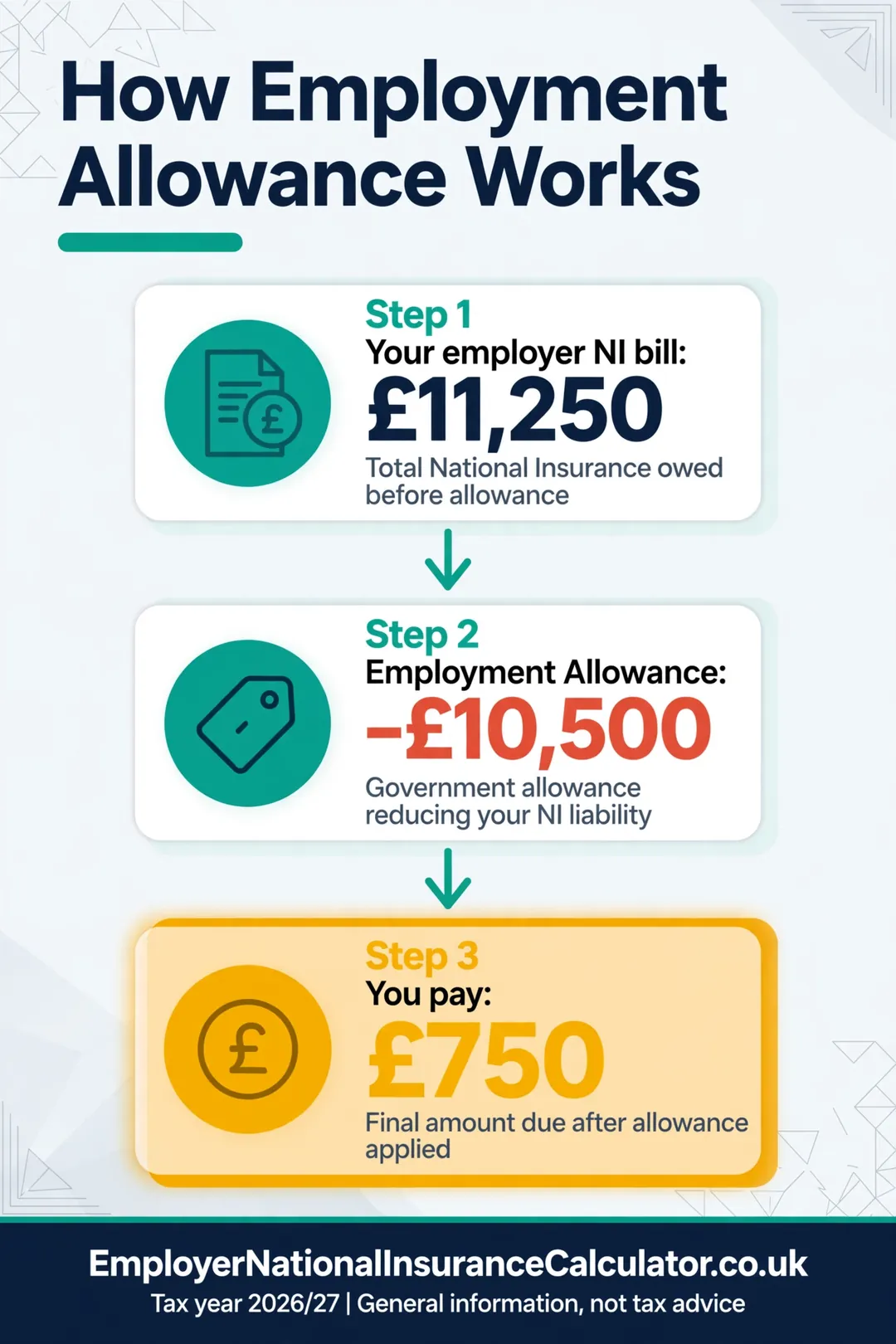
The allowance is a credit against your employer Class 1 NI bill. It does not come off any single employee. Your payroll software takes it off the bill each month until the £10,500 is used up. After that, you pay the full amount.
Bill after allowance = employer NI bill − £10,500 (but never below zero)
You claim it once a year through your payroll software. You do not need to apply again each month. See how to claim Employment Allowance.
Examples
| Business | Employer NI before | After allowance | Allowance used |
|---|---|---|---|
| 1 employee on £25,000 | £3,000 | £0 | £3,000 |
| 3 employees on £30,000 | £11,250 | £750 | £10,500 |
| 5 employees on £35,000 | £22,500 | £12,000 | £10,500 |
| 20 employees on £30,000 | £75,000 | £64,500 | £10,500 |
| 100 employees on £30,000 | £375,000 | £364,500 | £10,500 |
The allowance is a bigger relief for small firms. For a business with 20 staff, it saves about 14% of the bill. For a business with 2, it covers all of it.
What has changed
Until April 2025, the allowance was £5,000 and only employers with an employer NI bill under £100,000 in the previous year could claim. From April 2025, it rose to £10,500 and the £100,000 cap was removed. Both changes continue in 2026/27. Our rates history shows the full run.
Who can claim
You can claim if you are an employer and you pay Class 1 secondary NI. You cannot claim in some cases, mainly:
- A company with only one employee paid above the Secondary Threshold, if that employee is also a director
- Employers of household staff, such as a nanny, for personal reasons
- Public bodies and businesses doing mostly public-sector work
The full list is on the eligibility page, including connected companies.
How many employees until you pay?
A quick way to see where you stand is to ask how many staff it takes to use up the allowance.
| Average salary | Employer NI per employee | Roughly how many staff use up £10,500 |
|---|---|---|
| £20,000 | £2,250 | 5 |
| £25,000 | £3,000 | 4 |
| £30,000 | £3,750 | 3 |
| £40,000 | £5,250 | 2 |
Above those numbers, each extra person adds to what you pay in full.
When the allowance runs out
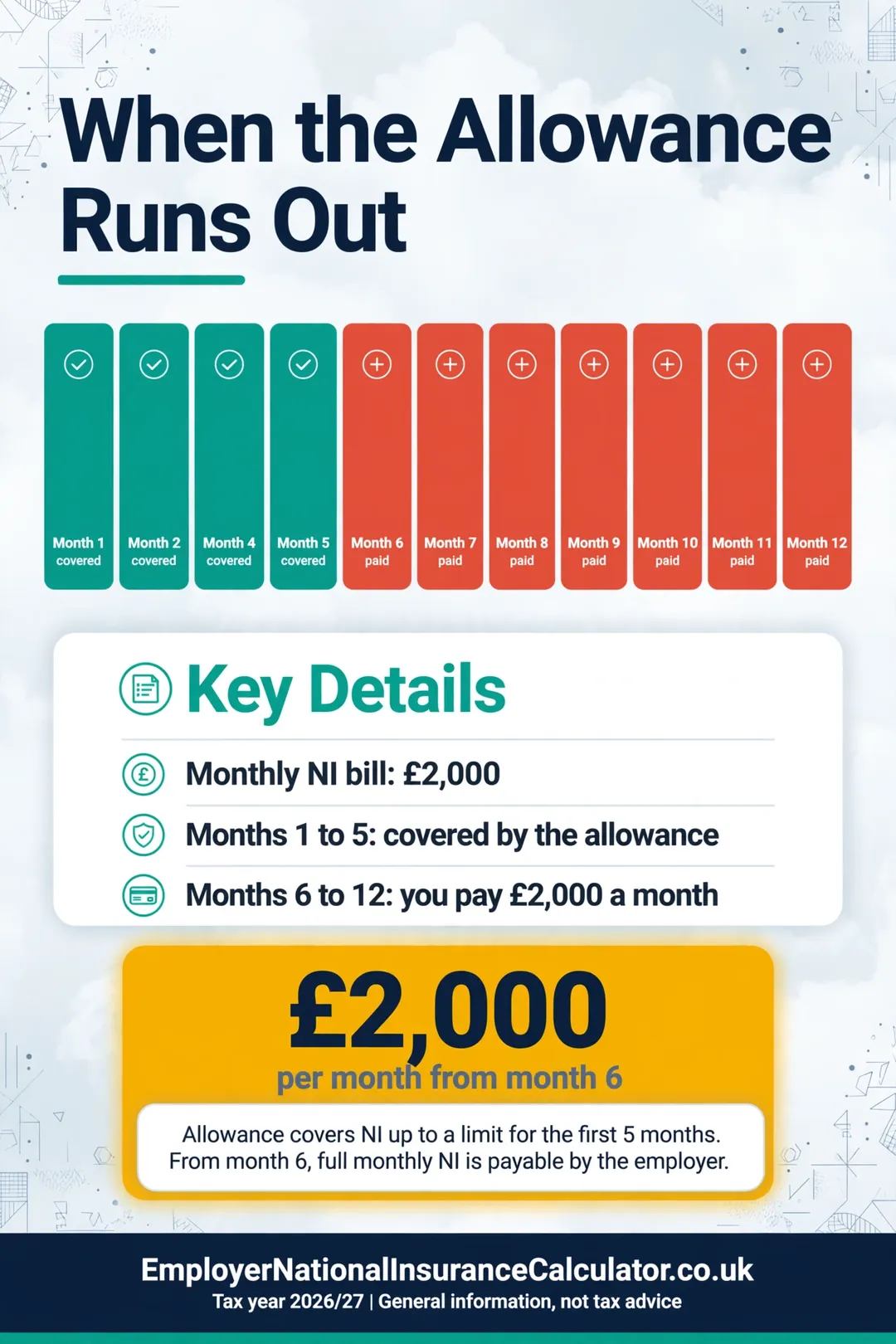
The allowance is used month by month. If your monthly bill is £2,000, it covers five months and a bit. After that, you pay in full. Budget for this as a cash-flow bump in the autumn.
| Monthly employer NI | Allowance runs out after | You start paying in |
|---|---|---|
| £700 | Not used up (15 months of cover) | Never |
| £1,000 | 10.5 months | Mid-February |
| £1,750 | 6 months | October |
| £2,500 | 4.2 months | August |
| £3,500 | 3 months | July |
Where the money shows up
You do not receive a cheque for Employment Allowance. It reduces your PAYE payment to HMRC. Your payroll software shows the allowance used. Each month the amount used is the lower of your employer NI due and the allowance left.
| Month | NI due | Allowance used | Left over | You pay |
|---|---|---|---|---|
| April | £1,500 | £1,500 | £9,000 | £0 |
| May | £1,500 | £1,500 | £7,500 | £0 |
| June | £1,500 | £1,500 | £6,000 | £0 |
| October | £1,500 | £1,500 | £0 | £0 |
| November | £1,500 | £0 | £0 | £1,500 |
After seven months the allowance is gone. You pay income tax and employee NI throughout. The remaining months of the year each cost the full £1,500.
Employment Allowance and Class 1A
The allowance also reduces Class 1A NI on benefits in kind, as long as there is room left. Your payroll software applies it against secondary Class 1 NI first. Anything left can be used against Class 1A. See Class 1A National Insurance.
Common mistakes
- Not claiming at all. Many small employers miss out because nobody ticked the box.
- Claiming as a sole-director company. If you are the only paid employee and also a director, the claim is wrong.
- Claiming twice across connected companies. Only one company in a group can claim.
- Expecting the allowance on pay that is already free of NI. If your bill is already nil, there is nothing to reduce.
- Forgetting to renew the claim each tax year. You claim again every year.
- Forgetting it is capped at the bill. The allowance cannot create a refund of employee NI or income tax.
Cash-flow planning
Because the allowance runs out part-way through the year, your PAYE payments jump in the month it ends. Put the date in your diary. Some businesses set aside the NI amount each month, even when the allowance covers it. This prevents a shock later. See employer NI for small businesses.
Does it make hiring cheaper?
For a very small business, the first few hires can cost no employer NI at all. A café with a £10,500 allowance can hire three people on £24,000 for £72,000 in wages and pay £0 in employer NI. A fourth hire costs £2,850 in employer NI in full, because the allowance is used up.
Next steps
If you are not sure you qualify, read the eligibility guide. If you qualify and have not claimed, see how to claim. If you have missed earlier years, see how to claim back employer NI.
Frequently asked questions
How much is Employment Allowance in 2026/27?
£10,500 per tax year.
Who can claim Employment Allowance?
Most employers who pay employer NI. A company whose only paid employee is also its director cannot claim. Public bodies and household employers are also excluded.
Do I need to apply every year?
Yes. You tick the Employment Allowance indicator in your payroll software for each tax year.
Can I claim for previous years?
Often yes, for up to four tax years. See how to claim.
Is there a cap on who can claim?
Not any more. The £100,000 cap on employer NI bills was removed in April 2025.
Does it reduce the apprenticeship levy?
No. The levy is a separate charge. Employment Allowance only reduces employer NI.
Can I claim if I have more than one company?
Only one company in a connected group can claim the allowance, and you choose which.
What if I claim in the middle of the tax year?
You can claim at any time. The allowance is then used against bills from that point, and you may be able to claim back earlier months. See claiming back.
Does the allowance carry over to next year?
No. Any unused allowance is lost at the end of the tax year.
Can I choose when to use the allowance?
No. It is used automatically against each month’s bill until it is gone.
Does it cover employer NI on directors?
Yes, if the company is eligible. A company with only one paid director cannot claim.
Related guides
- Employment Allowance Eligibility: Who Can Claim?
- How to Claim Employment Allowance (Step by Step)
- Can You Claim Back Employer NI? Yes, in These Cases
- Employer NI for Small Businesses: Hiring Cost and Cash Flow
- Employer National Insurance Calculator 2026/27
Official sources
This page is independent information, not tax advice, and has no link with HMRC. Figures were checked on 20 October 2026 for the 2026/27 tax year. Always confirm the final figures with HMRC or your payroll provider.
3 Comments
Comments are closed.