Cost of Employing Someone UK 2026/27: Calculator
Cost of employing someone
The full yearly and hourly cost of an employee, not just the salary.
Loading the calculator…
Estimate only. Independent tool, not affiliated with HMRC. Rates checked 20 October 2026. Real payroll rounds each pay period.
An employee on a £30,000 salary costs about £34,650 a year once employer NI and a 3% pension are added. That is roughly 15.5% on top of the salary, before you count equipment, insurance or training. The calculator above shows the figure for any salary, with the cost per month and per hour.
In this guide16 sections
What makes up the cost
| Cost | How it works in 2026/27 |
|---|---|
| Salary | The pay you agree. Holiday pay is part of it. |
| Employer NI | 15% above £5,000 a year |
| Employer pension | At least 3% of qualifying earnings under auto-enrolment |
| Employment Allowance | Up to £10,500 off the yearly NI bill |
| Other costs | Equipment, software, insurance, training, recruitment |
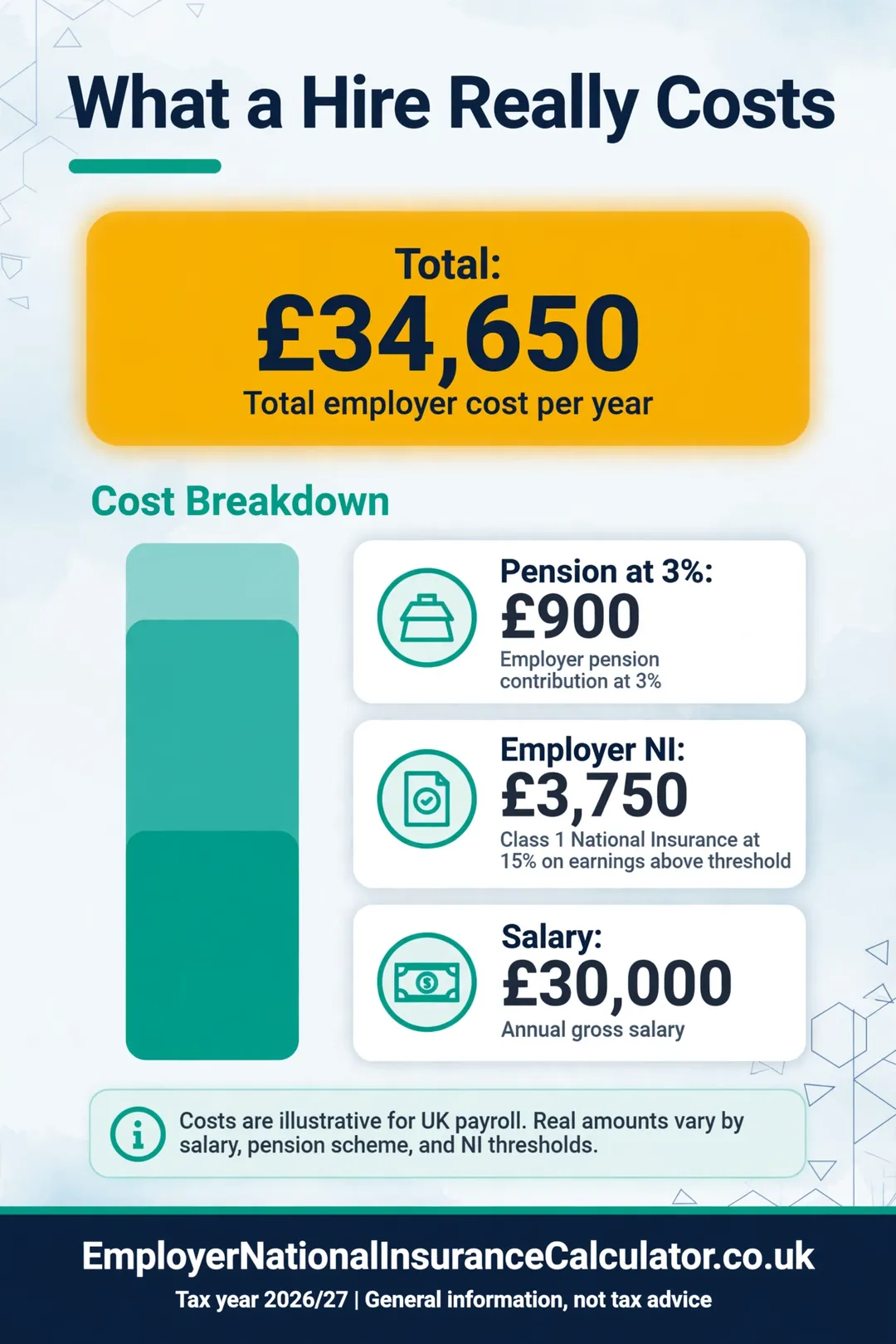
Worked example: a £30,000 hire
- Salary: £30,000
- Employer NI: (£30,000 − £5,000) × 15% = £3,750
- Pension at 3% of salary: £900 (the real figure is on qualifying earnings, so it can be a little lower)
- Total: £34,650, or about 15.5% above salary
If your business can claim Employment Allowance and has no other NI bill, the £3,750 drops to nil. The total becomes £30,900.
How the cost grows with salary
| Salary | Employer NI | Plus 3% pension | Total cost |
|---|---|---|---|
| £22,000 | £2,550 | £660 | £25,210 |
| £30,000 | £3,750 | £900 | £34,650 |
| £45,000 | £6,000 | £1,350 | £52,350 |
| £60,000 | £8,250 | £1,800 | £70,050 |
| £80,000 | £11,250 | £2,400 | £93,650 |
Employer NI has no upper cap, so every extra pound of salary costs another 15p in NI on top.
What an hour of work really costs
Salary is only part of the story. A full-time employee on 37.5 hours a week and 28 days of paid holiday (including bank holidays) works about 46.4 weeks, which is around 1,740 hours.
| Salary | Total cost with 3% pension | Cost per hour worked |
|---|---|---|
| £22,000 | £25,210 | £14.49 |
| £30,000 | £34,650 | £19.91 |
| £45,000 | £52,350 | £30.09 |
This is the number to use when you price a service. A £30,000 salary is about £17.24 for each hour actually worked. With employer NI and pension, the real cost is about £19.91 an hour.
Costs people forget
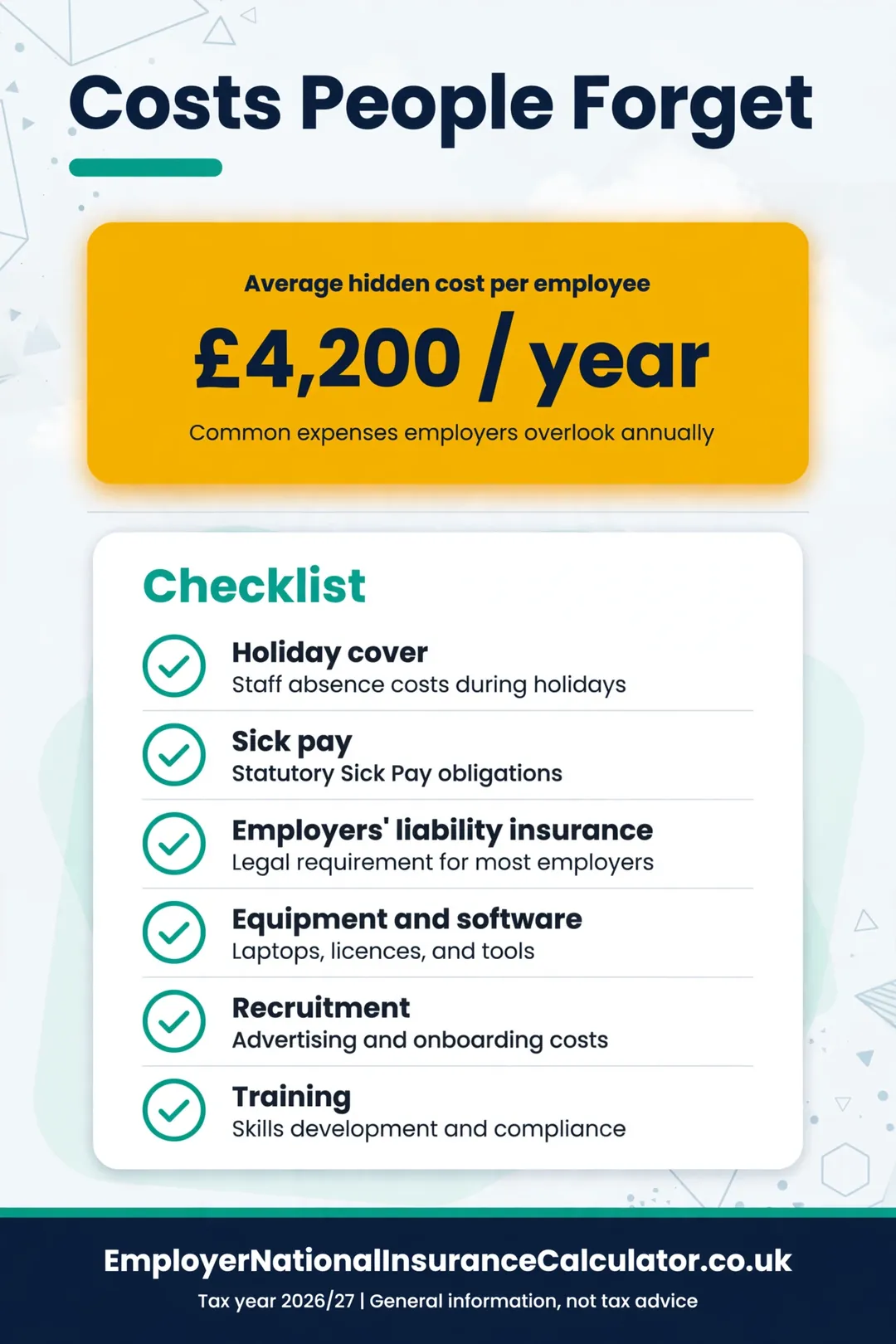
Recruitment fees, equipment and software often add £1,000 or more in the first year. Insurance, training and sick pay add to the cost as well. Enter these in “More options” in the calculator so the total reflects your real spend.
| Cost | Typical example | What to know |
|---|---|---|
| Recruitment | Job advert, or an agency fee of 15% to 20% of salary | A one-off cost, not repeated each year |
| Equipment | Laptop, phone, desk | Often £800 to £2,000 for an office role |
| Software | Licences and seats | A monthly cost per user |
| Training | Induction and courses | Budget a set amount a year |
| Insurance | Employers’ liability insurance | Required by law for most employers |
| Sick pay | Statutory Sick Pay once they qualify | Plus the cost of covering the work |
These figures are examples. Replace them with real quotes. Hiring staff under 21, or an apprentice under 25, can cut the NI bill to nil on pay up to £50,270. Read the employer NI exemptions guide to see who qualifies.
First hire in a small business
A first hire often costs less than expected because of Employment Allowance, but only if you qualify. A sole director paying only themselves cannot claim it. The moment a second person earns over £5,000, the allowance becomes available. See employer NI for small businesses for budgeting tips.
Here is a first-year budget for a small business hiring one administrator on £26,000.
| Item | Cost |
|---|---|
| Salary | £26,000 |
| Employer NI | £3,150 |
| Pension at 3% | £780 |
| Equipment and software | £1,200 |
| Recruitment (advert only) | £300 |
| Training | £500 |
| First-year total | £31,930 |
| Employer NI if you can claim Employment Allowance | £0 |
With the allowance, the same first year costs £28,780. The difference is the whole employer NI bill.
What a small team really costs
A café employs five people at £28,000 each.
| Cost | Per year |
|---|---|
| Salaries | £140,000 |
| Employer NI (£3,450 each) | £17,250 |
| Employment Allowance | −£10,500 |
| Employer NI paid | £6,750 |
| Employer pension (about 3%) | £4,200 |
| Total | £150,950 |
Without Employment Allowance, the total would be £161,450. The allowance is worth more to a small team than to a large one. A firm with 100 staff would find £10,500 a small fraction of the bill.
Full-time or part-time?
Employer NI is charged on pay above £5,000 a year per employee, so splitting one job into two part-time roles changes the bill.
| Option | Pay | Employer NI |
|---|---|---|
| One full-time employee | £30,000 | £3,750 |
| Two part-time employees, £15,000 each | £30,000 | £3,000 |
The two-person route saves £750 because each person has their own £5,000 free of employer NI. Do not choose it on NI alone, because two people mean more training, equipment and management. But it is a fair reason to think carefully about the shape of a role.
What changes if the employee is under 21
Employer NI is 0% on pay up to £50,270 for employees under 21, apprentices under 25 and veterans in their first 12 months.
| Salary | Standard employee total | Under-21 total | Saving |
|---|---|---|---|
| £22,000 | £25,210 | £22,660 | £2,550 |
| £30,000 | £34,650 | £30,900 | £3,750 |
| £40,000 | £46,450 | £41,200 | £5,250 |
The saving is real, but it ends on the 21st birthday. See employer NI for under-21s.
Costs people miss when budgeting
| Cost | What to know |
|---|---|
| Holiday pay | Paid leave is part of salary, but you must cover the work |
| Sick pay | Statutory Sick Pay applies once an employee qualifies |
| Employers’ liability insurance | Required by law for most employers |
| Equipment and software | Laptop, phone, licences and a desk |
| Recruitment | Adverts, agency fees and your own time |
| Training | Induction and ongoing courses |
Put a realistic number against each. A rule of thumb many small firms use is to budget 20% to 30% above salary for all-in cost, then refine with real quotes.
Ways to bring the cost down
- Claim Employment Allowance if you qualify. It is worth up to £10,500 a year.
- Use the 0% rate for staff under 21 and apprentices under 25, up to £50,270.
- Consider salary sacrifice for pensions. It cuts employer NI at 15% on the sacrificed amount. Read salary sacrifice savings.
- Choose pay levels carefully. The jump from £25,000 to £26,000 costs £150 in extra employer NI, plus the £1,000 raise.
- Check you are using the right NI category letter. A wrong letter can overcharge you for years.
Employee or contractor?
A genuine self-employed contractor does not attract employer NI. But getting this wrong carries penalties. HMRC looks at control, substitution and mutual obligation, not at the label on the contract. If the person works under your direction, set hours and your tools, treat them as an employee.
A simple budgeting method
- Start with the annual salary.
- Add employer NI from the calculator, less any Employment Allowance you can claim.
- Add pension at 3% or your scheme rate.
- Add one-off costs in the first year (recruitment, equipment).
- Add a yearly figure for training and software.
- Divide by hours worked to find the cost per hour.
- Review it each April when the rates and the minimum wage change.
Frequently asked questions
How much does it cost to employ someone on £25,000?
About £28,750 in 2026/27 with a 3% pension: £25,000 salary, £3,000 employer NI and £750 pension. With Employment Allowance covering the NI, the cost is £25,750.
Is employer NI paid on top of the salary?
Yes. The employee’s own NI is taken from their pay, but employer NI is an extra cost to the business.
Do I have to pay a pension for every employee?
Most employees aged 22 to State Pension age who earn over £10,000 must be automatically enrolled. Employers must pay in at least 3% of qualifying earnings.
Does holiday pay add to the cost?
Not on top of salary. Paid holiday is part of the annual pay figure. The cost comes from covering the work while the employee is away.
What is the true cost of a £40,000 employee?
About £46,450 a year with a 3% pension: £40,000 salary, £5,250 employer NI and £1,200 pension. Add equipment and insurance for the full figure.
Can I reduce the cost with Employment Allowance?
Yes, up to £10,500 a year, if you are eligible. Single-director companies with no other staff paid above £5,000 are not.
Does the cost change if I hire someone under 21?
Yes. Employer NI is 0% on pay up to £50,270, so a £25,000 salary costs £25,000 plus pension, with no employer NI.
How much should I budget on top of salary?
At least 15% to 17% for employer NI and a minimum pension. Most small firms budget 20% to 30% to cover equipment, insurance and training too.
Is the pension rate 3% of salary or of qualifying earnings?
The legal minimum is 3% of qualifying earnings, which at the time of writing means pay between £6,240 and £50,270. For a quick budget, 3% of salary is a safe estimate that errs slightly high.
What is the cheapest way to hire?
There is no single answer. Check whether Employment Allowance, the under-21 rate, apprenticeship rules or part-time roles fit your business. Never choose a model only to avoid NI.
Related guides
- Employer National Insurance Calculator 2026/27
- Employer NI for Small Businesses: Hiring Cost and Cash Flow
- Employment Allowance 2026/27: £10,500 Off Employer NI
- Salary Sacrifice Employer NI Savings (2026/27)
- Employer NI Exemptions and Reliefs 2026/27
Official sources
- National Insurance rates and categories
- Workplace pensions: employer duties
- HMRC: Rates and thresholds for employers 2026 to 2027
This page is independent information, not tax advice, and has no link with HMRC. Figures were checked on 20 October 2026 for the 2026/27 tax year. Always confirm the final figures with HMRC or your payroll provider.
2 Comments
Comments are closed.