Employer NI by Salary 2026/27: Table and Calculator
Employer NI calculator
Add each pay level in your team. Get the bill, the cost and the working.
Loading the calculator…
Estimate only. Independent tool, not affiliated with HMRC. Rates checked 20 October 2026. Real payroll rounds each pay period.
At a £30,000 salary, an employer pays £3,750 in National Insurance in 2026/27. The table below shows the cost at other salaries. Every row uses the standard rate of 15% on pay above £5,000. Use the calculator under the table for your own figure.
In this guide14 sections
Employer NI by salary table for 2026/27
| Salary | Employer NI per year | Per month | Total cost | NI as % of salary |
|---|---|---|---|---|
| £12,570 | £1,135.50 | £94.63 | £13,705.50 | 9.0% |
| £15,000 | £1,500.00 | £125.00 | £16,500.00 | 10.0% |
| £20,000 | £2,250.00 | £187.50 | £22,250.00 | 11.3% |
| £25,000 | £3,000.00 | £250.00 | £28,000.00 | 12.0% |
| £30,000 | £3,750.00 | £312.50 | £33,750.00 | 12.5% |
| £35,000 | £4,500.00 | £375.00 | £39,500.00 | 12.9% |
| £40,000 | £5,250.00 | £437.50 | £45,250.00 | 13.1% |
| £50,000 | £6,750.00 | £562.50 | £56,750.00 | 13.5% |
| £60,000 | £8,250.00 | £687.50 | £68,250.00 | 13.8% |
| £80,000 | £11,250.00 | £937.50 | £91,250.00 | 14.1% |
| £100,000 | £14,250.00 | £1,187.50 | £114,250.00 | 14.3% |
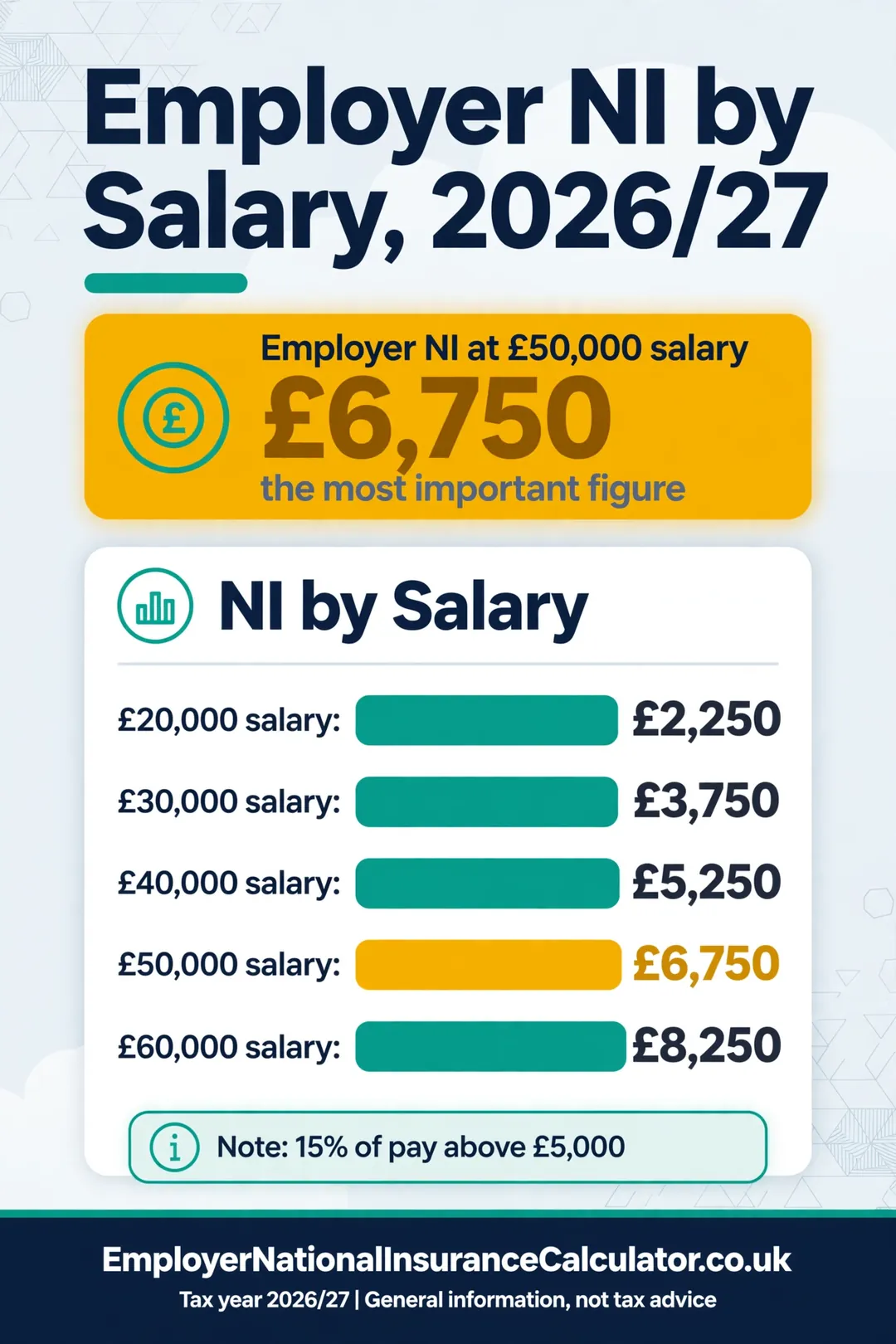
The percentage in the last column grows with salary. Employer NI is charged only above £5,000, so a bigger share of a small salary falls under the threshold. At £100,000 you pay 14.2% of salary, which gets close to the full 15%.
Check your own salary
How the table is worked out
For each salary, the sum is the same:
Employer NI = (salary − £5,000) × 15%
For a £40,000 salary: £40,000 − £5,000 = £35,000. Then £35,000 × 15% = £5,250 a year. Divide by 12 for £437.50 a month. The step-by-step guide shows the monthly and weekly method HMRC payroll uses.
If you are paid by the hour, turn the rate into a salary first. An employee on £15 an hour for 37.5 hours a week works about 1,950 hours, which is £29,250 a year. Employer NI on that is £3,637.50.
Salaries for common jobs
The table below shows the cost of ten typical annual salaries, with the total the employer pays once employer NI is added. Employer pension and other costs are not included.
| Typical role | Salary | Employer NI | Total with NI |
|---|---|---|---|
| Part-time shop assistant | £14,000 | £1,350 | £15,350 |
| Receptionist | £22,000 | £2,550 | £24,550 |
| Care worker | £26,000 | £3,150 | £29,150 |
| Administrator | £28,000 | £3,450 | £31,450 |
| Electrician | £36,000 | £4,650 | £40,650 |
| Marketing executive | £38,000 | £4,950 | £42,950 |
| Teacher-level salary | £44,000 | £5,850 | £49,850 |
| Project manager | £55,000 | £7,500 | £62,500 |
| Senior manager | £75,000 | £10,500 | £85,500 |
| Head of department | £95,000 | £13,500 | £108,500 |
These are examples, not pay advice. Use them to see how fast the on-cost grows. Between £22,000 and £44,000 the employer NI roughly doubles, from £2,550 to £5,850.
What changes the figure
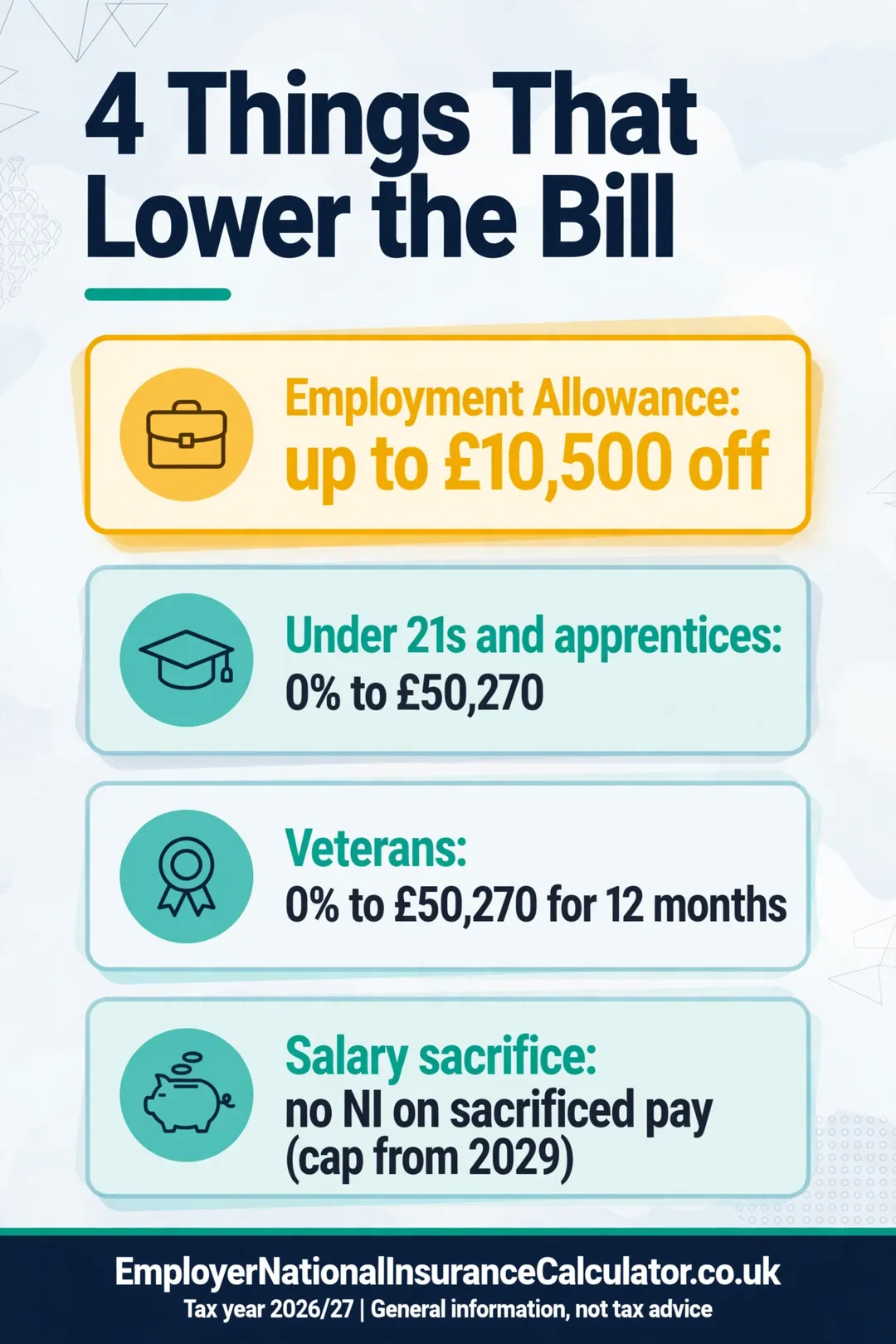
The table assumes one standard employee and no allowances. Four things can lower the bill:
- Employment Allowance. Up to £10,500 off your yearly bill if you qualify. A business with five staff on £30,000 owes £18,750 before it and £8,250 after it.
- Under-21s and apprentices under 25. No employer NI on pay up to £50,270.
- Veterans. No employer NI on pay up to £50,270 in their first 12 months of civilian work.
- Salary sacrifice. Pay given up for a pension is not charged employer NI today. The 2029 cap will limit this.
The cost of a pay rise
Employer NI is a flat 15% above £5,000, so the cost grows in a straight line. Every extra £1,000 of salary adds £150 of NI. That makes pay decisions easy to model.
| Raise | Salary cost | Extra employer NI | Total extra cost |
|---|---|---|---|
| £1,000 | £1,000 | £150 | £1,150 |
| £2,000 | £2,000 | £300 | £2,300 |
| £5,000 | £5,000 | £750 | £5,750 |
| £10,000 | £10,000 | £1,500 | £11,500 |
A 3% rise on a £30,000 salary is £900. With employer NI that is £1,035. For a team of ten, the same rise costs £10,350 a year.
How the same salary compared in earlier years
The rate and the threshold both moved in April 2025, so the same salary now costs more than it did two years ago.
| Salary | 2024/25 | 2025/26 and 2026/27 | Extra a year |
|---|---|---|---|
| £20,000 | £1,504.20 | £2,250 | £745.80 |
| £30,000 | £2,884.20 | £3,750 | £865.80 |
| £50,000 | £5,644.20 | £6,750 | £1,105.80 |
| £80,000 | £9,784.20 | £11,250 | £1,465.80 |
The increase is larger in pounds for higher pay, but low-paid roles feel it most as a share of their cost. See the full rate history.
Example: a team with mixed pay
A design studio has four employees.
| Role | Salary | Employer NI |
|---|---|---|
| Designer | £34,000 | £4,350 |
| Designer | £38,000 | £4,950 |
| Account manager | £45,000 | £6,000 |
| Studio manager | £52,000 | £7,050 |
The total is £22,350 before Employment Allowance. After the £10,500 allowance, the studio pays £11,850. To add this team in the calculator, press “Add another pay level” for each salary.
Which salaries pay nothing
Employer NI is nil for employees paid £5,000 or less a year. It is also nil for under-21s and apprentices under 25 up to £50,270. A 19-year-old on £28,000 costs £28,000, not £31,450.
| Employee | Salary | Employer NI |
|---|---|---|
| Standard, aged 30 | £28,000 | £3,450 |
| Under 21 | £28,000 | £0 |
| Apprentice under 25 | £28,000 | £0 |
| Veteran in first 12 months | £28,000 | £0 |
How to use the table for budgeting
- Find the closest salary row, or use the calculator for the exact one.
- Multiply by the number of staff on that pay.
- Take off Employment Allowance if you qualify.
- Add pension and other costs from the cost of employing someone page.
- Check the answer against the monthly figure on your payroll software when you run the first payslip.
Mistakes people make with salary tables
- Using the table for a part-year employee. Pay for the part of the year they work, not the full salary.
- Forgetting that a bonus is charged on top. See employer NI on bonuses.
- Using last year’s table. The 2025/26 and 2026/27 figures match, but 2024/25 and earlier do not.
- Leaving out pension. The cost of employing a person is more than salary plus NI.
Frequently asked questions
How much employer NI is paid on a £50,000 salary?
£6,750 a year in 2026/27. That is £50,000 minus £5,000, multiplied by 15%. It works out at £562.50 a month and takes the total cost to £56,750.
Why is employer NI a smaller share of low salaries?
The first £5,000 is free of employer NI for every employee. On a £15,000 salary, one third of the pay is under the threshold. On £100,000, only five per cent is.
Does the table include Employment Allowance?
No. It shows the bill before the allowance so you can compare salaries fairly. Switch on Employment Allowance in the calculator to see your bill after it.
Are the figures the same each month?
Roughly. HMRC payroll applies a monthly threshold of £417, so a monthly figure can differ from a yearly one by a few pence. Bonuses can also push one month higher.
How much is employer NI on a £25,000 salary?
£3,000 a year in 2026/27, which is £250 a month.
How much is employer NI on a £100,000 salary?
£14,250 a year. That is £100,000 minus £5,000, multiplied by 15%.
How much extra does a £1,000 raise cost?
£1,150 including employer NI, as long as the employee is already above £5,000.
Is there a salary where employer NI stops?
No. There is no upper cap on the 15% rate for standard employees.
What is employer NI on a £35,000 salary?
£4,500 a year, or £375 a month, before any Employment Allowance.
Is employer NI worked out on salary or on total pay?
It is worked out on total pay, including overtime, commission and bonuses. The salary table assumes pay equals salary.
Related guides
- Employer National Insurance Calculator 2026/27
- Employer NI on a £12,570 Salary (2026/27)
- How Employer National Insurance Is Calculated
- Cost of Employing Someone UK 2026/27: Calculator
Official sources
- National Insurance rates and categories
- HMRC: Rates and thresholds for employers 2026 to 2027
This page is independent information, not tax advice, and has no link with HMRC. Figures were checked on 20 October 2026 for the 2026/27 tax year. Always confirm the final figures with HMRC or your payroll provider.
One Comment
Comments are closed.