NI Category Letters for Employers (2026/27)
A National Insurance category letter tells your payroll software which rate to charge for each employee. Most staff are category A. The wrong letter means the wrong NI bill, so check it for every new starter. This guide lists the letters that matter to employers, shows what each costs in pounds, and explains when to change them.
In this guide15 sections
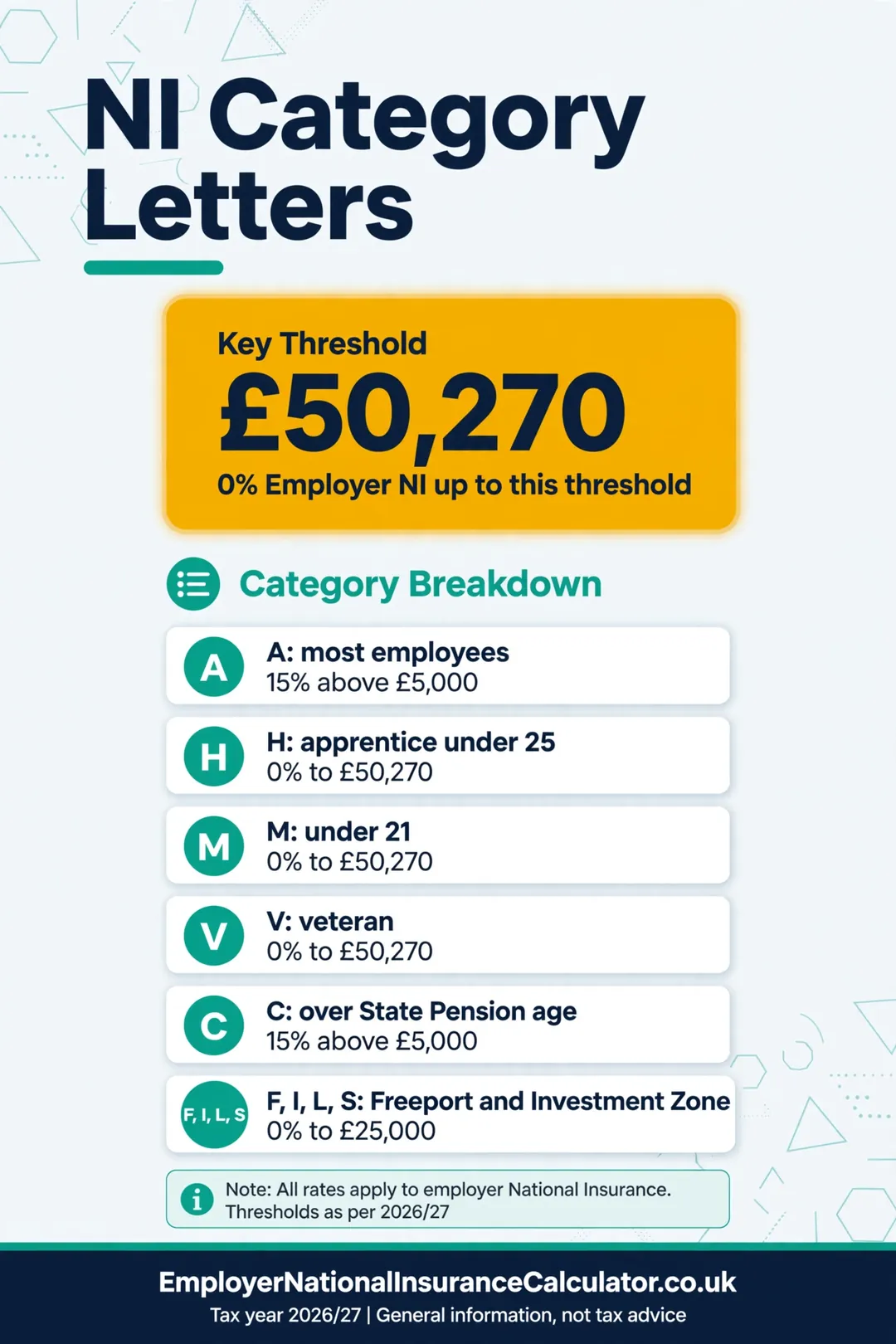
The main category letters
| Letter | Who it is for | Employer NI |
|---|---|---|
| A | Most employees | 15% above £5,000 |
| B | Married women and widows with a reduced-rate election | 15% above £5,000 |
| C | Employees over State Pension age | 15% above £5,000 |
| H | Apprentices under 25 | 0% up to £50,270, then 15% |
| J | Employees who defer NI because of another job | 15% above £5,000 |
| M | Employees under 21 | 0% up to £50,270, then 15% |
| V | Veterans in first 12 months of civilian employment | 0% up to £50,270, then 15% |
| Z | Employees under 21 who defer NI | 0% up to £50,270, then 15% |
| F, I, L, S | Freeport employees (standard, reduced-rate, deferment, over State Pension age) | 0% up to £25,000, then 15% |
The Freeport and Investment Zone letters depend on the employee’s own circumstances as well as the site. Check the current GOV.UK table before using them.
How to pick the right letter
- Is the person under 21? Use M, unless they have a deferment in place. Then use Z.
- Are they an apprentice under 25? Use H, if they are on an approved apprenticeship.
- Are they a veteran in their first 12 months of civilian work? Use V.
- Are they over State Pension age? Use C.
- Do they have another job with a deferment? Use J.
- Do they work mainly at a Freeport or Investment Zone site? Check the special letters.
- None of these? Use A.
What changes when you pick a different letter
The same £30,000 salary costs a different amount depending on the letter.
| Category | Employer NI on £30,000 |
|---|---|
| A (standard) | £3,750 |
| C (over State Pension age) | £3,750 |
| J (deferment) | £3,750 |
| M (under 21) | £0 |
| H (apprentice under 25) | £0 |
| V (veteran, first year) | £0 |
| F (Freeport site worker) | £750 |
For Freeport, (£30,000 − £25,000) × 15% = £750.
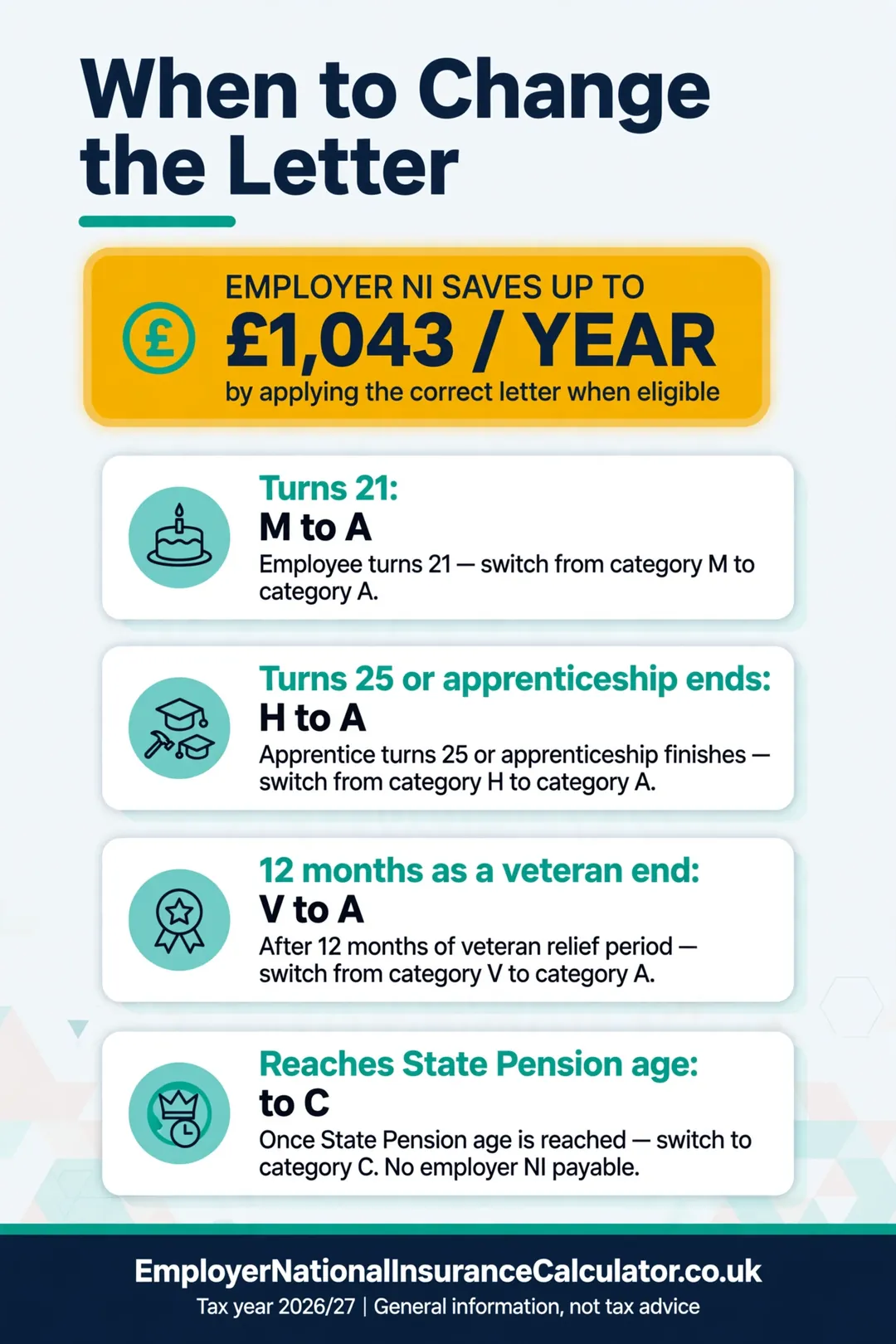
When letters need to change
- An employee turns 21. Move them from M to A from the pay period after their 21st birthday.
- An apprentice turns 25 or finishes the apprenticeship. Move them from H to A. An apprentice who is still under 25 but has finished the approved apprenticeship stops qualifying.
- A veteran’s first 12 months end. Move them from V to A.
- An employee reaches State Pension age. Move them to C, from the pay period after the birthday.
- A new employee gives you a form saying they have a deferment. Use J or Z as needed.
What a wrong letter can cost
| Mistake | Cost over a year on £28,000 |
|---|---|
| Using A for an under-21 | You overpay £3,450 |
| Using M for someone aged 22 | You underpay £3,450 and may owe interest |
| Using A for an apprentice under 25 | You overpay £3,450 |
| Using A for a veteran in the first year | You overpay £3,450 |
The first, third and fourth are overpayments that you can recover. See how to claim back employer NI. The second is an underpayment you must correct.
Mistakes to avoid
- Leaving a 22-year-old on M. This underpays NI and gets a bill later with interest.
- Leaving an apprentice on A. You pay 15% where you did not need to.
- Choosing H without an apprenticeship agreement. The 0% rate depends on an approved apprenticeship.
- Forgetting to record a veteran’s V status date. You cannot get the relief back later without evidence.
- Ignoring a birthday. Age-based letters change on a date, so diarise it.
More detail on each letter
Category A covers most employees aged 21 up to State Pension age. Unless there is a reason to use another letter, this is the default.
Category C is for people over State Pension age. They pay no employee NI, but you still pay 15% above £5,000. This surprises some employers who expect the cost to drop.
Categories M and H are your cheapest options. Both give 0% up to £50,270. Category M follows age, and category H follows an approved apprenticeship. See under-21s and apprentices.
Category V is for veterans in their first year of civilian employment. See veterans relief.
Category B is for married women and widows who elected to pay a reduced employee rate before 1977. It is rare today. The employer rate does not change.
Categories J and Z apply when an employee has deferred their NI because they pay it on another job. Employer NI still applies. Use J for standard employees and Z for under-21s.
Freeport letters depend on the site and the employee’s own category. See Freeport relief.
A starter checklist for each new employee
- Ask for their date of birth.
- Ask whether they are an apprentice or a veteran.
- Ask whether they work at a Freeport or Investment Zone site.
- Ask whether they have a deferment certificate.
- Pick the letter in your payroll software.
- Save your evidence in the employee file.
Where the letter lives
The letter is stored against each employee in payroll. It is sent to HMRC with each Full Payment Submission. You can change it at any time, from the pay period in which the change applies. Keep a note of why and when you changed it.
Example: a team in transition
A business has three staff, each on £28,000.
| Employee | Age | Letter now | Next change | Employer NI now | Employer NI after |
|---|---|---|---|---|---|
| Alex | 20 | M | A at 21 | £0 | £3,450 |
| Sam | 24, apprentice | H | A at 25 or end of apprenticeship | £0 | £3,450 |
| Jo | 66 | C | None | £3,450 | £3,450 |
Alex moves from £0 to £3,450 of employer NI when they turn 21. Sam’s change is similar. Jo is category C already, and you pay 15% above £5,000 for them throughout. Plan these dates into a yearly budget. See under-21s and apprentices.
A yearly review
Once a year, in April, export a list of employees with their dates of birth and categories. Check each one against the rules above. It takes only minutes and avoids bills with interest later.
Related guides
For the rates that go with each letter, see the rates page. For the reliefs, see the exemptions guide. To check the cost, use the employer NI calculator.
Frequently asked questions
What is the most common NI category letter?
A. It applies to most employees aged 21 to State Pension age.
What letter do I use for an employee over State Pension age?
C. They pay no employee NI, but you still pay employer NI at 15% above £5,000.
What letter applies to apprentices?
H, if the person is under 25 and on an approved apprenticeship. Employer NI is 0% up to £50,270.
What happens if I use the wrong letter?
HMRC may bill you for unpaid NI and interest, or you may overpay. Fix it through payroll as soon as you spot it.
How do I find an employee’s letter?
Ask for their date of birth and check their circumstances. An earlier payslip or P45 may show a letter, but check it is still right.
Where can I find the official list?
GOV.UK has a National Insurance rates and letters page that lists every category and its rates.
Can an employee have more than one category letter?
At a single employer, one letter applies at a time. A person with two jobs may have a different letter for each.
Is the letter printed on the payslip?
Often it is, near the NI number. Check with your payroll provider.
Do employer NI rates change by letter?
Yes, for H, M, V, Z and the Freeport letters. They have a higher 0% limit than the standard threshold.
Does category C reduce employer NI?
No. The employee pays nothing, but the employer pays 15% above £5,000 as for category A.
When does an under-21 move to category A?
From the pay period after their 21st birthday.
Related guides
- Employer NI Rates 2026/27: All Rates and Thresholds
- Employer NI Exemptions and Reliefs 2026/27
- Employer NI for Under 21s (2026/27): 0% to £50,270
- Employer NI for Apprentices (2026/27): Category H
- Employer NI Veterans Relief (2026/27): Category V
Official sources
- National Insurance rates and categories
- HMRC: Rates and thresholds for employers 2026 to 2027
This page is independent information, not tax advice, and has no link with HMRC. Figures were checked on 20 October 2026 for the 2026/27 tax year. Always confirm the final figures with HMRC or your payroll provider.
2 Comments
Comments are closed.