What Is Employer National Insurance? A Plain Guide
Employer National Insurance is a payroll tax that a business pays on top of an employee’s salary. In 2026/27 the rate is 15% on each employee’s pay above £5,000 a year. The employee does not see it on their payslip, and it is not taken from their wages.
This guide explains who pays it, what it is for, how it works in practice and what you can do to reduce it.
In this guide18 sections
The short answer
When you employ someone, two National Insurance bills arise. The employee pays theirs out of their pay. You pay yours in addition. The employer part is called secondary Class 1 National Insurance, or “employer NI” for short.
For an employee paid £30,000, the employer part is £3,750 a year. The employee’s own part is £1,394.40. Your total cost is £33,750 for that person, before pension and other costs.
What employer NI pays for
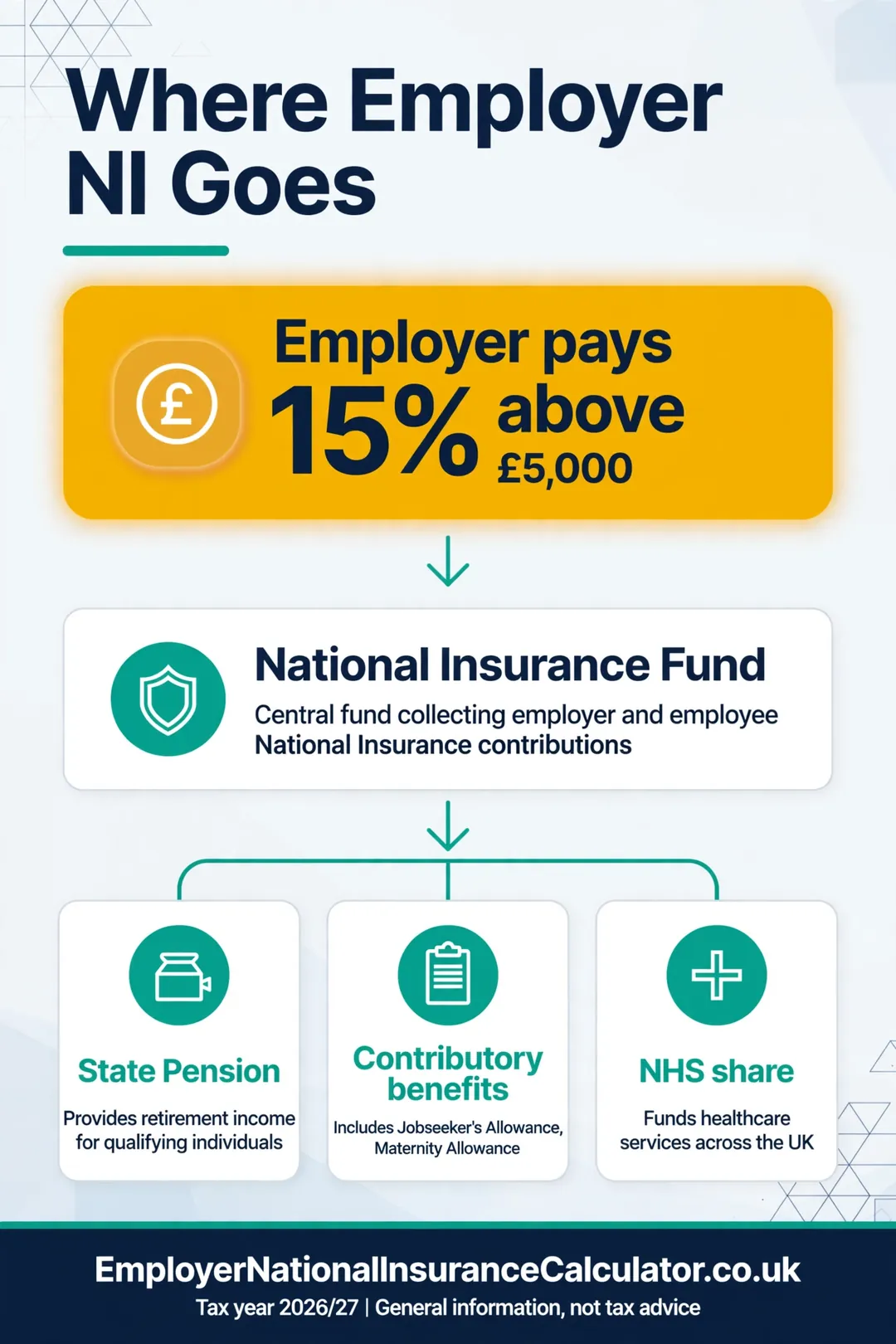
National Insurance contributions go into the National Insurance Fund. This pays for contributory benefits, mainly the State Pension. It also pays for Jobseeker’s Allowance and other benefits that depend on contributions. A share is also passed to the NHS. Employer NI is not a pension for your staff, and your payments do not build up in any account for them.
Who pays employer NI
You pay employer NI if you have employees who earn above the Secondary Threshold. That covers:
- Limited companies that pay staff or directors
- Sole traders and partnerships that employ people
- Charities and community groups with paid staff
- Households that employ staff, such as a nanny, if they earn above the threshold
You do not pay employer NI on yourself if you are a sole trader. Sole traders pay Class 4 on profits instead. You also do not pay it on genuine self-employed contractors who run their own business.
When employer NI is due
Employer NI starts once an employee’s pay passes the Secondary Threshold: £5,000 a year, £417 a month or £96 a week. You work it out each time you run payroll, and pay it to HMRC with your PAYE bill by the 22nd of the next month (19th if paying by post). See how to pay employer NI.
Employer NI against income tax
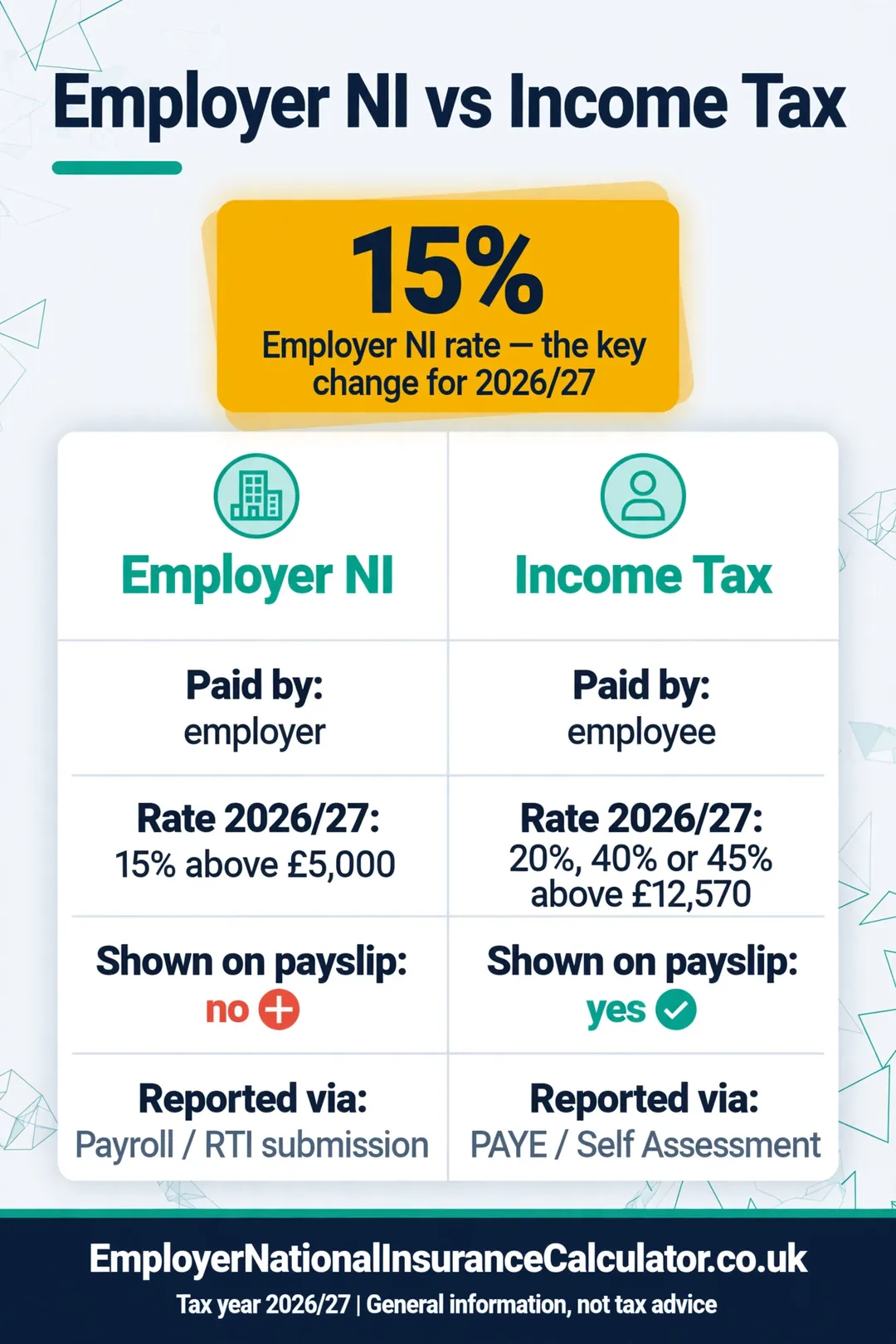
| Employer NI | Income tax | |
|---|---|---|
| Paid by | The employer | The employee |
| Taken from | The business’s own funds | The employee’s pay |
| Rate in 2026/27 | 15% above £5,000 | 20%, 40% or 45% above the personal allowance (England, Wales and Northern Ireland) |
| Shown on payslip | No | Yes |
| Can be reduced by | Employment Allowance and reliefs | Allowances and tax reliefs |
Who attracts a lower rate
Some employees cost less. Staff under 21 and apprentices under 25 have a 0% employer rate on pay up to £50,270. So do veterans in their first year of civilian work. Staff at a Freeport or Investment Zone have a 0% rate up to £25,000. See the exemptions guide.
| Employee on £30,000 | Employer NI |
|---|---|
| Standard (age 30) | £3,750 |
| Under 21 | £0 |
| Apprentice under 25 | £0 |
| Freeport employee | £750 |
Can you reduce it?
Yes, in several ways.
- Employment Allowance takes up to £10,500 off your yearly bill. See the Employment Allowance guide.
- Salary sacrifice into a pension reduces the pay that employer NI is charged on. See salary sacrifice savings.
- Category letters for younger staff, apprentices and veterans lower the rate to 0% up to £50,270.
- Allowable expenses paid at approved rates are not pay, so no NI arises on them.
- Tax relief on the cost. Employer NI is a deductible business expense. See is employer NI tax deductible?
A simple example
Maya runs a bakery with three staff on £24,000 each.
- Employer NI on each: (£24,000 − £5,000) × 15% = £2,850
- Total for three: £8,550
- Employment Allowance: −£8,550, as the allowance of £10,500 covers it
- Employer NI Maya pays: £0
If Maya hires a fourth person, the bill becomes £11,400, less £10,500, which leaves £900 to pay.
What it costs at different team sizes
| Team | Employer NI before allowance | After £10,500 allowance |
|---|---|---|
| 1 on £30,000 | £3,750 | £0 |
| 3 on £25,000 | £9,000 | £0 |
| 10 on £30,000 | £37,500 | £27,000 |
| 25 on £32,000 | £101,250 | £90,750 |
| 100 on £30,000 | £375,000 | £364,500 |
The allowance matters most to small teams. Use the salary table to see your own number.
Common questions from new employers
“Will it show up as a separate bill?” No. It is part of your monthly PAYE payment to HMRC. See how to pay employer NI.
“Does it change if the employee has a second job?” No. Each employer works out its own bill from the pay it gives.
“Does the employee know about it?” Not from the payslip. See employer NI on the payslip.
“Do I have to register for it?” You register as an employer with HMRC before the first payday. Employer NI is then part of your PAYE.
Why employers care about the difference
Income tax and employee NI are taken from the employee’s pay. Employer NI is paid on top. That is why it feels like a hidden cost. A £30,000 salary costs the business £33,750 but the employee sees only part of £30,000 after tax. A pay rise therefore costs the employer more than the employee gains.
| Raise of £2,000 | Employer | Employee |
|---|---|---|
| Gross change | £2,000 | £2,000 |
| Employer NI at 15% | £300 | n/a |
| Income tax at 20% | n/a | £400 |
| Employee NI at 8% | n/a | £160 |
| Net effect | Costs £2,300 | Gains £1,440 |
To see how this plays out for each side, read employer NI vs employee NI and the cost of employing someone guide.
Terms you will see
| Term | Meaning |
|---|---|
| Secondary Class 1 | Employer NI on pay |
| Primary Class 1 | Employee NI on pay |
| Secondary Threshold | £5,000, where employer NI starts |
| Primary Threshold | £12,570, where employee NI starts |
| Class 1A | Employer NI on benefits in kind |
| NI category letter | The code that sets the rate for each employee |
| EPS | Employer Payment Summary, used to claim Employment Allowance |
A short history
National Insurance began in 1911 as a way to pay for sickness and unemployment benefits. Today it funds the State Pension and other contributory benefits. It is collected through the same PAYE system as income tax, but it follows its own rules and rates. This is why it can be confusing.
What employer NI does not do
It does not give your staff a bigger pension. It does not reduce their tax. It does not give you any benefit in return. It does count as a business expense.
What to do next
- Work out your own cost with the employer NI calculator.
- Check whether you can claim Employment Allowance.
- Look at the reliefs for younger staff and apprentices in the exemptions guide.
- Read how it is calculated if you want to do the sums by hand.
Frequently asked questions
What is employer National Insurance in simple terms?
It is a tax a business pays on top of the wages it gives to employees. In 2026/27 it is 15% of pay above £5,000 a year for each employee.
Do I pay employer NI if I am a sole trader with no staff?
No. Employer NI only arises when you have employees. You pay Class 4 on your own profits instead.
Is employer NI the same as employee NI?
No. Employees pay a separate contribution from their own pay, at 8% above £12,570. See employer NI vs employee NI.
Do I pay employer NI on a director’s salary?
Yes, once annual pay passes £5,000, unless Employment Allowance applies. A company with only one employee who is also the director cannot claim the allowance. Read the director NI guide.
Is employer NI paid on employees over State Pension age?
Yes. Employees over State Pension age pay no employee NI, but you still pay 15% above £5,000.
Do I pay employer NI on all staff?
Only on those who earn above the threshold. Staff paid £5,000 or less a year cost you no employer NI.
Does employer NI count as a business expense?
Yes. It is a normal, allowable cost against profits. See is employer NI tax deductible?
What is the difference between employer NI and Class 1A?
Employer NI is charged on pay through payroll. Class 1A is charged once a year on benefits in kind. See Class 1A National Insurance.
How is employer NI different from the apprenticeship levy?
The levy is a separate 0.5% charge on large pay bills. See the levy calculator.
Do I pay employer NI on a one-off payment to a casual worker?
Yes, if they are an employee and the pay is above the threshold for that period.
Is employer NI part of income tax?
No. They are separate charges with different rates and thresholds.
Which is higher, income tax or employer NI?
Income tax rates are higher, but they are paid by the employee. Employer NI is a pure cost to the business.
Related guides
- How Employer National Insurance Is Calculated
- Employer NI vs Employee NI: What Is the Difference?
- Employer NI Rates 2026/27: All Rates and Thresholds
- Employer National Insurance Calculator 2026/27
- Employment Allowance 2026/27: £10,500 Off Employer NI
Official sources
- National Insurance rates and categories
- HMRC: Rates and thresholds for employers 2026 to 2027
This page is independent information, not tax advice, and has no link with HMRC. Figures were checked on 20 October 2026 for the 2026/27 tax year. Always confirm the final figures with HMRC or your payroll provider.