Employer NI vs Employee NI: What Is the Difference?
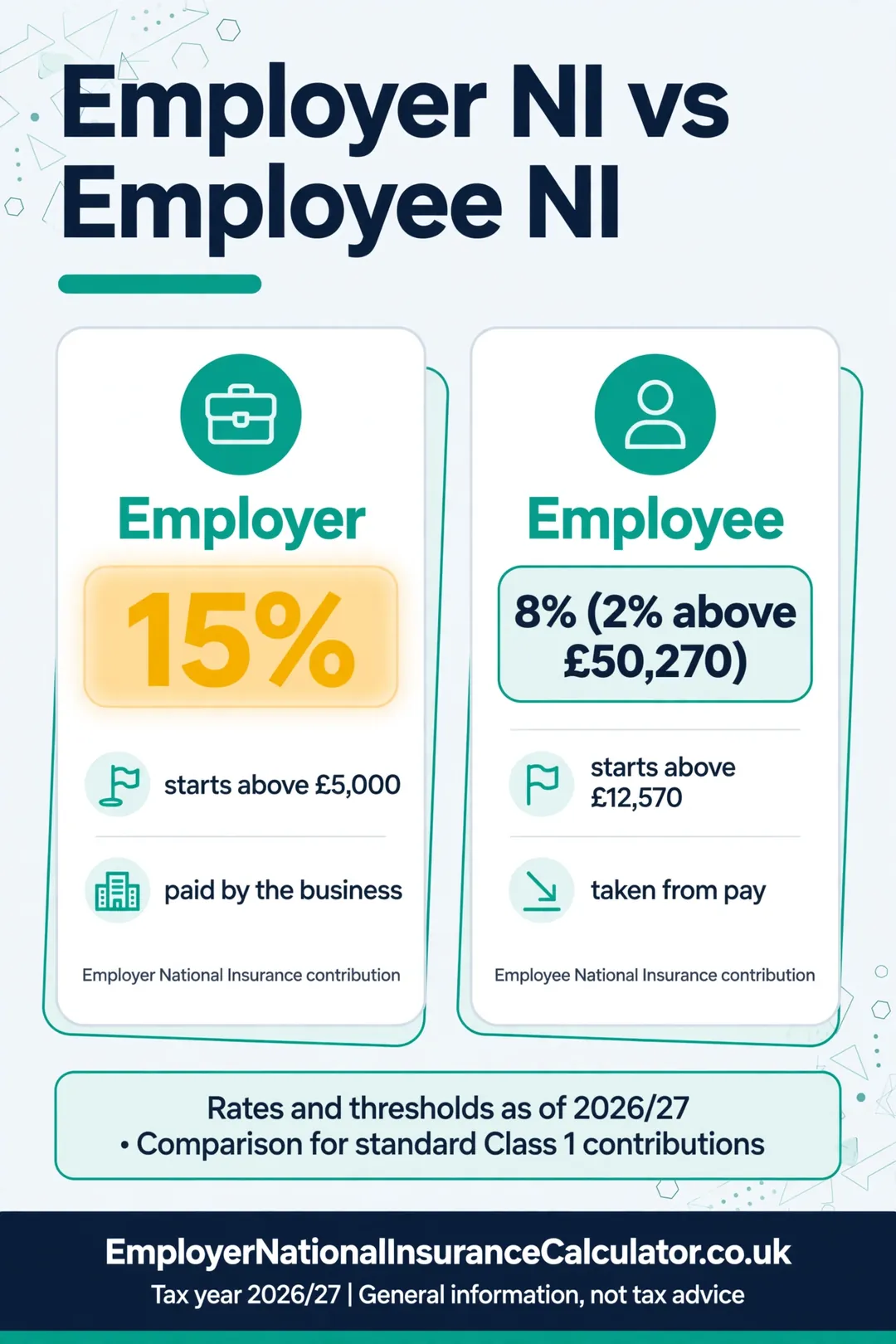
Employer NI is paid by the business at 15% on pay above £5,000. Employee NI is paid by the worker at 8% on pay between £12,570 and £50,270, and 2% above that. They are two separate bills on the same salary, and the employer one is usually the larger. This page compares them in detail, with figures at five salaries.
In this guide18 sections
The two bills side by side
| Employer NI | Employee NI | |
|---|---|---|
| Who pays | The employer | The employee |
| Official name | Secondary Class 1 | Primary Class 1 |
| Starts at | £5,000 a year | £12,570 a year |
| Rate | 15% | 8% to £50,270, then 2% |
| Where it comes from | The business’s own funds | Deducted from pay |
| On the payslip | No (only in payroll reports) | Yes |
| Counts towards the State Pension | No | Yes, for the employee |
Worked example on £30,000
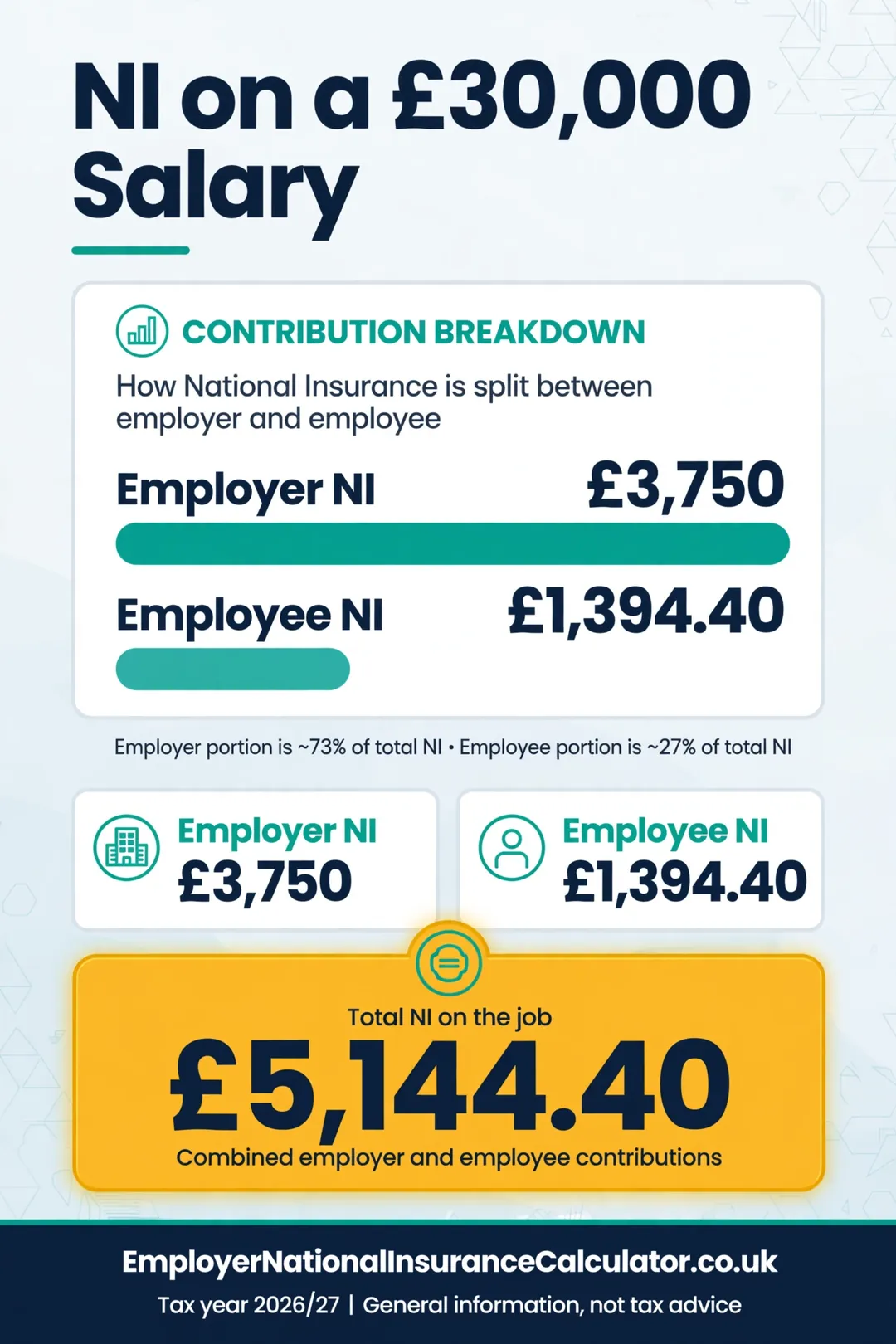
- Employer NI: (£30,000 − £5,000) × 15% = £3,750
- Employee NI: (£30,000 − £12,570) × 8% = £1,394.40
- Total NI on the job: £5,144.40
The employee takes home £30,000 minus income tax and £1,394.40. The business spends £30,000 plus £3,750. The government receives both NI amounts.
Comparison at different salaries
| Salary | Employer NI | Employee NI | Employer share of the total |
|---|---|---|---|
| £15,000 | £1,500 | £194.40 | 88.5% |
| £30,000 | £3,750 | £1,394.40 | 72.9% |
| £50,270 | £6,790.50 | £3,016 | 69.2% |
| £70,000 | £9,750 | £3,410.60 | 74.1% |
| £120,000 | £17,250 | £4,410.60 | 79.6% |
At £70,000, the employee pays 8% on £37,700 (£3,016) plus 2% on £19,730 (£394.60). The employer pays 15% on the full £65,000 above the threshold.
Why the thresholds differ
Employers start paying at £5,000, while employees start at £12,570. Employers pay on a much larger slice of pay. This is why a business can owe thousands in NI even when its employees pay none. A £12,570 salary costs the employer £1,135.50 and the employee nothing.
Band by band
| Pay band | Employer rate | Employee rate |
|---|---|---|
| Up to £5,000 | 0% | 0% |
| £5,000 to £12,570 | 15% | 0% |
| £12,570 to £50,270 | 15% | 8% |
| Above £50,270 | 15% | 2% |
Employers do not have a lower rate at the top. They pay 15% on all pay above £5,000, however high. So for higher earners the employer side is far bigger.
What each side gets
The employee builds a State Pension record and keeps entitlement to contributory benefits. The employer’s payment does not give the business any benefit. It does not earn the employee extra pension either. It is purely a cost of employing people.
Who decides which rate applies
Both sides depend on the employee’s category letter, set in payroll. A standard employee is category A. Some letters change the employer rate, such as M for under-21s. Others change the employee rate, such as C for people over State Pension age. See NI category letters.
Employees over State Pension age
They pay no employee NI at all. You still pay employer NI at 15% above £5,000. This catches some employers out when budgeting for older staff.
| Employee on £30,000 | Employer NI | Employee NI |
|---|---|---|
| Category A (under State Pension age) | £3,750 | £1,394.40 |
| Category C (over State Pension age) | £3,750 | £0 |
Why the employer pays more
Employers start paying at a lower threshold and at a higher rate. On a £30,000 salary, the employer’s £3,750 is 3 times the employee’s £1,394.40. The employer is charged on £25,000 of pay, against £17,430 for the employee, which is about 43% more. The rate is also 15% against 8%.
Over the last few years the employee rate has fallen from 12% to 8%, while the employer rate has risen from 13.8% to 15%. The balance has moved to the employer side. For the full run, see the rates history.
Example: three staff
| Employee | Salary | Employer NI | Employee NI |
|---|---|---|---|
| Part-time assistant | £14,000 | £1,350 | £114.40 |
| Team leader | £32,000 | £4,050 | £1,554.40 |
| Manager | £55,000 | £7,500 | £3,110.60 |
| Total | £12,900 | £4,779.40 |
The manager’s employee NI is 8% on £37,700 (£3,016) plus 2% on £4,730 (£94.60). Use the exact figure from your payroll software.
What this means for pay negotiations
When an employee asks for a £2,000 raise, their take-home rises by less than £2,000 after tax and NI, and your cost rises by £2,300. Both sides lose a share to HMRC.
| £2,000 raise | Employer | Employee on £30,000 |
|---|---|---|
| Gross | £2,000 | £2,000 |
| Employer NI at 15% | £300 | n/a |
| Income tax at 20% | n/a | £400 |
| Employee NI at 8% | n/a | £160 |
| Net | Costs £2,300 | Gains £1,440 |
Showing the figures on a calculator helps keep the conversation clear. See the cost of employing someone page, and employer NI on bonuses for one-off pay.
Reliefs that change the employer side only
The under-21, apprentice, veteran and Freeport reliefs cut employer NI to 0% up to a limit. They do not change what the employee pays. See the exemptions guide.
| Employee on £30,000 | Employer NI | Employee NI |
|---|---|---|
| Standard (A) | £3,750 | £1,394.40 |
| Under 21 (M) | £0 | £1,394.40 |
| Apprentice under 25 (H) | £0 | £1,394.40 |
| Freeport (F) | £750 | £1,394.40 |
What each side can do to cut its bill
Employees can use salary sacrifice for pensions to cut their own NI. Employers can use the same route, and also reliefs for younger staff and Employment Allowance. See salary sacrifice savings and Employment Allowance.
Where each bill shows up
Employee NI appears on the payslip. Employer NI does not, but it appears in your payroll reports and on your HMRC account. Both are paid to HMRC together in your monthly PAYE bill. See employer NI on the payslip and how to pay it.
Next steps
Use the calculator for your own salaries. Read what employer NI is if you are new to it.
Frequently asked questions
Who pays more, the employer or the employee?
On most salaries the employer pays more. On £30,000, employer NI is £3,750 against employee NI of £1,394.40.
Is employer NI taken from my pay?
No. It is paid by your employer on top of your pay. Only employee NI is deducted from wages.
What is the employee NI rate for 2026/27?
8% on earnings between £12,570 and £50,270, and 2% on earnings above £50,270.
Do employers pay NI on the same amount of pay as employees?
No. Employers pay on pay above £5,000, while employees pay on pay above £12,570.
Does the employee’s NI go up if the employer’s goes up?
No. They are separate. A change to the employer rate does not change what an employee pays.
Can an employer pass its NI to the employee?
Not legally as a deduction. An employer may think about it when setting pay, but cannot deduct its own NI from wages.
Do the two figures use the same threshold?
No. See the thresholds table.
Does an employee on £12,570 pay NI?
No. Their NI starts above £12,570. The employer still pays £1,135.50.
Does the employer pay NI on the employee’s NI?
No. Employee NI is a deduction from the employee’s pay and does not attract any further charge.
Why is employee NI lower above £50,270?
Parliament set the main rate at 8% up to the Upper Earnings Limit and a 2% rate above it. There is no matching drop for employers.
Which of the two builds a State Pension record?
Employee NI, or credits for earnings above the Lower Earnings Limit. Employer NI does not.
Related guides
- What Is Employer National Insurance? A Plain Guide
- Employer NI Thresholds 2026/27: Weekly, Monthly, Yearly
- How Employer National Insurance Is Calculated
- Is Employer NI on a Payslip? What Employees See
- NI Category Letters for Employers (2026/27)
Official sources
- National Insurance rates and categories
- HMRC: Rates and thresholds for employers 2026 to 2027
This page is independent information, not tax advice, and has no link with HMRC. Figures were checked on 20 October 2026 for the 2026/27 tax year. Always confirm the final figures with HMRC or your payroll provider.
One Comment
Comments are closed.