How and When to Pay Employer NI to HMRC
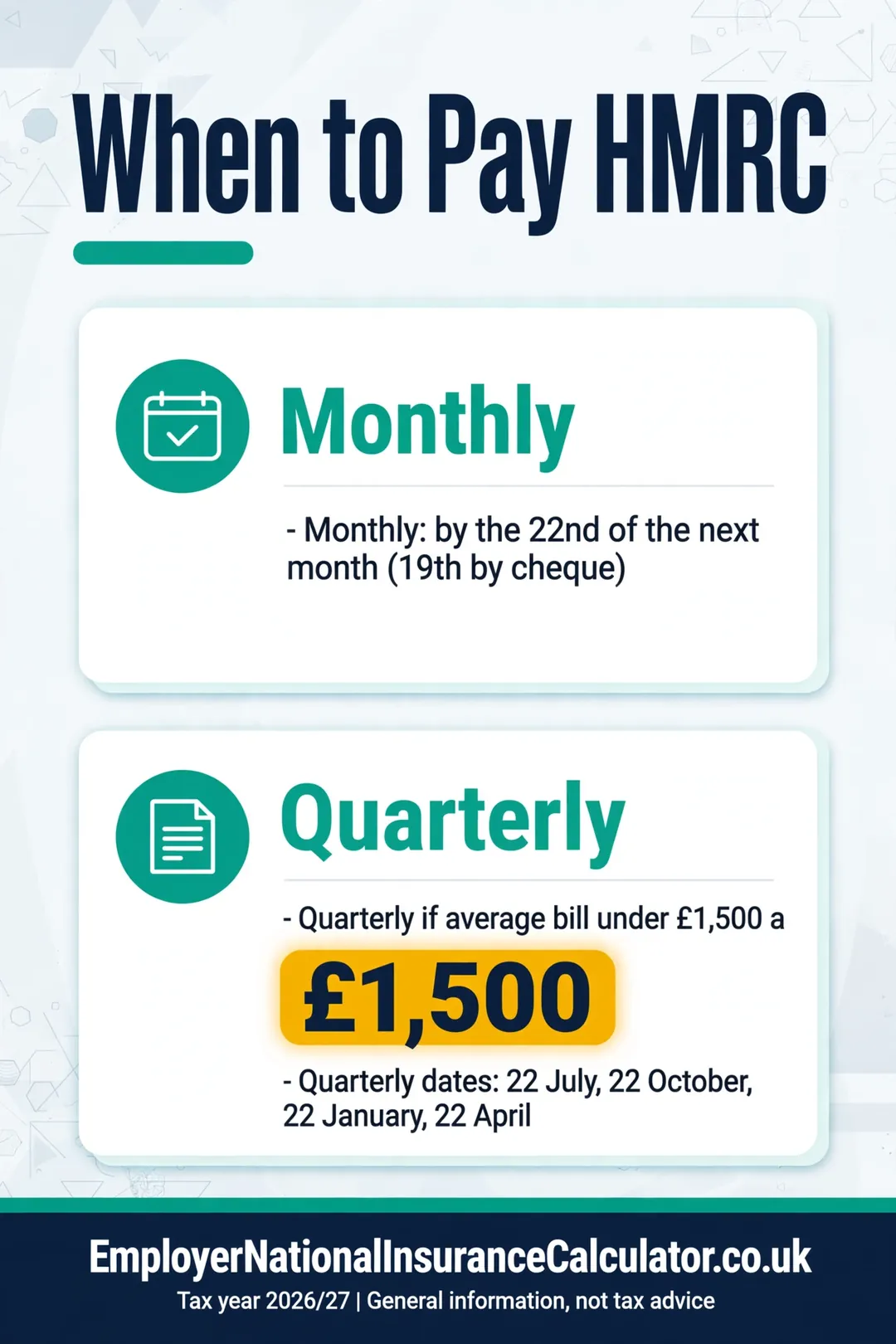
You pay employer NI to HMRC together with PAYE tax and employee NI, in one monthly bill. It is due by the 22nd of the month after the pay date if you pay electronically, or the 19th if you pay by post. Small employers can pay quarterly. This guide gives the dates, the methods and what to do if you are late.
In this guide16 sections
What you pay in one bill
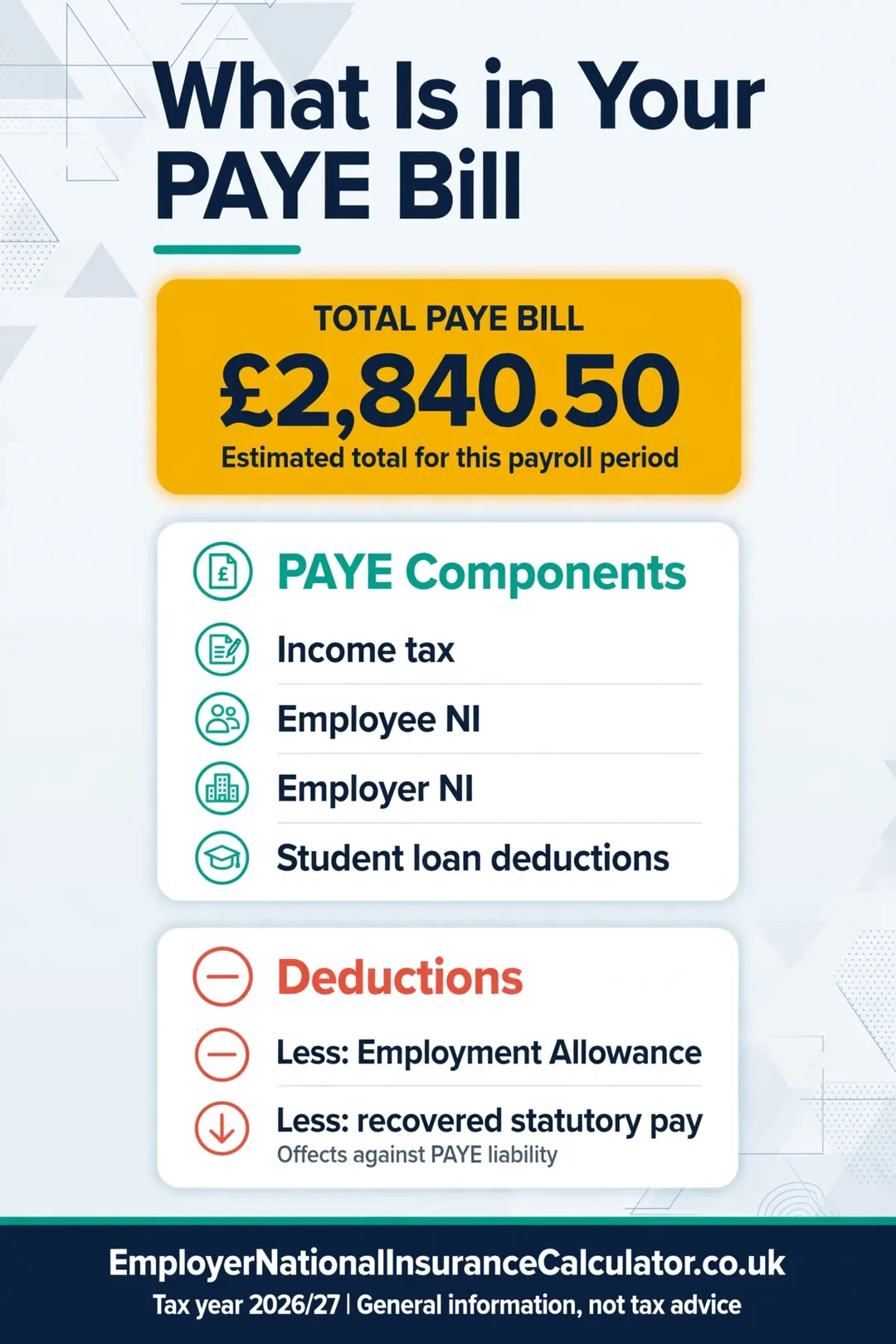
Your PAYE bill has four parts:
- Income tax taken from employees
- Employee NI taken from employees
- Employer NI
- Student loan deductions, if any
Less any Employment Allowance, statutory pay you recover, and Construction Industry Scheme deductions you suffered.
| Example: a month with 5 staff on £30,000 | Amount |
|---|---|
| Income tax deducted (illustrative) | £1,800 |
| Employee NI deducted | £581 |
| Employer NI | £1,562.50 |
| Less Employment Allowance used | −£1,562.50 |
| Bill to pay | £2,381 |
The income tax figure is illustrative. Your own figure depends on tax codes. The Employment Allowance wipes out the employer NI line until it is used up.
Payment dates
| Pay date in | Payment due |
|---|---|
| 6 April to 5 May | 22 May |
| 6 May to 5 June | 22 June |
| 6 June to 5 July | 22 July |
| 6 July to 5 August | 22 August |
| And so on | The 22nd of the following month |
The tax month runs from the 6th to the 5th. The payment must reach HMRC by the 22nd. If the 22nd is a weekend or bank holiday, aim to pay the working day before, since the payment needs to be cleared.
Quarterly payment
If you expect your average monthly PAYE bill to be under £1,500, you can pay quarterly. You need to tell HMRC. The dates are:
| Quarter | Due |
|---|---|
| 6 April to 5 July | 22 July |
| 6 July to 5 October | 22 October |
| 6 October to 5 January | 22 January |
| 6 January to 5 April | 22 April |
How to pay
| Method | Notes |
|---|---|
| Online or telephone banking (Faster Payments) | Fast. Usually arrives the same or the next day |
| CHAPS | Same day, with a fee |
| Bacs | Takes three working days |
| Direct Debit | Set up in advance through your HMRC account |
| Debit or corporate credit card online | A fee may apply on corporate cards |
| Cheque by post | Must arrive by the 19th |
Use your 13-character Accounts Office reference as the payment reference. A wrong reference leads to delays and mismatches.
Other yearly payments
| What | Due |
|---|---|
| P11D forms and P11D(b) | 6 July |
| Class 1A NI | 22 July (19 July by cheque) |
| Class 1B NI and PSA | 22 October (19 October by cheque) |
What if you are late
HMRC charges penalties for late payments. The penalty depends on how many times you have been late in the year and how late each payment is. Interest also runs on any unpaid amount. If you cannot pay, contact HMRC early and ask about a payment plan.
Tips for avoiding mistakes
- Set a standing reminder for the 15th each month, with time to prepare.
- Pay from the business account only, and use the correct reference.
- Check your payroll software’s “amount due” and compare it with HMRC’s online statement.
- Send your Full Payment Submission on or before the pay date.
- Send your Employer Payment Summary if you are claiming Employment Allowance or have nothing to pay. See how to claim the allowance.
Case study: a quarterly payer
A small firm’s PAYE bill averages £1,200 a month. It is under £1,500, so the firm pays quarterly.
| Quarter | Bill | Due |
|---|---|---|
| April to June | £3,600 | 22 July |
| July to September | £3,600 | 22 October |
| October to December | £3,600 | 22 January |
| January to March | £3,600 | 22 April |
Quarterly payment helps cash flow but means each payment is larger. Set aside money monthly in a separate account so the bill does not come as a shock.
Using your HMRC online account
Your PAYE online account shows what HMRC thinks you owe, and what you have paid. Compare it to your payroll report each month. If the two differ, find out why before the due date. See employer NI for small businesses for budgeting tips.
Common reference problems
A payment sent with the wrong reference may be allocated to the wrong period. Always include the 13-character Accounts Office reference, and add the tax month for monthly payments if the form asks for it.
A payroll payment calendar for 2026/27
| Pay dates | Payment due (electronic) |
|---|---|
| 6 April to 5 May 2026 | 22 May 2026 |
| 6 May to 5 June 2026 | 22 June 2026 |
| 6 June to 5 July 2026 | 22 July 2026 |
| 6 July to 5 August 2026 | 22 August 2026 |
| 6 August to 5 September 2026 | 22 September 2026 |
| 6 September to 5 October 2026 | 22 October 2026 |
| 6 October to 5 November 2026 | 22 November 2026 |
| 6 November to 5 December 2026 | 22 December 2026 |
| 6 December 2026 to 5 January 2027 | 22 January 2027 |
| 6 January to 5 February 2027 | 22 February 2027 |
| 6 February to 5 March 2027 | 22 March 2027 |
| 6 March to 5 April 2027 | 22 April 2027 |
Where the 22nd falls on a weekend, pay a working day early so the money clears in time.
A monthly routine that works
- Run payroll and send the Full Payment Submission on or before the pay date.
- Check the amount due in your software.
- Pay by Faster Payments at least two days before the 22nd.
- Save the payment confirmation with the payroll report.
- Check your HMRC account shows the payment.
If you cannot pay in full
Contact HMRC before the due date. They can agree a Time to Pay arrangement in some cases. Penalties and interest still apply to late amounts, but early contact shows good faith and can reduce the risk of larger charges.
Frequently asked questions
When do I pay employer NI to HMRC?
By the 22nd of the month after the pay date, if paying electronically.
Can I pay employer NI quarterly?
Yes, if your average monthly PAYE bill is under £1,500 and you tell HMRC.
Where do I find my payment reference?
It is your Accounts Office reference, shown on letters from HMRC and in your online PAYE account.
Do I pay employer NI separately from PAYE?
No. It is part of your single PAYE payment.
What happens if I miss a payment?
You may get penalties and interest. Contact HMRC as soon as possible.
Do I pay employer NI weekly if I pay staff weekly?
No. You still pay monthly or quarterly, not each pay date.
Where do I see what I owe?
In your HMRC online PAYE account, and in your payroll software’s payment report.
Can I pay early?
Yes. HMRC will hold the payment against your next bill.
What is the cut-off for a cheque?
It must reach HMRC by the 19th, not the 22nd.
Do I need to send anything if I owe nothing in a month?
Yes. Send an Employer Payment Summary to tell HMRC no payment is due.
Related guides
- Employer NI for Small Businesses: Hiring Cost and Cash Flow
- Class 1A National Insurance 2026/27: Rate and Deadlines
- Class 1B NI and PAYE Settlement Agreements (2026/27)
- Is Employer NI on a Payslip? What Employees See
- How to Claim Employment Allowance (Step by Step)
Official sources
This page is independent information, not tax advice, and has no link with HMRC. Figures were checked on 20 October 2026 for the 2026/27 tax year. Always confirm the final figures with HMRC or your payroll provider.
One Comment
Comments are closed.