How Employer National Insurance Is Calculated
Employer NI calculator
Add each pay level in your team. Get the bill, the cost and the working.
Loading the calculator…
Estimate only. Independent tool, not affiliated with HMRC. Rates checked 20 October 2026. Real payroll rounds each pay period.
To work out employer NI, take an employee’s pay for the period, subtract the Secondary Threshold, and multiply what is left by 15%. In 2026/27 the threshold is £5,000 a year, £417 a month or £96 a week. This page walks through the method step by step, with real examples for yearly, monthly and weekly pay, bonuses, directors and reliefs.
In this guide22 sections
The basic formula
Employer NI = (pay − Secondary Threshold) × 15%
If pay is at or below the threshold, no employer NI is due. Pay means earnings liable to Class 1 NI. That includes salary, overtime, bonuses and commission.
Use the calculator above to check any sum in this guide.
The four steps
- Find the pay for the period. Use gross pay before tax and employee deductions.
- Pick the right threshold. £96 for weekly pay, £385 for four-weekly, £417 for monthly, £5,000 for a year.
- Subtract. If the answer is zero or less, stop. No employer NI is due.
- Multiply by the rate. 15% for a standard employee. Use 0% up to £50,270 for categories M, H and V, and up to £25,000 for Freeport staff.
Worked example: yearly
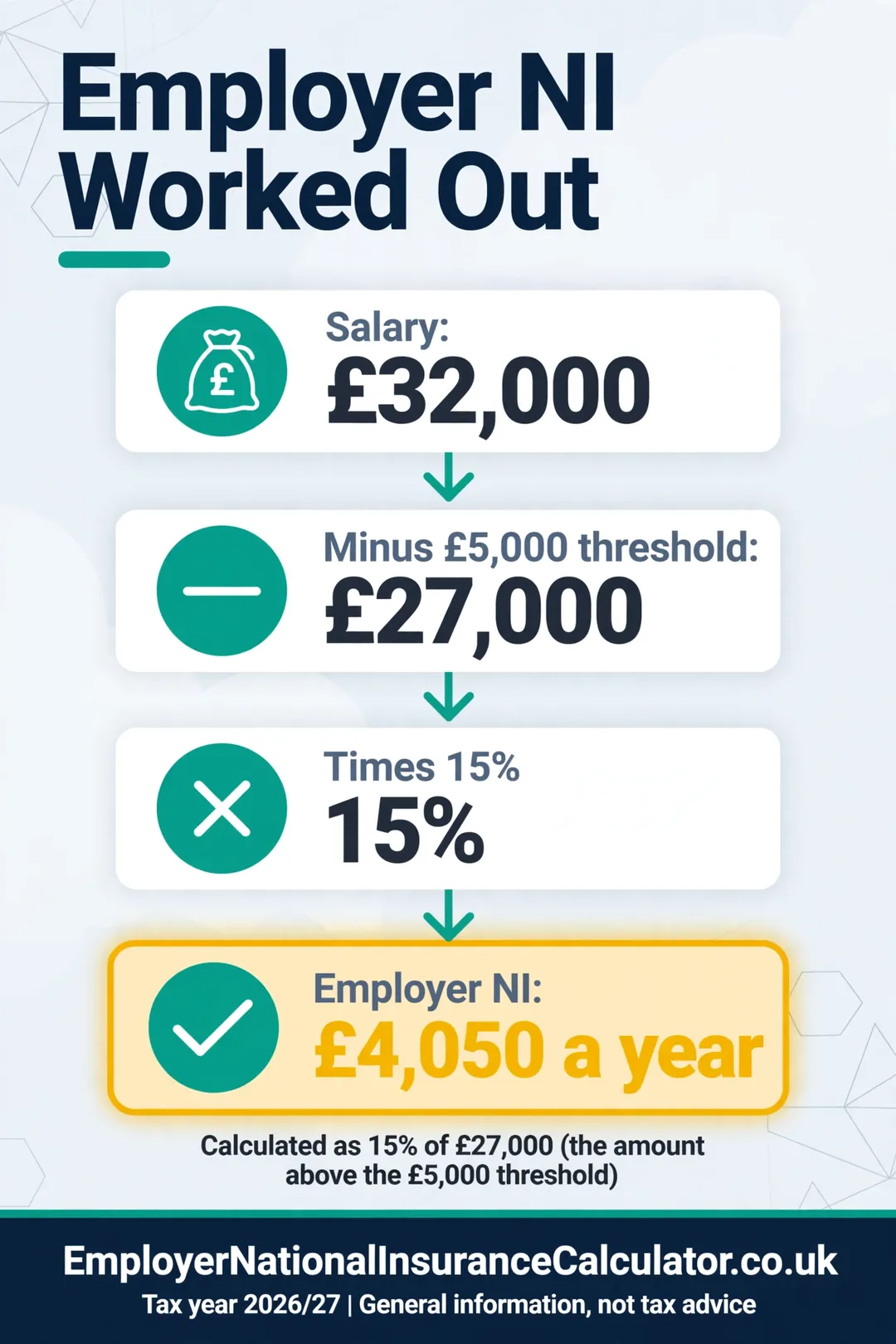
An employee earns £32,000 a year.
- £32,000 − £5,000 = £27,000
- £27,000 × 15% = £4,050
Employer NI is £4,050 a year.
Worked example: monthly
Pay is £2,800 in a month.
- £2,800 − £417 = £2,383
- £2,383 × 15% = £357.45
Payroll software runs this sum each pay period. See the monthly calculator for more.
Worked example: weekly
Pay is £620 in a week.
- £620 − £96 = £524
- £524 × 15% = £78.60
Worked example: four-weekly
Pay is £2,400 every four weeks.
- £2,400 − £385 = £2,015
- £2,015 × 15% = £302.25
The same pay across pay periods
The threshold is smaller for shorter periods, so the sums differ a little. The table shows an employee on £30,000 a year.
| Pay frequency | Pay per period | Threshold | Employer NI per period | Over a year |
|---|---|---|---|---|
| Weekly | £576.92 | £96 | £72.14 | £3,751.20 |
| Four-weekly | £2,307.69 | £385 | £288.40 | £3,749.25 |
| Monthly | £2,500 | £417 | £312.45 | £3,749.40 |
| Yearly | £30,000 | £5,000 | £3,750 | £3,750 |
The totals differ by a few pounds because HMRC rounds each period threshold to the nearest pound. This is normal. Your payroll software is the figure to file.
What counts as pay
Most cash pay counts. So do many payments in kind that can be turned into cash, such as vouchers. Employer pension contributions do not. Benefits like company cars are charged separately under Class 1A.
| Counts as pay | Does not count |
|---|---|
| Salary and wages | Employer pension contributions |
| Overtime and commission | Most expenses at approved rates |
| Bonuses | Statutory redundancy up to £30,000 |
| Statutory sick and maternity pay | Benefits in kind (charged under Class 1A) |
| Holiday pay and notice pay | Salary sacrifice amounts paid into a pension (until the 2029 cap) |
| Some vouchers and payments in kind | Reimbursed business travel at approved rates |
Special cases
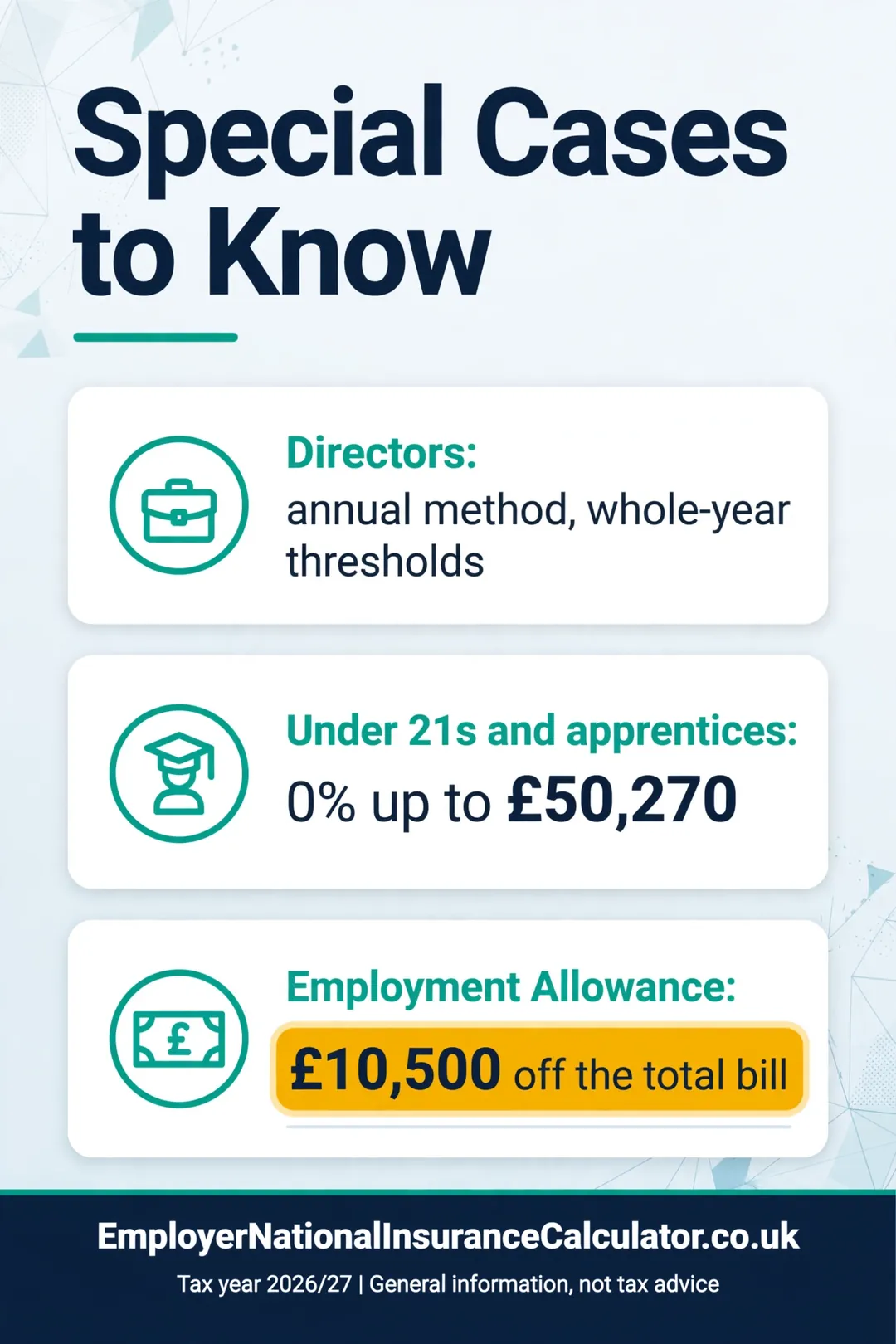
- Directors use an annual earnings period, so the whole year’s threshold applies in one go. See the director calculator.
- Under-21s and apprentices under 25 have a 0% rate up to £50,270. Above that, 15% applies.
- Veterans in their first 12 months of civilian work have the same 0% rate up to £50,270.
- Freeport and Investment Zone staff have 0% up to £25,000.
- Employment Allowance reduces the total bill at the end, up to £10,500.
Employer NI on several employees
Each employee is worked out on their own. You cannot pool the threshold. Take three employees on £20,000, £30,000 and £40,000.
| Employee | Salary | Employer NI |
|---|---|---|
| A | £20,000 | £2,250 |
| B | £30,000 | £3,750 |
| C | £40,000 | £5,250 |
| Total | £11,250 | |
| After £10,500 Employment Allowance | £750 |
Full payroll example with a bonus
Sam earns £36,000 a year, paid monthly at £3,000. In December Sam gets a £2,000 bonus.
| Month | Pay | Above £417 | Employer NI |
|---|---|---|---|
| January to November (each) | £3,000 | £2,583 | £387.45 |
| December | £5,000 | £4,583 | £687.45 |
Year total: 11 × £387.45 + £687.45 = £4,949.40. The yearly method gives (£38,000 − £5,000) × 15% = £4,950. The small gap is rounding. See employer NI on bonuses.
Employee NI at the same time
Employee NI on £3,000 a month is (£3,000 − £1,048) × 8% = £156.20. It is deducted from Sam’s pay and paid to HMRC with your employer share. Your own cost is only the employer part. See employer NI vs employee NI.
A part-time employee
A part-time employee earns £9,600 a year, which is £800 a month.
- Monthly pay: £800
- Above £417: £383
- Employer NI: £383 × 15% = £57.45 a month
- Yearly: £689.40
Even a small wage attracts employer NI once it passes £417 a month. Employee NI starts at £1,048 a month, so this employee pays none.
Rounding
HMRC rounds the figures it publishes, and payroll software rounds each period. If you add up twelve monthly figures, you may differ from the yearly figure by a few pounds. This is accepted. See the thresholds page for how the monthly figure is set.
Directors in more detail
A director’s NI is not worked out each month by default. It uses the whole tax year. If a director is paid £2,000 a month, nothing is due for the first two months, because the year-to-date figure has not passed £5,000. The charge starts in month three. By the end of the year, the total is the same as the annual formula.
| Director pay | Employer NI for the year |
|---|---|
| £6,708 (at the LEL) | £256.20 |
| £12,570 (at the Primary Threshold) | £1,135.50 |
| £24,000 | £2,850 |
| £50,270 | £6,790.50 |
See the director calculator and the salary guide.
Under 21s and apprentices
For these staff, the 15% charge only starts at £50,270 in place of £5,000. A 20-year-old on £30,000 costs £0 in employer NI. At 21, the figure rises to £3,750. See employer NI for under 21s and employer NI for apprentices.
Employment Allowance
Employment Allowance is not set against any one employee. It works on your total bill. If the total is £8,000, the allowance wipes it out. If it is £14,000, you pay £3,500. See the Employment Allowance guide.
A mistake-proof checklist
- Use the right tax year. Last year’s thresholds give the wrong answer.
- Include every payment. Bonuses are charged in the month paid.
- Apply Employment Allowance to the total bill. Not to each person.
- Check the category letter. A wrong letter means a wrong rate.
- Check worker status. A contractor treated as an employee, or the reverse, changes the bill.
- Use the right period threshold. Do not use £5,000 for monthly pay.
Checking your answer
After doing a sum by hand, check three things. Did you use the right period threshold? Did you include bonuses and overtime? Did you apply the right rate for the category letter? Then compare your answer with the calculator.
Frequently asked questions
How do I calculate employer NI by hand?
Subtract the Secondary Threshold from the employee’s pay for the period, then multiply by 15%. Use £417 for monthly pay and £96 for weekly pay.
Does employer NI include the first £5,000?
No. Only pay above £5,000 a year is charged.
Is employer NI worked out on gross pay?
Yes. It is based on gross earnings before tax and employee deductions, except for exempt items such as employer pension contributions.
Does the employer NI bill change if the employee has two jobs?
Each employer works out its own bill. Pay from different employers is not added together for employer NI.
Is employer NI worked out before or after tax?
It is worked out on gross pay, before income tax and employee deductions.
Do I pay employer NI on expenses?
Not on genuine business expenses reimbursed at approved rates. Payments that are really extra pay are charged.
Do I pay employer NI on holiday pay?
Yes. Holiday pay is part of earnings and is charged like normal pay.
How do I get the exact figure for my payroll?
Your payroll software gives the exact figure. Use this site’s calculator for planning, checking and budgeting.
How do I work out employer NI for a part-time worker?
Use the same formula. Take their pay for the period, subtract the threshold for that period, and multiply by 15%.
Do I use the annual threshold for monthly staff?
No. Use the monthly one, £417, unless they are a director. See the director guide.
Which special case saves the most?
For one employee, the under-21 and apprentice reliefs, which save up to £6,790.50 a year. For a business, Employment Allowance saves up to £10,500.
Is employer NI worked out differently if pay is irregular?
No. Each pay date is a separate period. Pay on that date is tested against that period’s threshold.
Related guides
- Employer NI Thresholds 2026/27: Weekly, Monthly, Yearly
- Monthly Employer NI Calculator 2026/27
- Director National Insurance Calculator 2026/27
- Employer National Insurance Calculator 2026/27
- Employment Allowance 2026/27: £10,500 Off Employer NI
Official sources
- National Insurance rates and categories
- HMRC: Rates and thresholds for employers 2026 to 2027
This page is independent information, not tax advice, and has no link with HMRC. Figures were checked on 20 October 2026 for the 2026/27 tax year. Always confirm the final figures with HMRC or your payroll provider.
One Comment
Comments are closed.