Employer NI Rates 2025/26: Rates and Thresholds
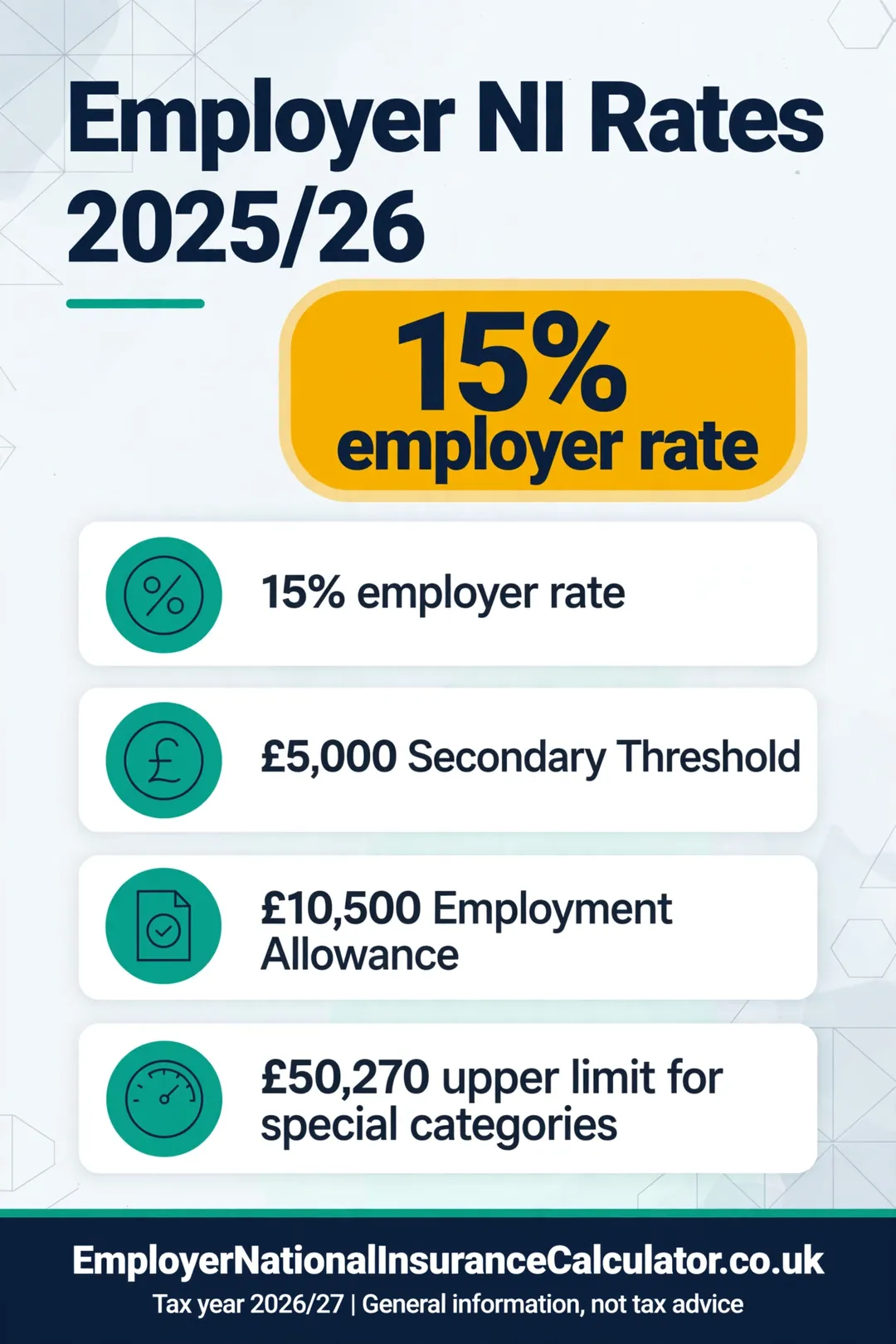
For the 2025/26 tax year (6 April 2025 to 5 April 2026), the employer National Insurance rate was 15% on pay above £5,000 a year. Employment Allowance rose to £10,500. Both figures carry on into 2026/27. This page lists every 2025/26 figure and shows what the April 2025 change cost in pounds.
In this guide17 sections
2025/26 employer NI rates
| Item | 2025/26 |
|---|---|
| Employer Class 1 rate | 15% |
| Class 1A rate | 15% |
| Secondary Threshold | £5,000 a year (£417 a month, £96 a week) |
| Upper Secondary Threshold | £50,270 |
| Freeport and Investment Zone limit | £25,000 |
| Employment Allowance | £10,500 |
| Lower Earnings Limit | £6,500 |
2025/26 against 2024/25
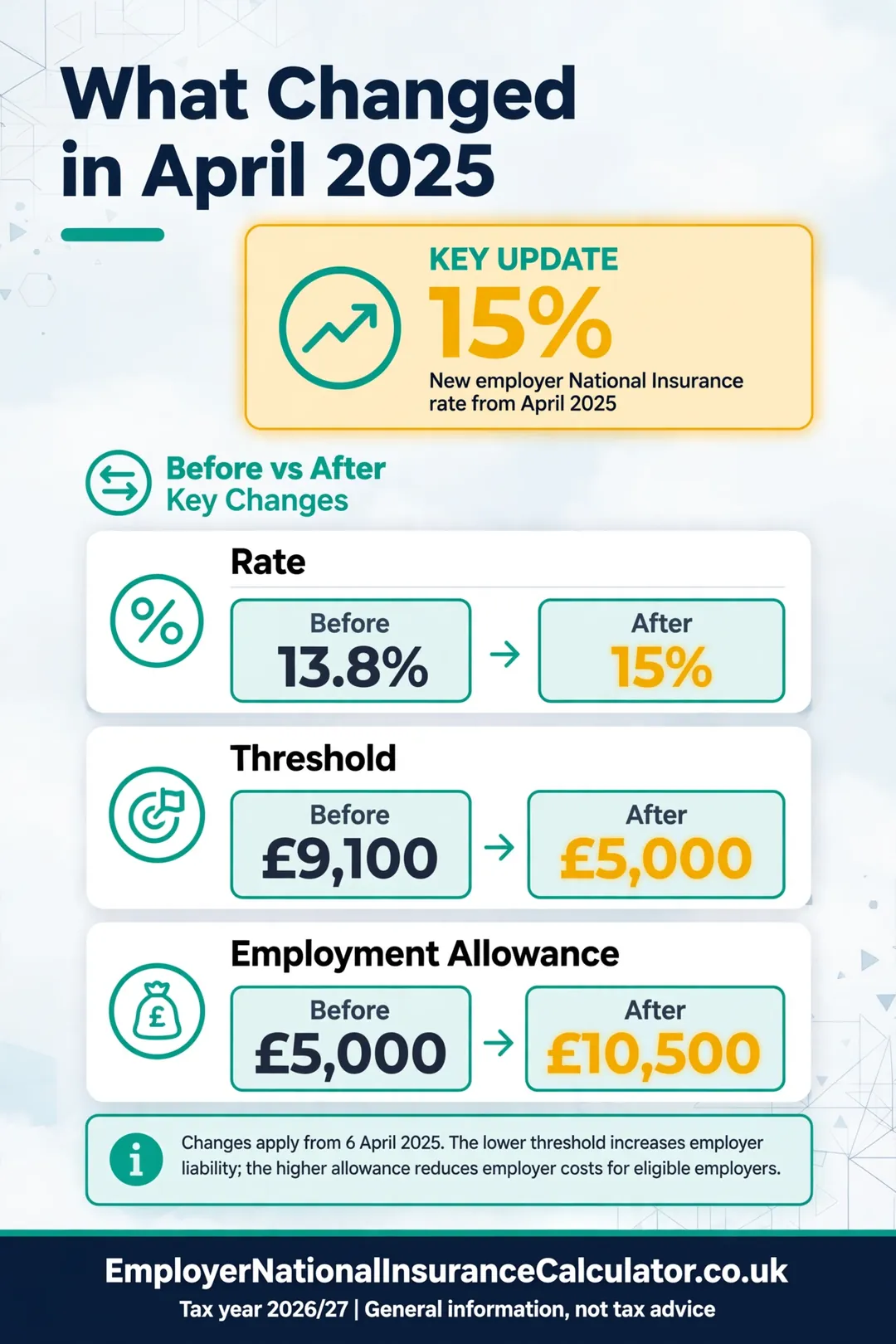
| Item | 2024/25 | 2025/26 |
|---|---|---|
| Employer rate | 13.8% | 15% |
| Secondary Threshold | £9,100 | £5,000 |
| Employment Allowance | £5,000 | £10,500 |
| Employment Allowance cap | NI bill under £100,000 | No cap |
The rate went up and the threshold went down, so most employers paid more. The larger allowance and removal of the £100,000 cap helped small employers.
What it meant in pounds
For one employee on £30,000:
- 2024/25: (£30,000 − £9,100) × 13.8% = £2,884.20
- 2025/26: (£30,000 − £5,000) × 15% = £3,750
That is £865.80 more per employee. A business with one such employee and a £10,500 allowance paid nothing in both years.
The change by salary
The extra cost depends on pay. It is a fixed amount for each employee on a salary above £9,100, plus a slice that grows with pay.
| Salary | 2024/25 | 2025/26 | Extra per employee |
|---|---|---|---|
| £9,000 | £0 | £600 | £600 |
| £15,000 | £814.20 | £1,500 | £685.80 |
| £25,000 | £2,194.20 | £3,000 | £805.80 |
| £40,000 | £4,264.20 | £5,250 | £985.80 |
| £60,000 | £7,024.20 | £8,250 | £1,225.80 |
Low-paid staff saw the biggest rise as a share of their cost, because the threshold fall pulled much more of their pay into the charge. A part-time employee on £9,000 went from a bill of nothing to £600.
Who was affected most by the 2025/26 change
The April 2025 change hit employers with larger teams the hardest. A firm with 50 staff on £35,000 paid £214,500 in employer NI in 2025/26 after the allowance. In 2024/25 the same firm paid £178,710, because its bill was over £100,000 and it could not claim the old allowance. Small firms often paid less than before because of the larger Employment Allowance.
| Business | 2024/25 bill | 2025/26 bill |
|---|---|---|
| 1 employee on £30,000 | £0 (allowance £5,000 covers £2,884.20) | £0 (allowance covers £3,750) |
| 4 employees on £30,000 | £6,536.80 | £4,500 |
| 20 employees on £30,000 | £52,684 | £64,500 |
| 50 employees on £35,000 | £178,710 | £214,500 |
The pattern is clear. Firms with a bill below about £10,500 under the new rules were better off or no worse off. Firms with larger bills paid more. The break-even point depends on pay, so test your own numbers with the 2025/26 calculator.
Employment Allowance in 2025/26
The allowance more than doubled, and two rules changed with it.
- The amount rose from £5,000 to £10,500.
- The £100,000 cap went. In 2024/25, an employer whose employer NI bill in the previous year was over £100,000 could not claim it. From April 2025 every eligible employer can claim.
- The claim route did not change. You still tick the allowance in your payroll software.
For a business with 20 employees on £30,000, the bigger allowance cut the rise from £17,316 before allowance to £11,816 after allowance. See the Employment Allowance guide.
Employee rates in 2025/26
Employees paid 8% NI on earnings between £12,570 and £50,270, and 2% above it. The Primary Threshold stayed at £12,570. None of this changed in April 2025. It is the same in 2026/27. See employer NI vs employee NI.
Still need 2025/26 figures?
Use the 2025/26 calculator for late payroll, corrections or records. For the current year, see employer NI rates for 2026/27.
Using 2025/26 rates today
You may need the old year for any of these jobs:
- Correcting a payroll error found after the year ended
- Preparing accounts for a business with a year end inside 2025/26
- Making a backdated Employment Allowance claim
- Reconciling HMRC’s end-of-year statement with your payroll records
For each, use the date pay was made, not the date you ran the report.
Steps if you did not claim
If you were eligible for Employment Allowance in 2025/26 and did not claim it, act soon.
- Check that you were eligible. A sole-director company and a public authority were not.
- Work out the value: the allowance is the lower of your employer NI bill and £10,500.
- Send an amended Employer Payment Summary through your payroll software.
- Check your HMRC account to see the credit.
See how to claim Employment Allowance for the full steps.
How 2025/26 compares with the current year
| Item | 2025/26 | 2026/27 |
|---|---|---|
| Employer rate | 15% | 15% |
| Secondary Threshold | £5,000 | £5,000 |
| Employment Allowance | £10,500 | £10,500 |
| Lower Earnings Limit | £6,500 | £6,708 |
| Salary sacrifice NI cap | None | None (£2,000 cap from April 2029) |
The headline figures match. If you budgeted for 2025/26, your 2026/27 budget is the same apart from pay changes.
Records worth keeping from 2025/26
Keep payroll records for at least three years after the end of the tax year. For 2025/26 that means until at least 5 April 2029. The useful documents are:
- Payroll summaries for each month
- Employer Payment Summaries and the Employment Allowance claim
- Year-end submissions and HMRC statements of account
- Evidence for category letters, such as dates of birth for under-21s and apprenticeship agreements
Who gained and who lost
A one-person company with one employee on a typical salary paid nothing either year, because the allowance covers the bill. Larger firms with ten or more staff paid more. Firms in the middle gained or lost depending on average pay.
| Business | Gained or lost |
|---|---|
| Five staff on £20,000 each | Paid £750 in 2025/26 against £2,521 in 2024/25 |
| Ten staff on £30,000 each | Paid £27,000 in 2025/26 against £23,842 in 2024/25 |
| Thirty staff on £40,000 each | Paid £147,000 in 2025/26 against £127,926 in 2024/25 |
What employers did in response
Common responses to the 2025/26 change were to check category letters for under-21s and apprentices, claim every pound of Employment Allowance, review pension salary sacrifice, and revisit hiring plans for 2026/27. See salary sacrifice savings and the exemptions guide.
Frequently asked questions
What was the employer NI rate in 2025/26?
15% on pay above £5,000 a year. It rose from 13.8% on 6 April 2025.
What was the Secondary Threshold in 2025/26?
£5,000 a year, which is £417 a month and £96 a week. It was £9,100 in 2024/25.
What was Employment Allowance in 2025/26?
£10,500, up from £5,000. The £100,000 cap on who could claim it was also removed.
Are 2025/26 rates the same as 2026/27?
Almost. The rate, the Secondary Threshold and Employment Allowance are the same. The Lower Earnings Limit rose from £6,500 to £6,708.
How much was employer NI on a £50,000 salary in 2025/26?
£6,750. That is (£50,000 − £5,000) × 15%.
Did Statutory Maternity Pay recovery change in 2025/26?
Small employers’ recovery rate is set separately from the NI rates. Check HMRC guidance for the year in question, because the rules for what you can recover are specific.
Where do I find the official 2025/26 figures?
GOV.UK and HMRC publish archived rates and thresholds tables for each tax year.
Did the 0% rate for under-21s and apprentices change in 2025/26?
No. The upper limit stayed at £50,270 and the 0% rate continued for those groups.
How long should I keep 2025/26 payroll records?
At least three years after the end of the tax year, so until 5 April 2029.
Where can I run a 2025/26 sum?
Use the 2025/26 calculator, or switch the tax year on the main calculator.
Was the April 2025 change a one-off?
The rate and threshold changed once, in April 2025, and both carry into 2026/27. The threshold is frozen until April 2031.
How much more did a typical employee cost in 2025/26?
An employee on £30,000 cost £865.80 more in employer NI than in 2024/25, before any Employment Allowance.
Related guides
- Employer NI Calculator 2025/26
- Employer NI Rates 2026/27: All Rates and Thresholds
- Employer NI Rates History: 2023/24 to 2026/27
- How to Claim Employment Allowance (Step by Step)
Official sources
- National Insurance rates and categories
- HMRC: Rates and thresholds for employers 2025 to 2026
This page is independent information, not tax advice, and has no link with HMRC. Figures were checked on 20 October 2026 for the 2026/27 tax year. Always confirm the final figures with HMRC or your payroll provider.