Apprenticeship Levy Calculator 2026/27
Apprenticeship levy calculator
Find out if you pay the levy, how much, and what you can spend.
Loading the calculator…
Estimate only. Independent tool, not affiliated with HMRC. Rates checked 20 October 2026. Real payroll rounds each pay period.
Employers with a UK pay bill over £3 million pay the apprenticeship levy. The charge is 0.5% of the pay bill, minus a £15,000 yearly allowance. Smaller employers normally pay nothing. Enter your pay bill above to see what you would owe, plus the funds you could spend on training.
In this guide15 sections
How the levy is worked out
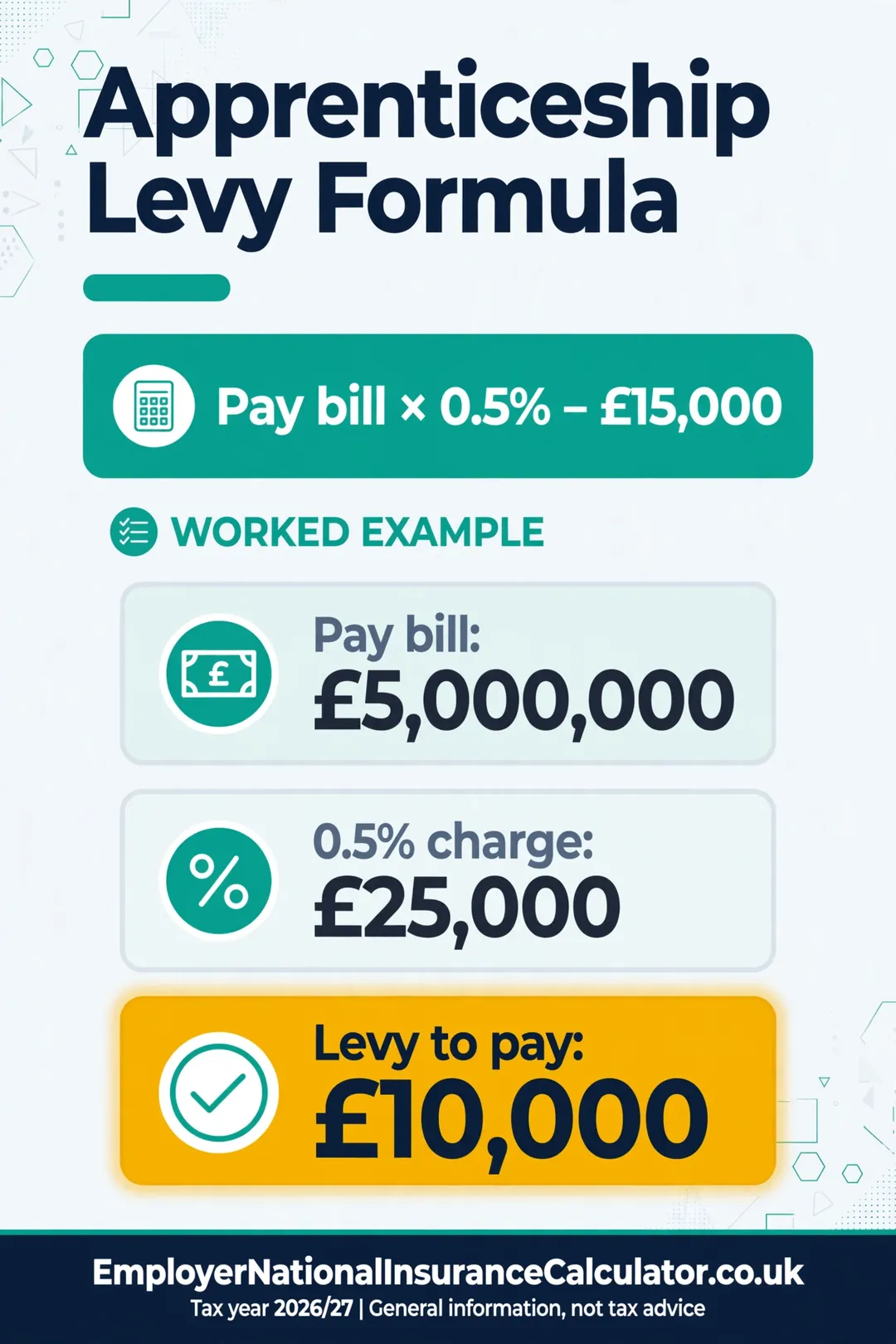
Levy = (annual pay bill × 0.5%) − £15,000
Your pay bill is all pay that is liable to employer Class 1 National Insurance. That includes wages, bonuses and commission. It also covers employees under 21 and apprentices under 25, even though you pay no employer NI on them. The levy is paid monthly with your PAYE bill.
Examples
| Annual pay bill | 0.5% charge | Allowance | Levy per year |
|---|---|---|---|
| £2,000,000 | £10,000 | £15,000 | £0 |
| £3,000,000 | £15,000 | £15,000 | £0 |
| £5,000,000 | £25,000 | £15,000 | £10,000 |
| £10,200,000 | £51,000 | £15,000 | £36,000 |
| £25,000,000 | £125,000 | £15,000 | £110,000 |
| £50,000,000 | £250,000 | £15,000 | £235,000 |
At £3 million the charge equals the allowance, so that is where the levy begins to bite. Above it, the levy is 0.5% of every extra pound of pay bill.
What counts as your pay bill
The pay bill is all earnings liable to employer Class 1 NI in the tax year. It includes:
- Wages and salaries, bonuses, commission and overtime
- Statutory pay such as maternity and sick pay
- Pay for staff under 21 and apprentices under 25, even though employer NI on them is 0%
- Payments to directors and agency workers on your payroll
It does not include employer pension contributions, benefits reported on a P11D, or payments to the self-employed.
The levy covers pay for UK staff only. It is the same figure on which employer NI is due, before any relief. A quick check: your pay bill is the total of “earnings subject to employer Class 1 NI” on your payroll reports for the year.
Estimating your pay bill from headcount
If you do not have the exact figure, multiply the number of staff by their average pay.
| Staff | Average pay | Estimated pay bill | Levy |
|---|---|---|---|
| 60 | £30,000 | £1,800,000 | £0 |
| 100 | £30,000 | £3,000,000 | £0 |
| 120 | £35,000 | £4,200,000 | £6,000 |
| 250 | £32,000 | £8,000,000 | £25,000 |
| 500 | £30,000 | £15,000,000 | £60,000 |
A business crosses the £3 million line at roughly 100 staff on £30,000. The calculator has a “work it out from staff” mode for this.
How the allowance works month by month
The £15,000 allowance is spread across the year at £1,250 a month. The levy is calculated on a running total through the tax year. If your pay bill is £400,000 in a month, the levy for that month is £2,000 and the allowance cuts it to £750.
| Month’s pay bill | 0.5% charge | Monthly allowance | Levy for the month |
|---|---|---|---|
| £200,000 | £1,000 | £1,250 | £0 |
| £250,000 | £1,250 | £1,250 | £0 |
| £400,000 | £2,000 | £1,250 | £750 |
| £1,000,000 | £5,000 | £1,250 | £3,750 |
Because the calculation is cumulative, a quiet month can bring a refund of earlier levy if the running total falls below the allowance.
Connected companies
If you run several companies that are connected, they share one £15,000 allowance. So a group can owe levy even when each company’s pay bill is under £3 million. The same connection idea applies to Employment Allowance, so read the eligibility rules together.
Example: a group of companies
Three connected companies each have a pay bill of £2.5 million. Individually, each is below £3 million. Together the pay bill is £7.5 million.
- Levy at 0.5%: £37,500
- Less one shared allowance of £15,000
- Levy to pay: £22,500
The group decides how to split the allowance among the companies. Many groups put it all on one company.
How the levy and employer NI differ
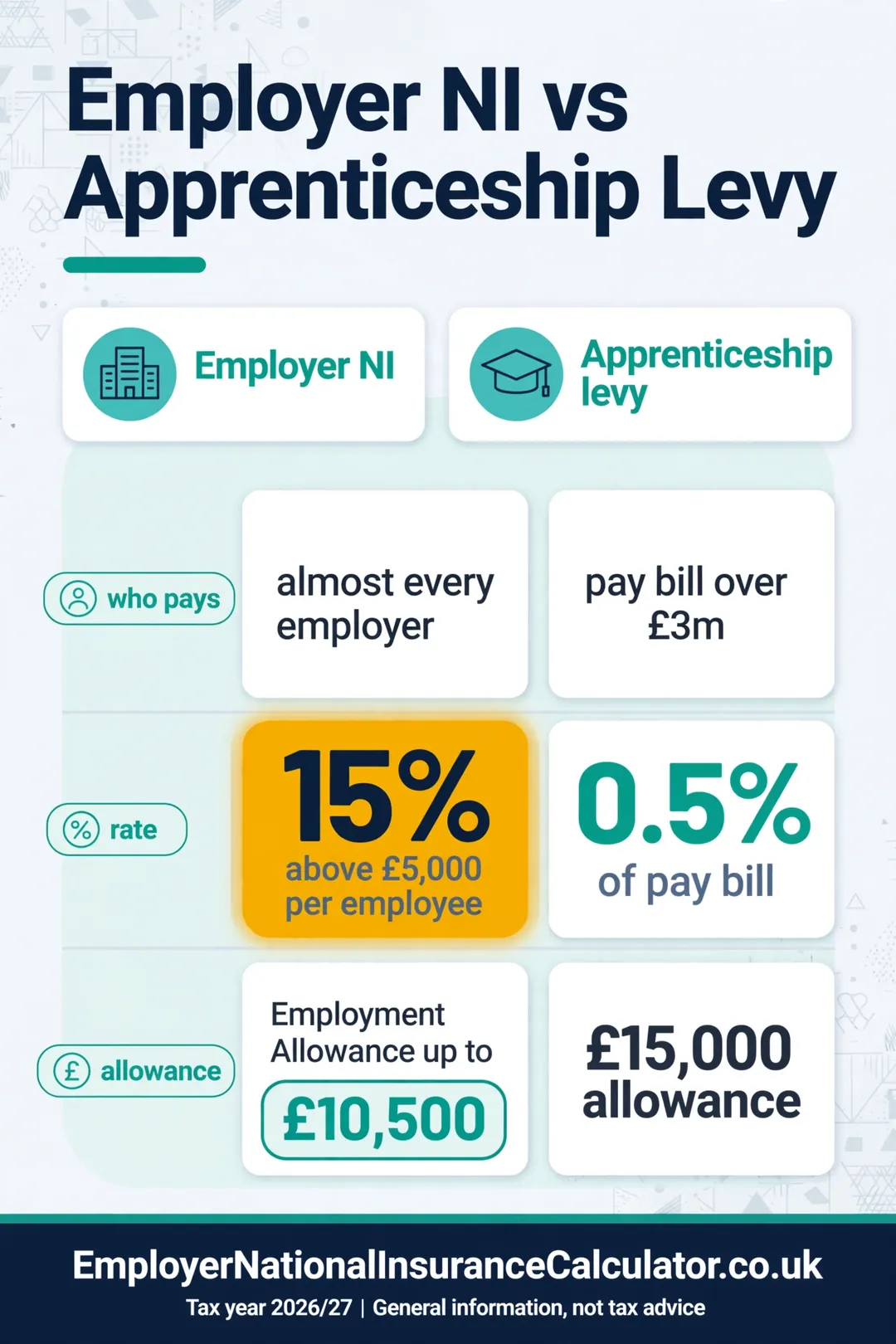
| Employer NI | Apprenticeship levy | |
|---|---|---|
| Who pays | Almost every employer | Employers with a pay bill over £3 million |
| Rate | 15% above £5,000 per employee | 0.5% of the whole pay bill |
| Allowance | Employment Allowance, up to £10,500 | £15,000 |
| Paid on staff at 0% NI | No | Yes, the pay still counts |
Apprentices under 25 can also attract no employer NI. Read about that in employer NI for apprentices.
What the levy gets you
Levy payers can use their payments to fund apprenticeship training through the government’s apprenticeship service. In England, the government adds a 10% top-up to levy funds each month. Funds expire 24 months after they are paid in, so plan the spend.
| Levy paid in | With the 10% top-up |
|---|---|
| £10,000 | £11,000 |
| £36,000 | £39,600 |
| £110,000 | £121,000 |
Scotland, Wales and Northern Ireland run their own apprenticeship systems, so the rules for spending the money differ. Check the current guidance on GOV.UK before you plan spend. Employers who do not pay the levy can still get funding towards apprenticeship training, and the government pays most of the cost for small employers.
Worked example: a mid-size employer
A care group has 250 staff paid £32,000 on average.
- Pay bill: 250 × £32,000 = £8,000,000.
- Levy at 0.5%: £40,000.
- Less the allowance: £40,000 − £15,000 = £25,000 a year.
- With the 10% top-up, £27,500 of apprenticeship funding is available each year.
- That is about £2,083 a month going into the digital account.
If the group trains six apprentices at £9,000 each over the year, it can use £54,000 of funding, so it should plan to use levy funds across several years.
Quick check: do you need to worry?
- Add up your annual pay bill.
- If it is below £3 million and you are not connected to other companies, you almost certainly pay no levy.
- If it is near £3 million, test the numbers with the calculator.
- If you run a group, add all connected companies together.
- If you pay the levy, set up your apprenticeship service account and plan how to spend the funds before they expire.
Where the levy fits in your costs
The levy is on top of employer NI. A large employer might pay both. See the cost of employing someone for the NI side and apprentice NI relief for how apprentices are treated. For the thresholds that decide NI, see the thresholds page.
Frequently asked questions
Who pays the apprenticeship levy?
Employers with a UK pay bill over £3 million a year. The levy is 0.5% of the pay bill, with a £15,000 allowance taken off.
Is the levy part of employer National Insurance?
No. It is a separate charge, collected through PAYE. The pay bill it is based on is the pay that is liable to employer Class 1 NI.
Can I use the £15,000 allowance to pay for training?
No. The allowance only reduces the amount you owe. It cannot be spent on apprenticeship training.
What if my pay bill is under £3 million?
You normally pay no levy. You may still get government funding towards apprenticeship training.
How do I know if I owe the apprenticeship levy?
Add up the annual pay bill for your company and any connected companies. If the total is over £3 million, the 0.5% charge minus the £15,000 allowance is due.
Is the levy paid monthly or yearly?
Monthly, with your PAYE bill. It is calculated cumulatively through the year.
Do I pay the levy on staff who attract 0% employer NI?
Yes. The levy is based on pay liable to employer Class 1 NI, even if the rate for that employee is 0%.
Is the apprenticeship levy tax deductible?
It is generally treated as a deductible expense for corporation tax. Check with your accountant for your case.
Does the levy change if I hire more apprentices?
Not directly. The levy depends on your pay bill, not on how many apprentices you employ.
What happens to unspent levy funds?
Funds in your apprenticeship service account expire 24 months after they are added, oldest first. Spend them on approved training before then.
Does the Employment Allowance reduce the levy?
No. Employment Allowance reduces employer NI only. The levy has its own £15,000 allowance.
Related guides
- Employer NI for Apprentices (2026/27): Category H
- Employer NI Thresholds 2026/27: Weekly, Monthly, Yearly
- Cost of Employing Someone UK 2026/27: Calculator
- Employment Allowance Eligibility: Who Can Claim?
Official sources
- Pay apprenticeship levy
- HMRC: Rates and thresholds for employers 2026 to 2027
This page is independent information, not tax advice, and has no link with HMRC. Figures were checked on 20 October 2026 for the 2026/27 tax year. Always confirm the final figures with HMRC or your payroll provider.