Employer NI Veterans Relief (2026/27): Category V
Employer NI calculator
Add each pay level in your team. Get the bill, the cost and the working.
Loading the calculator…
Estimate only. Independent tool, not affiliated with HMRC. Rates checked 20 October 2026. Real payroll rounds each pay period.
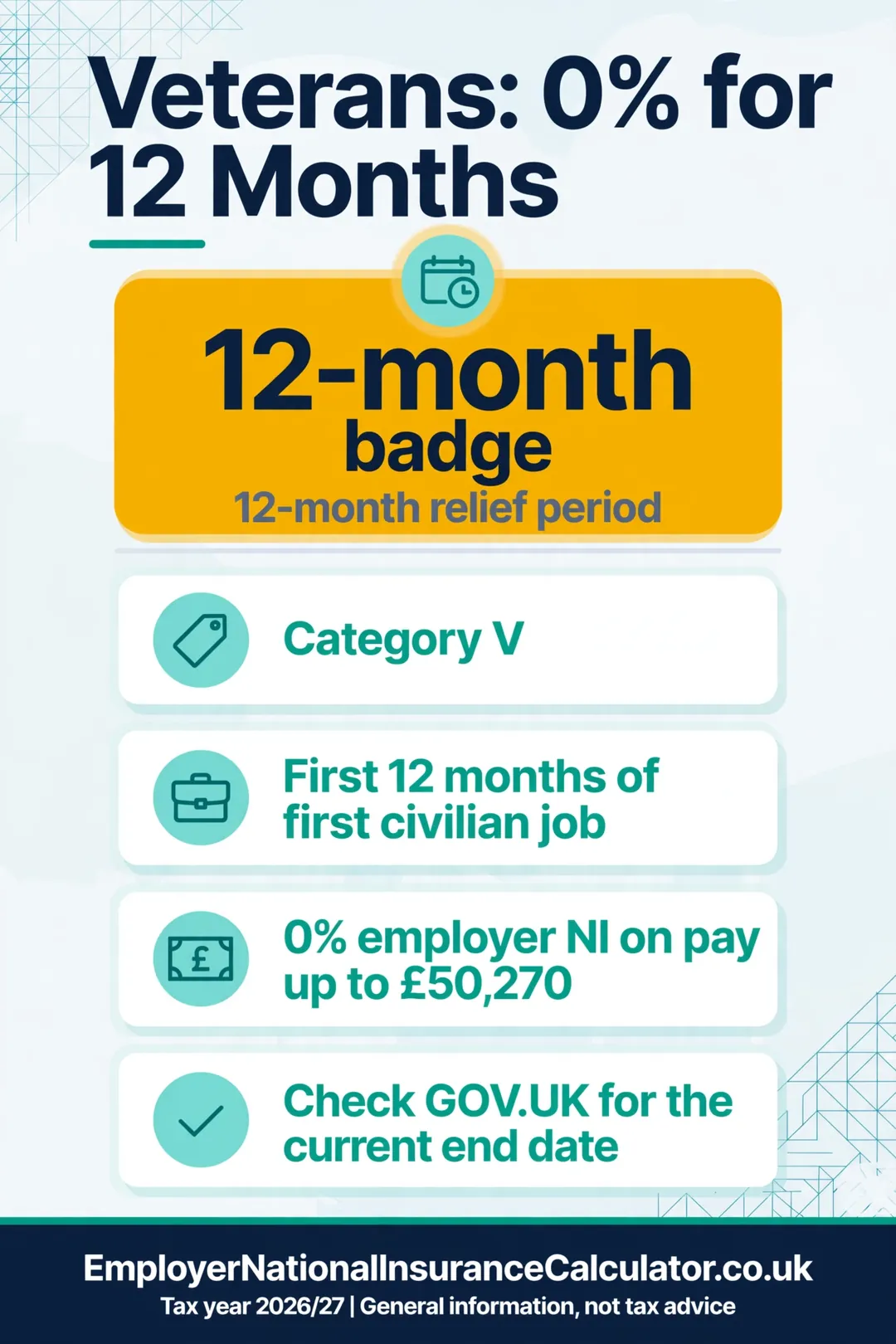
Employers pay no National Insurance on a veteran’s pay up to £50,270 a year, for the first 12 months of the veteran’s first civilian job. The relief uses NI category V. For a veteran on £35,000, it saves £4,500 in the year. Try the calculator above, then read who counts as a veteran, what proof to keep and how to set it up.
In this guide16 sections
Who counts as a veteran
A veteran is someone who has served in the UK armed forces, including the regulars and reserves, and who is now in their first civilian employment since leaving. The relief covers the first 12 months of that job. Only the first civilian job after leaving counts, so if the veteran has worked elsewhere in civilian life, they may not qualify.
The government has announced an extension to this relief. Check the current GOV.UK page for the end date and the exact definition before you plan, as the rules can change.
How much you save
| Veteran’s pay | Standard employer NI | Category V | Saving over 12 months |
|---|---|---|---|
| £25,000 | £3,000 | £0 | £3,000 |
| £35,000 | £4,500 | £0 | £4,500 |
| £45,000 | £6,000 | £0 | £6,000 |
| £60,000 | £8,250 | £1,459.50 | £6,790.50 |
Proof you need
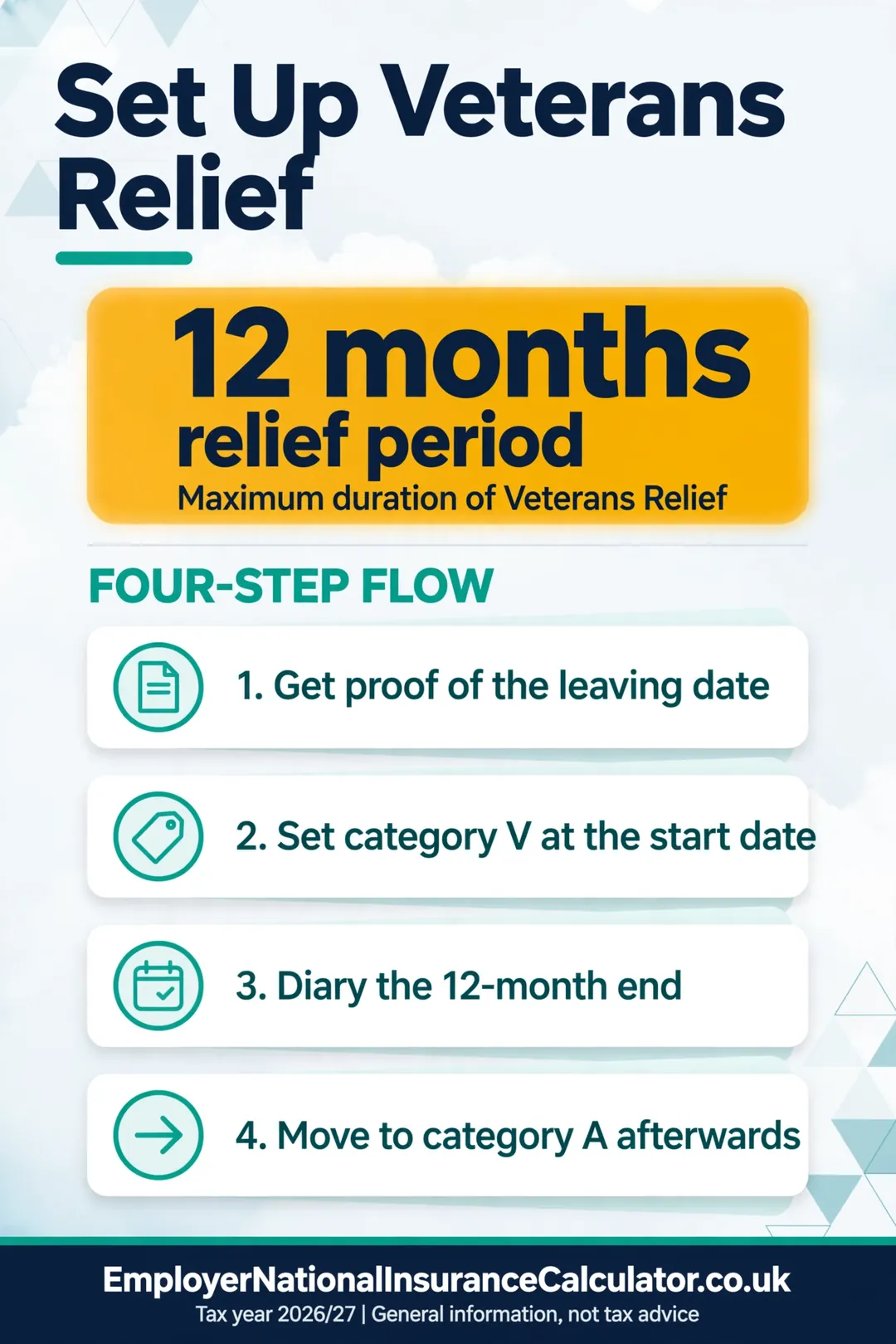
Ask the veteran for evidence of their leaving date from the armed forces, usually a discharge document or a service leaver’s paper. You also need to know that this is their first civilian role. Keep a copy with your payroll records. The employer decides, so make sure the file stands up to a check.
| Document | Why you need it |
|---|---|
| Service leaver paperwork | Shows the date of leaving |
| CV or application | Shows this is the first civilian job |
| Payroll note | Records the V category start date |
Setting it up in payroll
- Set the NI category to V from the date they start.
- Diary the 12-month end date.
- Move them to category A on the first pay period after the 12 months end.
- If your software asks for a veteran date, enter the first day of civilian employment.
What if the veteran changes jobs?
The relief is tied to the veteran’s first 12 months of civilian employment. If they move to a new employer inside that period, check with HMRC whether the new employer can claim the rest. Do not assume it carries over.
Veterans and other reliefs
A veteran may also fit another relief category, such as apprentice. Use one category at a time. The result is the same 0% rate up to £50,270.
Case study: five veteran hires
A security firm hires five veterans on £32,000 each.
| Item | Per person | For five |
|---|---|---|
| Standard employer NI | £4,050 | £20,250 |
| With category V | £0 | £0 |
| Saving in the first 12 months | £4,050 | £20,250 |
After 12 months, each moves to category A, and the firm pays £4,050 a year per person. Plan for the change in your budget.
What happens in month 13
| Months 1 to 12 | From month 13 | |
|---|---|---|
| Category | V | A |
| Employer NI per month on £32,000 | £0 | £337.50 |
| Five veterans, per month | £0 | £1,687.50 |
Employment Allowance can absorb part of this. Five veterans on £32,000 would produce a bill of £20,250 a year, which is within the £10,500 allowance if nothing else is on the payroll. See the allowance guide.
Why employers hire veterans
Veterans bring skills that suit many roles, from logistics to security to management. The NI relief is a bonus, not the main reason to hire, but it makes the first year cheaper. Compare it with the under-21 and apprentice reliefs when you plan your team, and use the calculator with category V to see your own saving.
Mistakes to avoid
- Forgetting to change the letter after 12 months.
- Applying the relief to a veteran’s second civilian job without checking.
- Not keeping proof of the leaving date.
- Assuming the veteran’s own NI is lower. It is not.
Planning pay for a veteran hire
Because the relief ends after 12 months, the second year costs more than the first. Budget for both from the start.
| Salary | Year 1 employer NI (category V) | Year 2 employer NI (category A) | Step-up |
|---|---|---|---|
| £28,000 | £0 | £3,450 | £3,450 |
| £35,000 | £0 | £4,500 | £4,500 |
| £45,000 | £0 | £6,000 | £6,000 |
A pay rise at the 12-month mark adds 15% on top of the raise. A £2,000 raise costs £2,300 once employer NI is included.
A simple hiring checklist
- Ask for the leaving date at the offer stage, so you can plan the 12-month window.
- Keep a copy of the service documents in the personnel file.
- Set category V from the first pay date.
- Add a 12-month reminder to payroll.
- Check the current GOV.UK rules on the end date of the relief before you rely on it.
What counts as the first civilian job
The test is about the veteran’s first employment after leaving the forces. If a veteran has done other paid civilian work since leaving, check with HMRC before applying category V. A reasonable file note records when they left, the date they started with you and any other work in between.
Frequently asked questions
What is the NI relief for veterans?
Employers pay 0% on pay up to £50,270 in the first 12 months of a veteran’s first civilian job.
What is the category letter?
V.
How do I prove a veteran qualifies?
Keep evidence of their discharge date and of the start of their first civilian job.
Does it apply to reservists?
Check GOV.UK for the current definition of a veteran. Rules on who is covered can change.
Do veterans pay less employee NI?
No. Employee NI is the same as for other employees.
Has the relief been extended?
The government has announced an extension. Check GOV.UK for the current end date.
Does the relief apply if the veteran was self-employed first?
Check the current GOV.UK rules for what counts as the first civilian employment.
Can I claim the relief for a veteran I hired six months ago?
Yes, for the remaining months, if they meet the rules. Change the letter from the next pay period and tell your adviser about earlier months.
Where can I find support when hiring a veteran?
GOV.UK and armed forces charities list guidance for employers.
Does the relief apply above £50,270?
No. Pay above £50,270 is charged at 15%.
Related guides
- Employer NI Exemptions and Reliefs 2026/27
- NI Category Letters for Employers (2026/27)
- Employer NI for Under 21s (2026/27): 0% to £50,270
- Employer NI for Apprentices (2026/27): Category H
- Employer National Insurance Calculator 2026/27
Official sources
- National Insurance rates and categories
- HMRC: Rates and thresholds for employers 2026 to 2027
This page is independent information, not tax advice, and has no link with HMRC. Figures were checked on 20 October 2026 for the 2026/27 tax year. Always confirm the final figures with HMRC or your payroll provider.