How to Claim Employment Allowance (Step by Step)
You claim Employment Allowance through your payroll software by sending an Employer Payment Summary (EPS) to HMRC with the Employment Allowance indicator set to yes. There is no separate form. You can claim at any time in the tax year, and often for up to four years back. This guide gives the steps, shows what the credit looks like on your bill and covers backdated claims.
In this guide16 sections
Before you start
Check three things.
- You are an eligible employer. See the eligibility rules.
- You run PAYE through payroll software that can send an EPS. Most commercial packages and HMRC’s Basic PAYE Tools can.
- You know whether any connected company has already claimed.
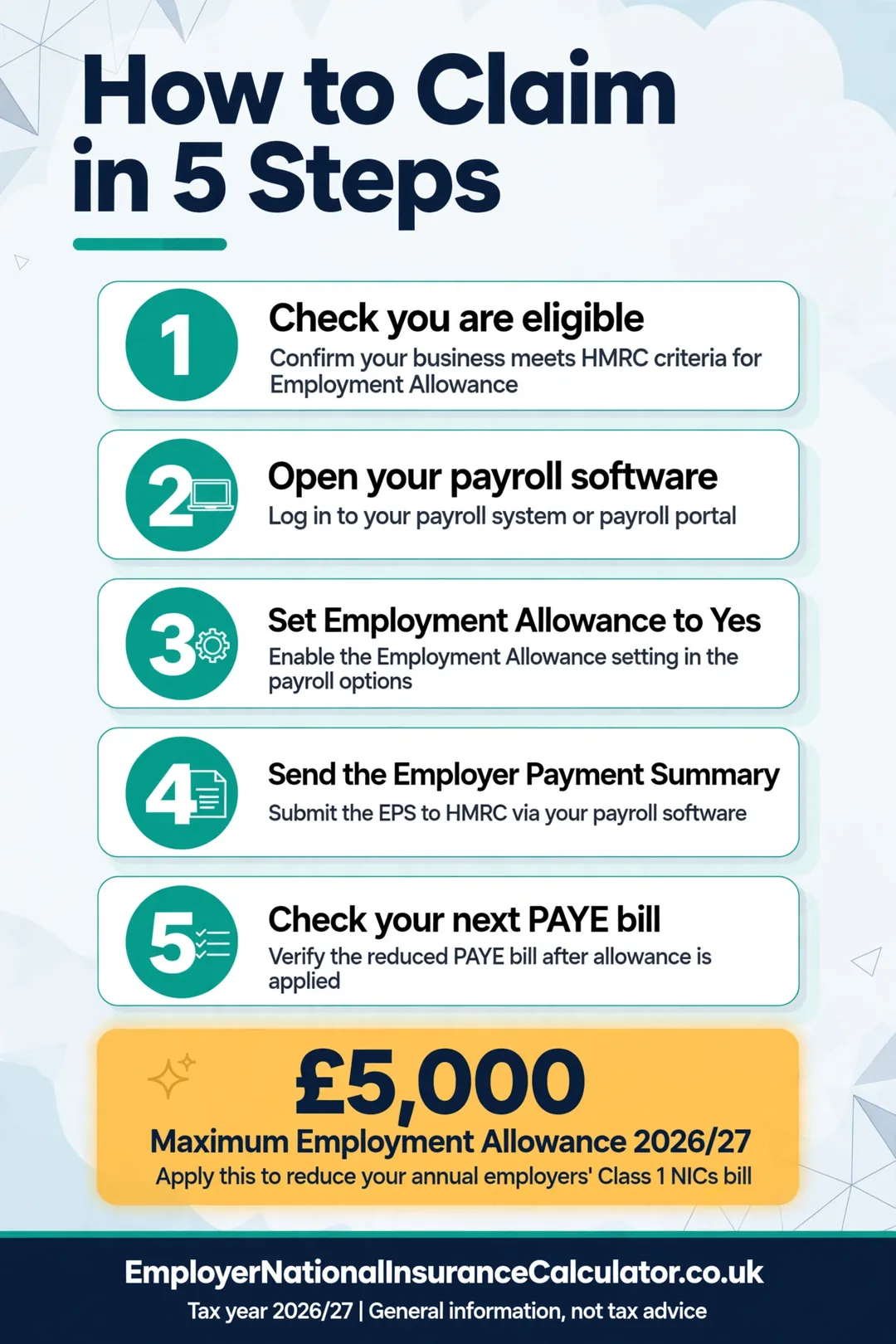
Step by step: claim for the current year
- Open your payroll software and find the Employment Allowance setting. It may be under company settings, EPS or HMRC settings.
- Choose “Yes” for Employment Allowance, and confirm that you are not excluded.
- If your software asks for an amount, enter £10,500.
- Send the EPS to HMRC, or run the next payroll with the indicator on.
- Check the next payment calculation. Your PAYE bill should show the allowance credit.
When to claim
Claim at the start of the tax year, with your first payroll run in April. You can claim later, but you then pay the full bill until you claim. HMRC applies the credit to your bills for the year, and you get an offset or a refund.
How the credit appears
Your monthly bill shows the employer NI due less the allowance used. If your monthly NI is £1,200, then in the first month your bill shows £1,200 of NI and an Employment Allowance credit of £1,200. The next payment shows the same, until £10,500 is gone. You still pay employee NI and PAYE tax.
Worked example
A shop has three staff on £24,000. Monthly employer NI is £712.50 (£2,850 each a year, divided by 12 and multiplied by 3). In April the owner turns on the allowance.
| Month | NI due | Allowance applied | You pay |
|---|---|---|---|
| Each of the 12 months | £712.50 | £712.50 | £0 |
| Total for the year | £8,550 | £8,550 | £0 |
The allowance of £10,500 covers it all, with £1,950 unused. That unused amount is lost at the end of the year. See the Employment Allowance guide.
A second example: the allowance runs out
A firm has 12 staff on £30,000. Monthly employer NI is £3,750.
| Month | NI due | Allowance left at start | Allowance applied | You pay |
|---|---|---|---|---|
| April | £3,750 | £10,500 | £3,750 | £0 |
| May | £3,750 | £6,750 | £3,750 | £0 |
| June | £3,750 | £3,000 | £3,000 | £750 |
| July onward | £3,750 | £0 | £0 | £3,750 |
Over the year the firm pays £34,500, which is the bill of £45,000 less the allowance.
Claiming for earlier years
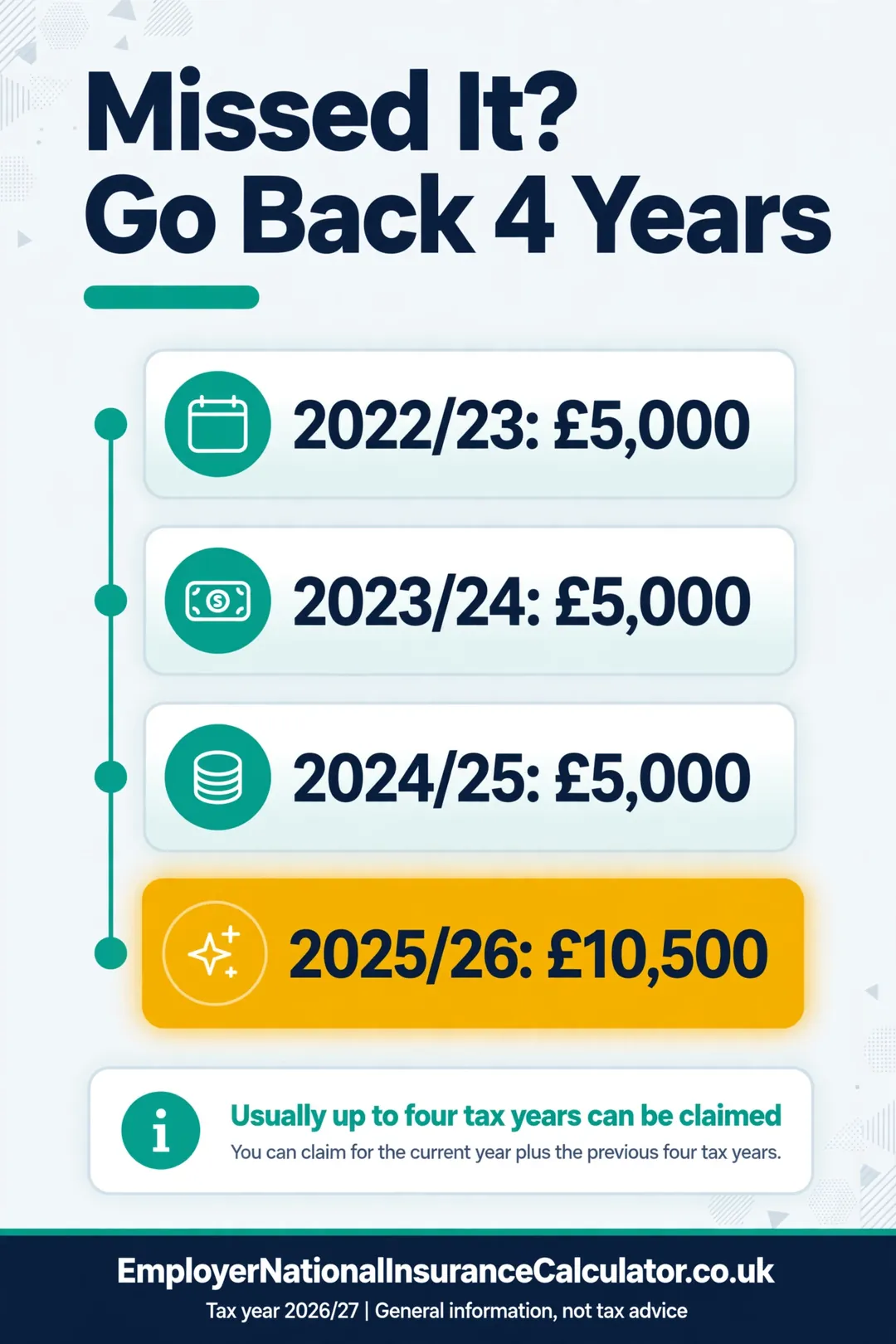
If you missed a claim, you can usually go back up to four tax years. The steps depend on the year.
- Check you were eligible in that year and that the allowance was not already claimed.
- Send an amended EPS using payroll software that covers that tax year, or contact HMRC.
- HMRC credits the amount to your account. You can ask for a refund or leave it against future bills.
The amount you can claim depends on the year:
| Tax year | Allowance | Eligibility cap |
|---|---|---|
| 2022/23 | £5,000 | Employer NI bill under £100,000 in the year before |
| 2023/24 | £5,000 | Employer NI bill under £100,000 in the year before |
| 2024/25 | £5,000 | Employer NI bill under £100,000 in the year before |
| 2025/26 | £10,500 | None |
| 2026/27 | £10,500 | None |
See the rates history and how to claim back employer NI.
A backdated claim in numbers
A small design studio employed three staff from 2021 and never claimed. It asks its accountant to check in October 2026. It was eligible each year, and its employer NI bills were £4,200 for 2022/23, £4,600 for 2023/24, £5,400 for 2024/25 and £8,900 for 2025/26.
| Year | Employer NI paid | Allowance available | Claimable |
|---|---|---|---|
| 2022/23 | £4,200 | £5,000 | £4,200 |
| 2023/24 | £4,600 | £5,000 | £4,600 |
| 2024/25 | £5,400 | £5,000 | £5,000 |
| 2025/26 | £8,900 | £10,500 | £8,900 |
| Total | £22,700 |
The allowance can never be more than the NI you actually paid for that year. Your own figures will differ.
Common errors
| Error | What goes wrong | Fix |
|---|---|---|
| Tick box missed in April | You overpay each month | Send an EPS now |
| Claiming as a sole-director company | HMRC asks for repayment | Correct and repay |
| Claiming twice in a group | Over-claimed amount | Pick one company and correct |
| Wrong software setting | Allowance not applied | Check settings and resend |
| Sending the EPS before the first payroll | Software may reject it | Run the first payroll, then send |
| Forgetting it again next April | Overpay for months | Add a reminder to your payroll checklist |
Checking that it worked
After you send the claim, check three things.
- The next payment summary in your software should show the allowance used.
- Your HMRC online account should show the credit against the bill.
- The figure on the next payment should be lower by the NI you would otherwise have paid.
If anything is off, resend the Employer Payment Summary.
If you use an accountant or bureau
Ask them to confirm the claim in writing. Make sure they have checked eligibility. Keep a copy of the confirmation.
Documents to gather
- Payroll summaries for each year
- Proof of your PAYE reference
- Notes on who was paid and when
- Any earlier letters from HMRC
What next
Once the claim is in, plan your cash flow for the month the allowance runs out. See how to pay employer NI for deadlines and payment methods.
Frequently asked questions
How do I claim Employment Allowance?
Set the Employment Allowance indicator to yes in your payroll software and send an Employer Payment Summary to HMRC.
Is there a form to fill in?
No. It is done through payroll software, not a paper form or a separate online application.
Can I claim in the middle of the year?
Yes. You can claim at any point in the tax year. HMRC then applies it against your NI.
How far back can I claim?
Usually four tax years. Check the rules for the year in question.
Do I need to claim each year?
Yes. Tick the indicator again at the start of each tax year.
Where does the money go?
It reduces your PAYE bill. If you have overpaid, HMRC can offset it against future bills or refund it.
Does an accountant need to do it?
No, but many small firms use one. It takes only a few minutes if you run payroll yourself.
What if my payroll software does not show an option?
Update it, or contact the provider. HMRC’s free Basic PAYE Tools support the claim as well.
Can I claim for a year in which I had only one employee, who was a director?
No. The sole director rule applies. See the eligibility rules.
Do I have to claim before the first payday?
No, but claiming with your first payroll run means you never pay the full bill.
Can I switch the allowance off if I made a mistake?
Yes. Send a corrected EPS with the indicator set to no, and ask HMRC how to repay anything already used.
Related guides
- Employment Allowance 2026/27: £10,500 Off Employer NI
- Employment Allowance Eligibility: Who Can Claim?
- Can You Claim Back Employer NI? Yes, in These Cases
- Employer NI Rates 2025/26: Rates and Thresholds
- How and When to Pay Employer NI to HMRC
Official sources
This page is independent information, not tax advice, and has no link with HMRC. Figures were checked on 20 October 2026 for the 2026/27 tax year. Always confirm the final figures with HMRC or your payroll provider.
One Comment
Comments are closed.