Employer NI Thresholds 2026/27: Weekly, Monthly, Yearly
Employer NI starts when pay passes the Secondary Threshold, which is £5,000 a year in 2026/27. That is £417 a month or £96 a week. Four other limits matter for payroll. This page lists all of them, explains what each one does, and shows how they work together.
In this guide21 sections
All the 2026/27 thresholds
| Threshold | Weekly | Monthly | Yearly |
|---|---|---|---|
| Lower Earnings Limit (LEL) | £129 | £559 | £6,708 |
| Secondary Threshold (ST) | £96 | £417 | £5,000 |
| Primary Threshold (PT) | £242 | £1,048 | £12,570 |
| Freeport and Investment Zone Upper Secondary Threshold | £481 | £2,083 | £25,000 |
| Upper Secondary Threshold (UST) | £967 | £4,189 | £50,270 |
For a four-weekly pay period, the Secondary Threshold is £385.
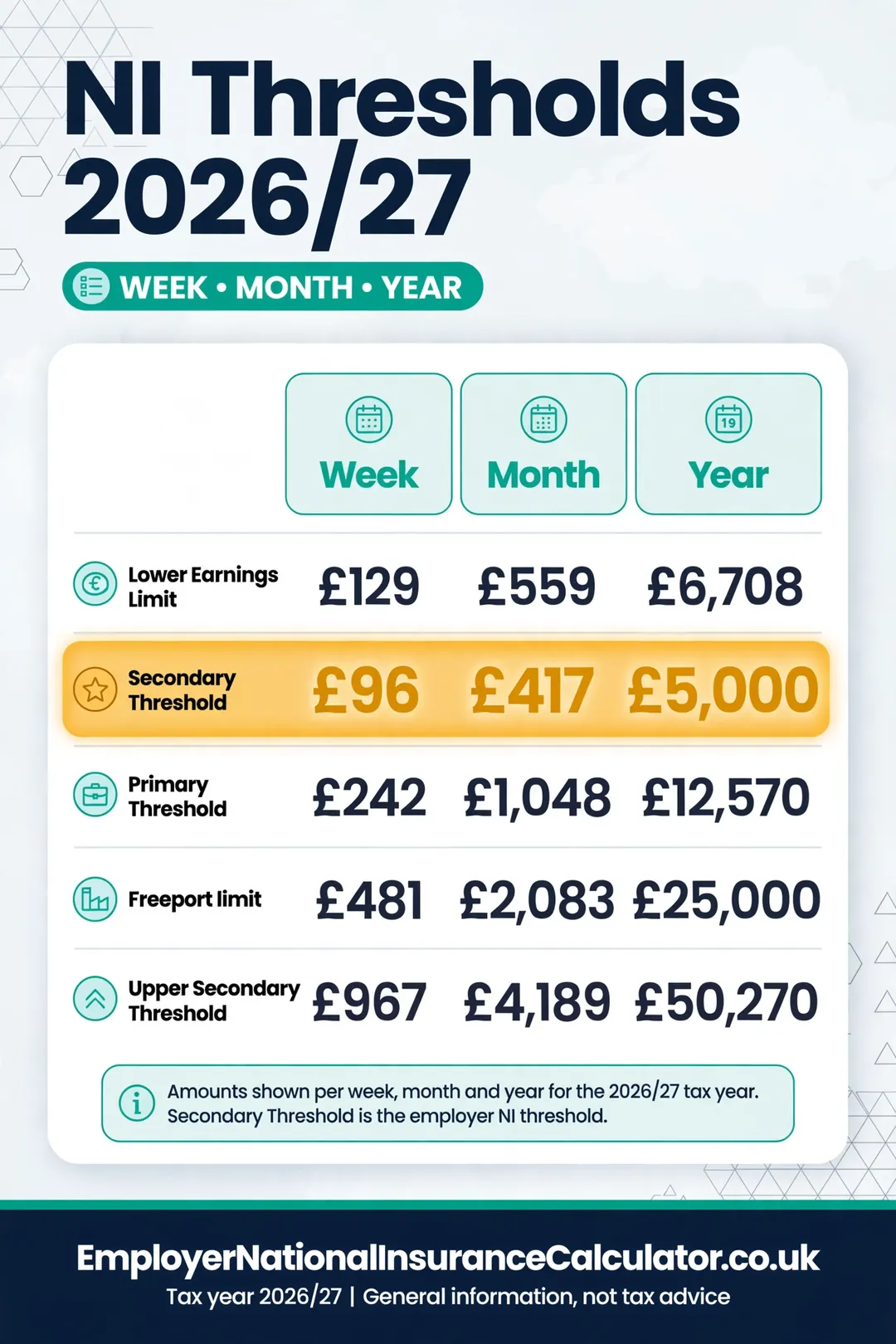
What each threshold does
Lower Earnings Limit. Pay at or above this level earns a qualifying year towards the State Pension, even if no NI is paid.
Secondary Threshold. Employers start paying 15% on pay above this level.
Primary Threshold. Employees start paying 8% on pay above this level.
Freeport and Investment Zone limit. Eligible staff attract 0% employer NI up to this level.
Upper Secondary Threshold. Under-21s, apprentices under 25 and veterans attract 0% employer NI up to this level.
How the thresholds fit together
Think of annual pay as a ladder. Each rung switches something on.
| Pay (per year) | What happens |
|---|---|
| £5,000 | Employer NI starts at 15% (standard employees) |
| £6,708 | The employee earns a qualifying year for the State Pension |
| £12,570 | The employee starts paying 8% NI and income tax |
| £25,000 | Freeport relief ends. 15% applies above this level for those staff |
| £50,270 | Employee NI drops to 2%. Relief for under-21s, apprentices and veterans ends |
Employer NI at 15% on standard employees applies from £5,000 upwards, with no top limit. The ladder shows where the special rates and limits sit around it.
A quick example
An employee earns £2,000 in a month. The Secondary Threshold is £417, so £1,583 is above it. Employer NI is £1,583 × 15% = £237.45. The employee’s own NI starts at £1,048 a month, so they pay 8% on £952, which is £76.16. That comes out of their pay and is not your cost.
The freeze
The Secondary Threshold is frozen at £5,000 until April 2031. It was £9,100 until April 2025. A fixed threshold means a pay rise adds 15p of employer NI for each extra pound of pay.
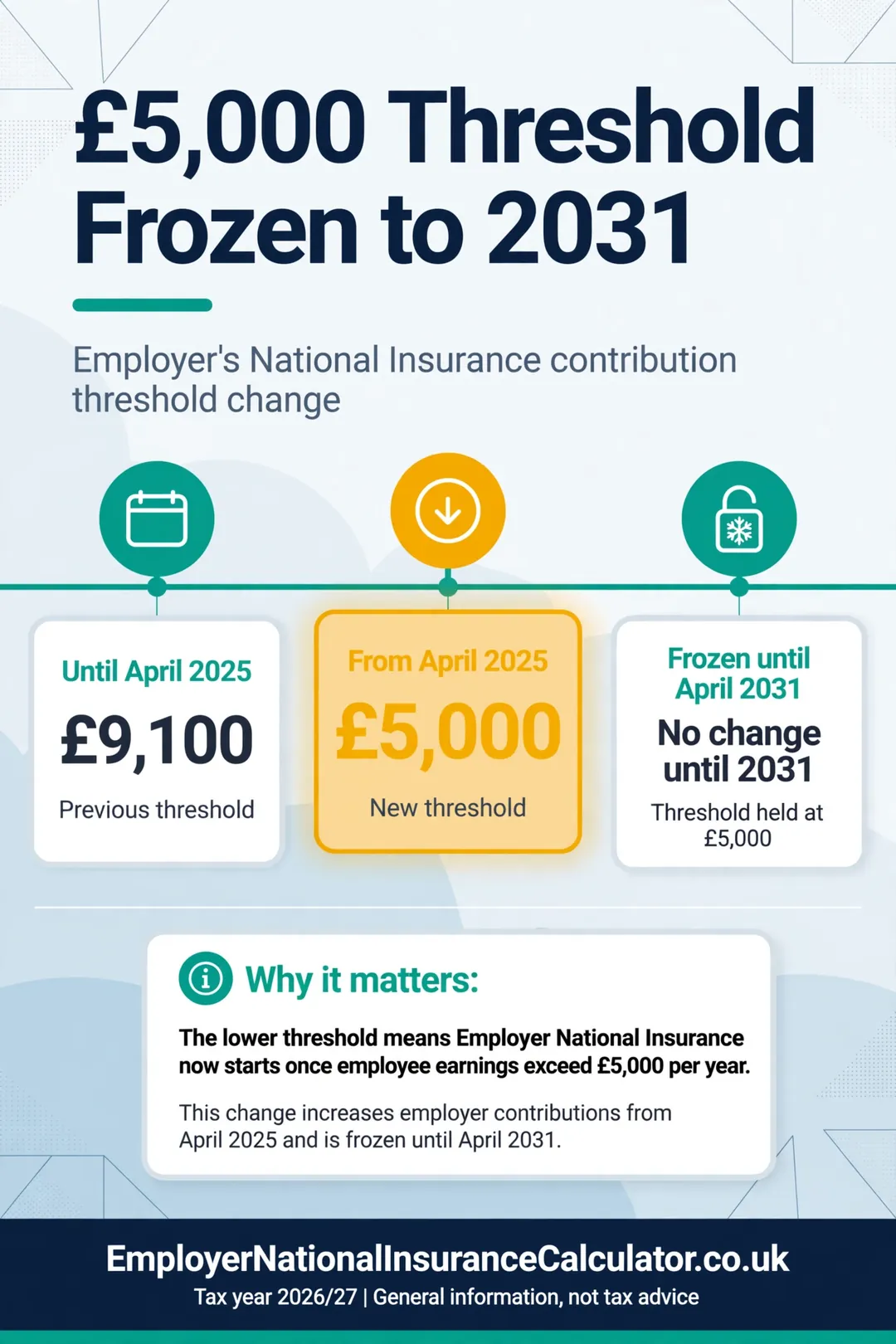
How the thresholds have moved
| Tax year | LEL | Secondary Threshold | Primary Threshold | UST |
|---|---|---|---|---|
| 2023/24 | £6,396 | £9,100 | £12,570 | £50,270 |
| 2024/25 | £6,396 | £9,100 | £12,570 | £50,270 |
| 2025/26 | £6,500 | £5,000 | £12,570 | £50,270 |
| 2026/27 | £6,708 | £5,000 | £12,570 | £50,270 |
The big move was the Secondary Threshold, which fell by £4,100 in April 2025. The rest are the same or rising slowly. See the rate history for the full picture.
How weekly and monthly thresholds are worked out
HMRC divides the yearly figure by 52 for weekly pay, by 12 for monthly pay and by 13 for four-weekly pay. It then rounds to the nearest pound.
| Threshold | Yearly | Weekly (÷ 52) | Four-weekly (÷ 13) | Monthly (÷ 12) |
|---|---|---|---|---|
| Secondary Threshold | £5,000 | £96.15 → £96 | £384.62 → £385 | £416.67 → £417 |
| Primary Threshold | £12,570 | £241.73 → £242 | £966.92 → £967 | £1,047.50 → £1,048 |
| Lower Earnings Limit | £6,708 | £129 | £516 | £559 |
| UST | £50,270 | £966.73 → £967 | £3,866.92 → £3,867 | £4,189.17 → £4,189 |
Because of the rounding, 12 months of £417 add up to £5,004, not £5,000. That is why monthly sums come out a few pounds different from the yearly sum. It is normal and HMRC expects it.
Why the numbers differ between tools
Payroll software rounds weekly and monthly thresholds to whole pounds. The exact yearly threshold divided by 12 is £416.67, but HMRC uses £417. So you may see differences of a few pence. Your payroll software is right for filing. Use the monthly calculator for planning.
Which threshold applies to which person
| Employee | Employer NI starts at | Employee NI starts at |
|---|---|---|
| Standard employee (category A) | £5,000 | £12,570 |
| Under 21 (category M) | £50,270 | £12,570 |
| Apprentice under 25 (category H) | £50,270 | £12,570 |
| Veteran, first year (category V) | £50,270 | £12,570 |
| Freeport or Investment Zone (F, I, L, S) | £25,000 | £12,570 |
Employee NI is 8% between £12,570 and £50,270 and 2% above £50,270.
Example: someone earning £14,000
- Employer NI: (£14,000 − £5,000) × 15% = £1,350
- Employee NI: (£14,000 − £12,570) × 8% = £114.40
- State Pension credit: £14,000 is above the £6,708 LEL, so the year counts
This shows why a small salary can still cost an employer well over £1,000 a year.
Part-time and low-paid staff
An employee paid between £6,708 and £12,570 pays no NI themselves but still earns a qualifying year. If the same person earns between £5,000 and £6,708, you pay employer NI on the part above £5,000, but they do not earn a qualifying year. Some employers raise pay to the LEL for this reason. Doing so costs 15% of the extra, up to £256.20 in employer NI a year.
| Annual pay | Employer NI | Qualifying year? |
|---|---|---|
| £4,800 | £0 | No |
| £5,500 | £75 | No |
| £6,708 | £256.20 | Yes |
| £9,000 | £600 | Yes |
| £12,570 | £1,135.50 | Yes |
Other pay periods
| Pay period | Secondary Threshold |
|---|---|
| Weekly | £96 |
| Two-weekly | £192 |
| Four-weekly | £385 |
| Monthly | £417 |
| Yearly | £5,000 |
Common mistakes with thresholds
- Mixing up the employer and employee thresholds. They are £5,000 and £12,570.
- Using last year’s LEL. It is £6,708 now.
- Forgetting the freeze. The Secondary Threshold will not rise with inflation before April 2031.
- Applying monthly thresholds to directors. Directors use the annual figure.
- Using the wrong threshold for a relief category. Under-21s use £50,270, not £25,000.
How to use the threshold table
For monthly payroll, use the monthly column. For weekly payroll, use the weekly column. For a director or a yearly sum, use the yearly figure. If you pay every four weeks, use £385 for the Secondary Threshold.
Worked example across three thresholds
An employee is paid £3,500 in a month.
| Test | Threshold | Result |
|---|---|---|
| Earns a qualifying year? | LEL £559 | Yes |
| Employer NI due? | ST £417 | Yes, on £3,083 |
| Employee NI due? | PT £1,048 | Yes, on £2,452 |
| Special rate limit reached? | UST £4,189 | No |
Employer NI is £3,083 × 15% = £462.45, and employee NI is £2,452 × 8% = £196.16.
Where thresholds come from
The government sets them each year. The Secondary Threshold is frozen. The other figures follow separate rules, and the Primary Threshold also stays at £12,570. For an overview of what each one triggers, see how employer NI is calculated.
What the freeze means in pounds
Because the threshold stays at £5,000, any pay rise is fully charged. Consider an employee on £30,000.
| Year | Salary | Employer NI | Extra from a 3% rise |
|---|---|---|---|
| 2026/27 | £30,000 | £3,750 | n/a |
| 2027/28 | £30,900 | £3,885 | £135 |
| 2028/29 | £31,827 | £4,024.05 | £139.05 |
If the threshold had risen with inflation, the extra would be a little lower. The gap grows each year. Over five years, the cumulative effect on a team of ten can reach several thousand pounds.
What employers can do
- Budget a little more each year. Assume employer NI rises by 15p for each extra £1 of pay.
- Claim every relief you can. See the exemptions guide.
- Use Employment Allowance. It is a fixed £10,500 and it is also frozen, so its value shrinks in real terms. See the allowance guide.
- Plan salary sacrifice. The 2029 cap changes the maths. See the cap guide.
Frequently asked questions
What is the employer NI threshold for 2026/27?
£5,000 a year, which is £417 a month and £96 a week. Employers pay 15% on pay above it.
Is the employer threshold different from the employee threshold?
Yes. Employees start paying NI at £12,570 a year. Employers start at £5,000.
What is the Upper Secondary Threshold?
£50,270 a year. For under-21s, apprentices under 25 and veterans, employers pay 0% on pay up to this level and 15% above it.
Will the thresholds go up with inflation?
Not yet. The Secondary Threshold is frozen until April 2031. Check what changed in 2026/27 for the latest.
What is the Primary Threshold in 2026/27?
£12,570 a year, £1,048 a month or £242 a week. It is where employee NI at 8% starts.
What is the Lower Earnings Limit for 2026/27?
£6,708 a year, £559 a month or £129 a week.
Why does an employee on £6,000 not get a State Pension year?
Because £6,000 is below the £6,708 LEL. The year only counts once earnings reach the limit.
Do thresholds differ in Scotland or Wales?
No. The National Insurance thresholds are the same across the UK, unlike income tax bands in Scotland.
Which threshold decides whether I pay employer NI?
The Secondary Threshold, £5,000 a year. See the rates page.
Which threshold sets the special 0% limit?
The Upper Secondary Threshold, £50,270. It applies to under-21s, apprentices under 25 and veterans.
Will the Secondary Threshold rise before 2031?
No. It is frozen at £5,000 until April 2031.
Does the freeze apply to the other thresholds?
The Primary Threshold also stays at £12,570. The Lower Earnings Limit changes separately.
What is the two-weekly threshold?
£192. It is twice the weekly figure of £96.
Related guides
- Employer NI Rates 2026/27: All Rates and Thresholds
- Monthly Employer NI Calculator 2026/27
- How Employer National Insurance Is Calculated
- Employer NI vs Employee NI: What Is the Difference?
- National Insurance Changes for 2026/27
Official sources
- National Insurance rates and categories
- HMRC: Rates and thresholds for employers 2026 to 2027
This page is independent information, not tax advice, and has no link with HMRC. Figures were checked on 20 October 2026 for the 2026/27 tax year. Always confirm the final figures with HMRC or your payroll provider.