Is Employer NI on a Payslip? What Employees See
Employer NI does not have to appear on a payslip, and most payslips leave it out. A payslip shows what the employee earns and what is taken from their pay, such as income tax and employee NI. Employer NI is a cost the business pays on top, so it is not a deduction.
This page shows what a payslip contains, how to find the employer figure and what employers can do to make it clear.
In this guide15 sections
What a payslip must show
By law, a payslip must show:
- Gross pay
- Deductions that change from pay to pay, such as tax and NI
- Fixed deductions, either as a total or itemised
- Net pay
- The number of hours worked, if the pay depends on hours
Employer NI is not on this list. Employers can show it as extra information, and a few do, so staff see the full cost of their job.
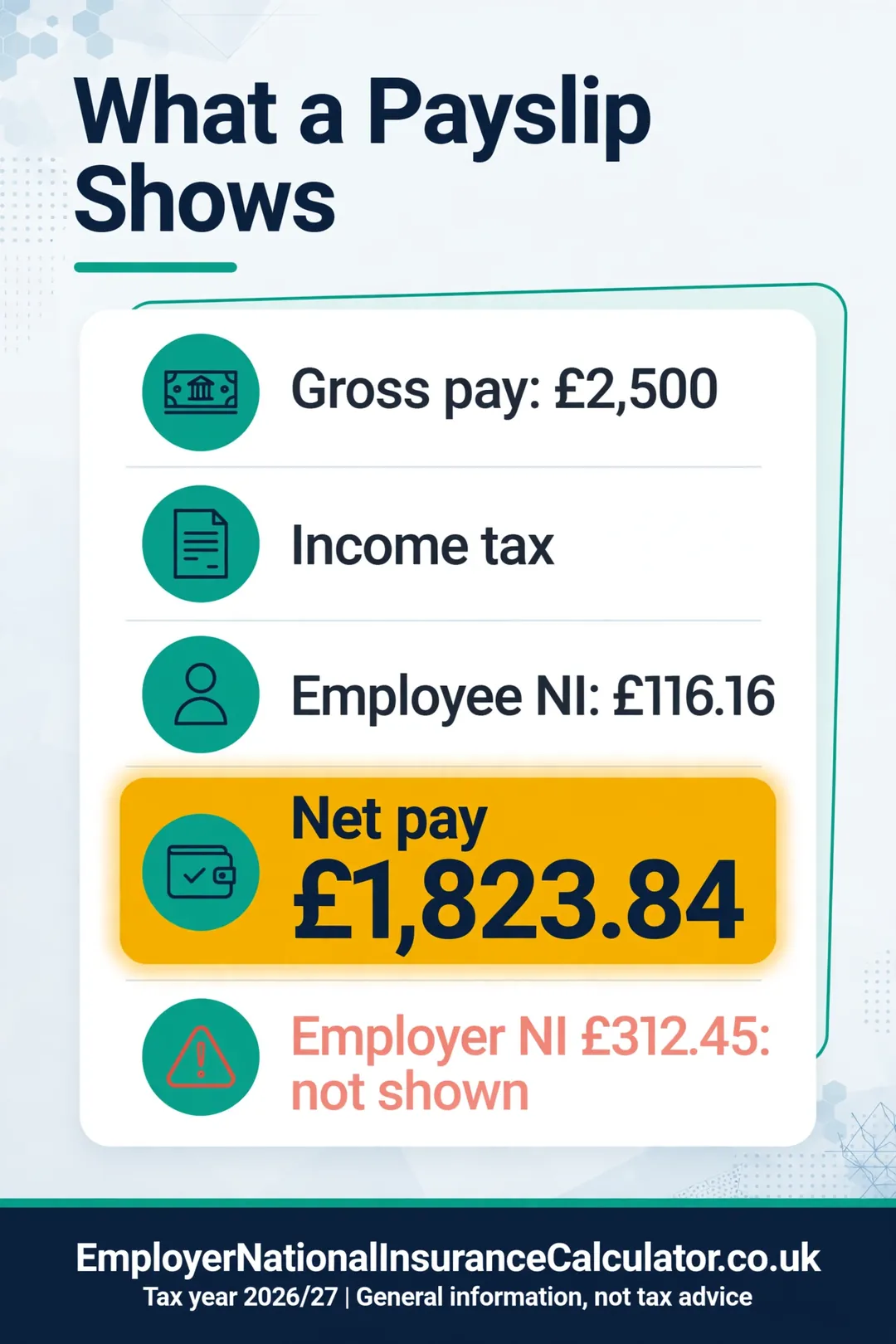
What the NI line on a payslip means
The “NI” or “National Insurance” line on a payslip is employee NI. It is taken from pay. For a salary of £30,000 it is about £116.20 a month. The employer’s own share of about £312.50 a month does not show.
| Item | Monthly on £30,000 |
|---|---|
| Gross pay | £2,500 |
| Employee NI at 8% | £116.20 |
| Employer NI at 15% | £312.50 (not shown) |
A sample payslip next to the employer’s costs
| Employee’s payslip (monthly) | Amount |
|---|---|
| Gross pay | £2,500 |
| Income tax (illustrative) | £250 |
| Employee NI | £116.20 |
| Net pay (illustrative) | £2,133.80 |
| What the employer pays (monthly) | Amount |
|---|---|
| Gross pay | £2,500 |
| Employer NI | £312.50 |
| Employer pension at 3% of qualifying earnings | £59.40 |
| Total cost | £2,871.90 |
The income tax figure is only an example. It depends on the tax code. The key point is the gap: the employee sees a net figure far below the employer’s total cost.
How to find your employer’s NI cost
- Calculate it. (Monthly pay − £417) × 15%.
- Check your payroll report. Payroll software shows employer NI in the summary.
- Look at your P60. It shows pay and employee NI. It may not show employer NI.
- Use the calculator.
Why some employers show it
Showing the total cost of employment is a way to help staff see their full reward. A payslip footer might say “Employer NI: £312.50” alongside the employer’s pension payment. It helps in pay discussions, and it is not required.
For employers: what to include
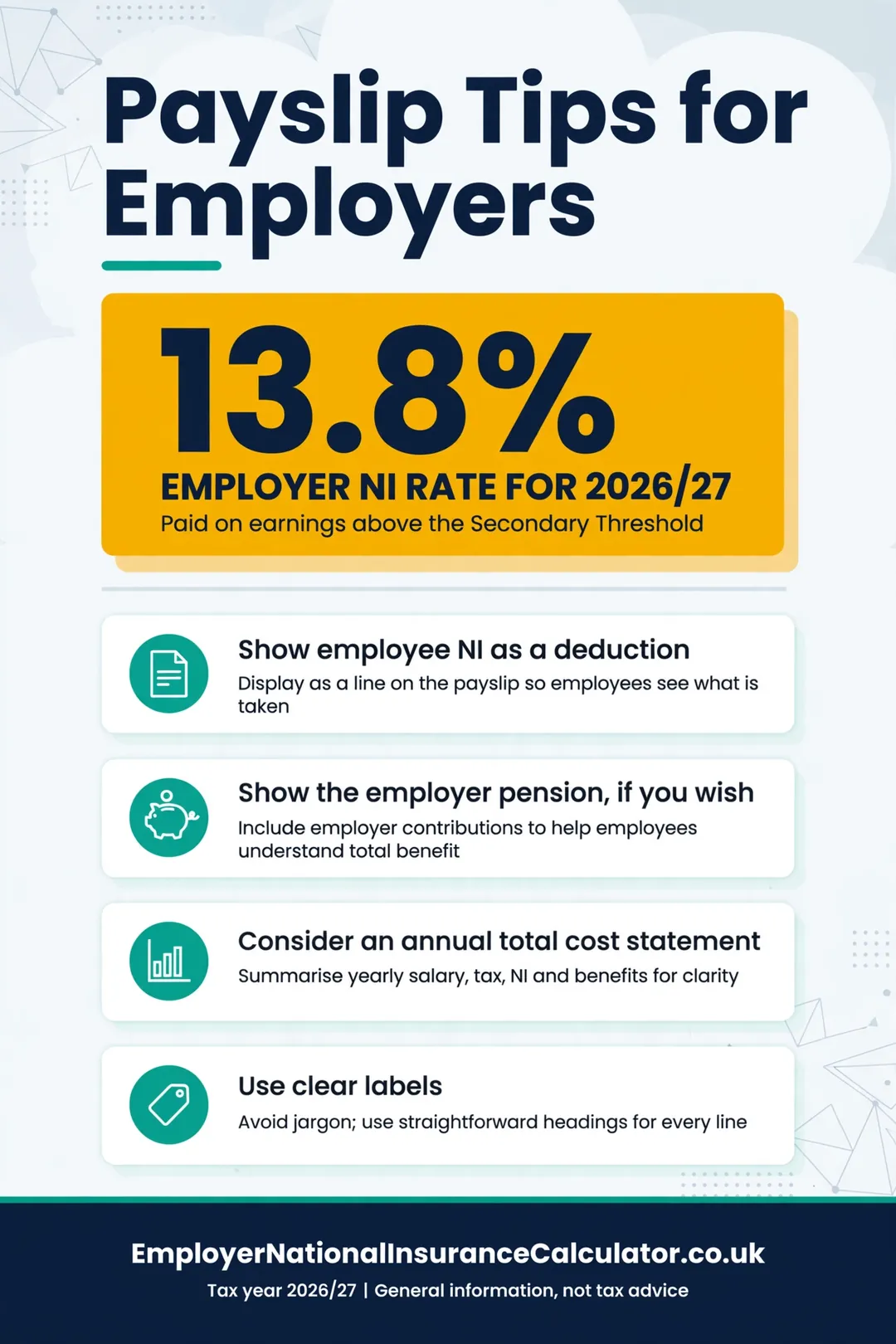
- Show employee NI as a deduction.
- Show the employer pension contribution, if you want staff to see it.
- Consider showing total employment cost on an annual statement instead.
- Use clear labels, so staff do not confuse employer and employee NI.
What employees can ask
An employee may ask their employer for the total cost of employing them, or for details of the pension. They have no right to see the employer’s NI, but many employers share it for transparency. A short annual statement can show salary, employer pension and employer NI.
| Item | Annual amount |
|---|---|
| Salary | £30,000 |
| Employer pension at 3% of qualifying earnings | £712.80 |
| Employer NI | £3,750 |
| Total cost | £34,462.80 |
Using it in pay reviews
A total cost statement helps explain why a pay rise of £2,000 costs the business £2,300. It also helps staff see the value of benefits such as pension contributions, which carry no NI. See the cost of employing someone for the full breakdown and employer NI vs employee NI for the two sides of the bill.
Why this question comes up
HR teams often field this question in March and April, when payslips change after the new tax year starts. A short note on the intranet explains that NI on the payslip is the employee’s share, and the employer pays a separate share. Link to a plain guide to employer NI so staff can read more. Employers can point to the calculator for a quick estimate.
Reading the other lines on a payslip
NI is only one line. A typical payslip also shows:
| Line | What it means |
|---|---|
| Tax code | Sets how much income tax is taken, for example 1257L |
| Gross pay | Pay before deductions |
| Income tax | Taken by PAYE |
| National Insurance | The employee’s share only |
| Pension | The employee’s contribution, if any |
| Net pay | Take-home pay |
| Year-to-date totals | Running totals for the tax year |
The employer’s share of NI, the employer pension contribution and any Employment Allowance used appear in payroll reports, not on the payslip.
Explaining it to a new starter
A short script works well. “The NI on your payslip is your own share. We also pay our own share to HMRC, which does not come out of your wages. For your salary of £30,000, that is about £312.50 a month on top of your pay.”
What payroll teams should check each month
- The NI category letter matches the employee’s situation.
- The NI line is zero for employees below £1,048 a month.
- Employees over State Pension age show no employee NI.
- The year-to-date NI figure is rising as expected.
- Employer NI in the payroll report matches the HMRC payment.
Frequently asked questions
Is employer NI on my payslip?
Usually not. Payslips show employee NI. Employer NI is an extra cost to the employer.
Do employers have to show their NI on payslips?
No. It is not a legal requirement.
Where can I see how much my employer pays?
Ask your payroll team, or use the formula: (pay − threshold) × 15%.
Is employee NI the same as the NI line on the payslip?
Yes. The NI line is the employee’s contribution.
Does my employer’s NI affect my take-home pay?
Not directly. It does not come out of your pay, but it adds to the cost of employing you.
Where do I see employer NI on a P60?
A P60 does not normally show it. It shows your pay and the deductions from you.
Can my employer deduct their NI from my pay?
No. Employer NI cannot be taken from an employee’s wages.
Does the NI on my payslip count towards my pension?
Yes. Employee NI payments earn qualifying years for the State Pension, if your earnings reach the Lower Earnings Limit.
Why does my NI change in April?
Rates and thresholds can change at the start of the tax year. Your payslip uses the new ones.
Does the payslip show my category letter?
Often it does, near the NI number. If yours looks wrong, ask your payroll team.
Related guides
- Employer NI vs Employee NI: What Is the Difference?
- What Is Employer National Insurance? A Plain Guide
- How Employer National Insurance Is Calculated
- Is Employer NI Tax Deductible? Yes, With Examples
- Cost of Employing Someone UK 2026/27: Calculator
Official sources
- National Insurance rates and categories
- HMRC: Rates and thresholds for employers 2026 to 2027
This page is independent information, not tax advice, and has no link with HMRC. Figures were checked on 20 October 2026 for the 2026/27 tax year. Always confirm the final figures with HMRC or your payroll provider.